In This Article
His Story
On April 19, 1775, Gideon Foster led a company of Massachusetts minutemen from Danvers toward the fighting at Lexington and Concord. He had been appointed their captain only ten days earlier. By the end of the day, seven men from his community were dead, and Foster had participated in one of the bloodiest engagements of the opening day of the American Revolution.
Foster survived the fighting at Menotomy and continued serving during the Siege of Boston. He helped deliver ammunition toward Charlestown during the Battle of Bunker Hill and eventually rose to the rank of major general in the Massachusetts militia.
Yet his military career tells only part of his story. Foster was also a businessman, surveyor, and public official. He operated several water-powered mills, including one used in chocolate production, and represented his community in the Massachusetts legislature.
His life spanned nearly a century of extraordinary change. Born in colonial Massachusetts, he witnessed the Revolution, the establishment of the United States, and the growth of the early republic. His memory survives through historical records, an engraving made during his lifetime, and a historic house that still bears his name.
A Young Man from Danvers
Gideon Foster was born in 1749 in the South Parish of Danvers, Massachusetts, an area that later became the city of Peabody. The Peabody Historical Society gives his birth date as February 24, 1749, and identifies his parents as Gideon Foster and Lydia Goldthwaite.
The Goldthwaite family had established itself in the Foster Street area around 1700. Their home stood near what is now the intersection of Peabody Square and Foster Street.
Foster grew up in a community shaped by farming, local commerce, and small-scale manufacturing. The family’s connection to mills along Goldthwaite’s Brook would later become an important part of his livelihood.
He also developed practical skills as a surveyor and draftsman. Those abilities would serve him in civilian business and public life, even as the growing conflict between Massachusetts and British authorities drew him toward military service.
A Captain Ten Days Before War
According to the Peabody Historical Society, Foster was appointed captain of the local minutemen ten days before the Battle of Lexington on April 19, 1775.
Massachusetts communities had been organizing militia companies and preparing for the possibility of armed conflict. The minutemen were expected to assemble quickly when an alarm was raised.
When word arrived that British troops had marched toward Lexington and Concord, Foster gathered his men and led them westward. His company traveled approximately sixteen miles in four hours, according to the Historical Society’s account.
By the time the Danvers men reached West Cambridge, in the area then known as Menotomy and now part of Arlington, British troops were retreating toward Boston. American militia companies had gathered along the route, turning the withdrawal into a running battle.
The Bloody Fighting at Menotomy
Near the home of Jason Russell, the Danvers minutemen encountered British regulars during the retreat from Concord. The fighting at Menotomy became one of the most violent episodes of April 19, 1775.
The Peabody Historical Society describes Foster’s men as outnumbered and flanked by British troops. Fighting occurred at close range as the British column pushed eastward toward Boston.
Seven men from Danvers and the area now known as Peabody were killed: Samuel Cook, George Southwick, Henry Jacobs, Ebenezer Goldthwaite, Benjamin Daland, Jotham Webb, and Perley Putnam.
The deaths devastated a relatively small community. These were neighbors and local men who had answered an emergency call to arms. Their families and fellow townspeople would remember the losses for generations.
Foster survived the engagement, but the events of that day remained closely connected with his reputation and the history of his hometown.
The detailed account of Menotomy comes from local historical research. Foster’s pension declaration provides separate evidence of his Revolutionary War service and should not be treated as the source of every battlefield detail preserved in later histories.
Ammunition for Bunker Hill
Less than two months after the fighting at Menotomy, American and British forces clashed at Charlestown during the Battle of Bunker Hill on June 17, 1775.
Foster served in the Massachusetts militia during the early Siege of Boston. His pension declaration connects him with Colonel John Mansfield’s regiment and military duties involving ammunition during the Bunker Hill campaign.
The Peabody Historical Society also records that Foster delivered ammunition to Charlestown during the battle.
American forces faced serious shortages of gunpowder and other military supplies. Moving ammunition toward the fighting was an important responsibility, even for men who were not positioned within the battlefield defenses themselves.
Foster’s documented connection to Bunker Hill concerns ammunition duty. The available evidence does not establish that he personally fought inside the American redoubt on Breed’s Hill.
The Siege of Boston
Following the opening battles of the Revolution, American forces surrounded British-occupied Boston. Militia units maintained positions on the surrounding heights and helped contain British forces within the city.
Foster’s pension account places him in service during this period, including duties associated with Prospect Hill and Winter Hill.
These positions formed part of the American military encampments surrounding Boston. The troops stationed there helped guard approaches to the city, maintain defensive positions, and support the growing American army.
Foster’s Revolutionary War service combined leadership in the opening fighting at Menotomy with the less celebrated but essential duties required to maintain an army in the field.
From Captain to Major General
Foster continued his military association with Massachusetts long after the Revolution ended.
The Peabody Historical Society records that he became a colonel in 1792, a brigadier general in 1796, and a major general in 1801.
These promotions occurred after the Revolutionary War. Foster was a captain during the events of April 1775, while his later title of General Gideon Foster reflects his subsequent service in the Massachusetts militia.
His advancement illustrates the continued importance of state military organizations during the early years of the United States.
The Chocolate-Making General
One of the more unusual aspects of Foster’s life was his involvement in the production of chocolate.
Foster operated three mills powered by Goldthwaite’s Brook: a bark mill, a grist mill, and a chocolate mill.
Each served a different purpose. The grist mill processed grain, while the bark mill was associated with preparing materials used in leather tanning. The chocolate mill processed cacao for chocolate products, which in colonial and early American life were commonly prepared as beverages.
The Peabody Historical Society preserves a tin chocolate mold associated with the Foster family’s chocolate-making activities beginning in the eighteenth century.
The artifact offers a tangible connection to the family’s manufacturing work and demonstrates that Foster’s civilian livelihood was rooted in the practical economy of his community.
The same man who led minutemen into battle in 1775 later became a prominent local businessman operating several forms of water-powered industry.
Two Fires and a New Beginning
Foster’s business career suffered two serious setbacks when his mills burned on separate occasions.
According to the Peabody Historical Society, the second fire occurred when Foster was seventy-nine years old. Rather than rebuild the mills again, he decided to leave the business behind.
He sold his Foster Street property to Zechariah King and moved to an eighty-acre farm at 138 Lynnfield Street.
The move marked a major transition. After decades spent operating mills and participating in local commerce, Foster retired to a farm where he remained for the rest of his life.
His experience illustrates how even prominent Revolutionary War veterans could face significant economic losses in old age.
A Soldier in Public Office
Alongside his military and business responsibilities, Foster served in local and state government.
He was town clerk from 1791 to 1794, a position involving the preservation of public records and the administration of town affairs.
He also represented his community in the Massachusetts General Court in 1796 and again from 1799 through 1806.
His public service reflected the important role played by Revolutionary War veterans in the political institutions of the early republic.
Foster’s reputation rested on more than military accomplishments. He was also known for his practical abilities, local business interests, and participation in community government.
Remembering the Men of 1775
In April 1835, sixty years after the first battles of the Revolution, residents of Danvers gathered to commemorate the men who had died during the fighting of April 19, 1775.
Foster was among the surviving veterans who attended a ceremony associated with the monument honoring the fallen.
The event connected the memories of elderly veterans with a younger generation that knew the Revolution through stories, records, and public commemorations.
For Foster, the monument honored men who had once marched from his community and never returned. His participation helped preserve their memory as the generation that had fought for independence gradually passed away.
From His Account
Remembering the opening months of the Revolution
In August 1832, Gideon Foster gave an account of his Revolutionary War service as part of his application for a federal pension.
His declaration described service in the Massachusetts militia during the opening months of the Revolution. It connected him with Colonel John Mansfield’s regiment and military duties during the Siege of Boston.
His testimony also described responsibilities involving ammunition during the Battle of Bunker Hill and service associated with the American positions at Prospect Hill and Winter Hill.
The declaration is valuable because it preserves the veteran’s own recollections more than fifty years after the events.
Other details in this biography, including the fighting at Menotomy, the seven local casualties, his postwar military promotions, and his civilian career, are drawn from local historical records and research by the Peabody Historical Society.
Source note: This section paraphrases Foster’s pension documentation. It does not present reconstructed dialogue or unverified direct quotations.
Military Service
| Conflict | American Revolutionary War |
| State | Massachusetts |
| Revolutionary Rank | Captain |
| Command | Danvers minutemen |
| Captain’s Appointment | Approximately ten days before April 19, 1775 |
| April 19, 1775 | Lexington Alarm and fighting at Menotomy |
| June 17, 1775 | Ammunition duty during the Battle of Bunker Hill |
| Associated Regiment | Colonel John Mansfield’s regiment |
| Other Revolutionary Service | Siege of Boston; Prospect Hill and Winter Hill |
| Postwar Rank | Colonel, 1792 |
| Postwar Rank | Brigadier General, 1796 |
| Postwar Rank | Major General, 1801 |
| Pension Declaration | 1832 |
| National Archives ID | 54597374 |
Later Life & Burial
Gideon Foster remained closely connected to Danvers throughout his long life.
Published Danvers records identify his first wife as Mercy Jacobs, whom he married on June 18, 1771. They also record a later marriage to Mary Tapley in November 1828.
After the destruction of his mills, Foster sold his Foster Street property and retired to an eighty-acre farm at 138 Lynnfield Street, where he spent his remaining years.
He died on November 1, 1845. The Peabody Historical Society describes him as ninety-seven years old, although its published birth date of February 24, 1749, indicates he was ninety-six. The discrepancy is preserved rather than silently reconciled.
A Find a Grave memorial for Gideon Foster is available under memorial number 9689465. Its precise cemetery and grave details have not been independently verified for this biography.
Family & Descendants
Parents and the Goldthwaite Family
Gideon Foster was born into a family with longstanding connections to the South Parish of Danvers, in the area that later became Peabody, Massachusetts. The Peabody Historical Society identifies his parents as Gideon Foster and Lydia Goldthwaite.
The Goldthwaite family was established in the Foster Street area by about 1700. Foster’s later mills stood along Goldthwaite’s Brook, a reminder of the family’s connection to the local landscape and economy. The records used for this biography do not, however, provide a documented list of his siblings or identify both sets of grandparents. Those relationships should not be inferred from shared surnames alone.
First Marriage: Mercy Jacobs
Published Danvers marriage records identify Mercy Jacobs as Gideon Foster’s first wife and give their marriage date as June 18, 1771. The marriage preceded the outbreak of the Revolutionary War by nearly four years.
Foster was therefore a married man when he took command of the Danvers minutemen in April 1775. His service at Menotomy, the Siege of Boston, and the later demands of his militia career formed part of a family life that continued beyond the war. The supplied sources do not establish Mercy’s birth and death dates or the date on which this marriage ended.
Later Marriage: Mary Tapley
Published Danvers records also report that Foster married Mary Tapley in November 1828, when he was approximately seventy-nine years old. This marriage occurred around the period when he withdrew from mill operations and settled into his later years.
The available summary does not provide a precise day for the marriage or establish Mary’s parentage, prior marital history, or death date. Further examination of the original marriage entry, church records, and probate documents may clarify those details.
Children and Their Families
The sources assembled for this biography identify Foster’s parents and two marriages, but they do not supply a reliably documented list of his children. No son or daughter is named here without an identified record connecting that individual to Gideon Foster and one of his spouses.
Danvers and Peabody birth and baptismal records, marriage registers, deeds, probate files, and household records are promising sources for establishing whether Foster had children and, if so, identifying their spouses. The existence of other people named Foster in Essex County does not, by itself, prove descent from the general.
Descendants and Research Opportunities
Although Foster’s military career, marriages, business interests, and historic home are comparatively well documented, a verified line of grandchildren and later descendants has not been established from the material used for this article. This is a limit of the research presented here, not evidence that he left no descendants.
A reliable descendant account would need to connect each generation through contemporary records, beginning with a documented child of Gideon Foster and continuing through marriages, births, deaths, or probate relationships. Until that chain is established, claims about modern descendants should be treated as research leads rather than confirmed family history.
His Historical Likeness
Unlike many Revolutionary War veterans whose appearances are known only through written descriptions, Gideon Foster was represented in an engraving created during his lifetime.
The Peabody Historical Society identifies the engraving as dated March 7, 1836, and credits the work to M. C. Torrey and B. F. Nutting. Foster was then in his late eighties, having lived more than sixty years beyond the opening battles of the Revolution.
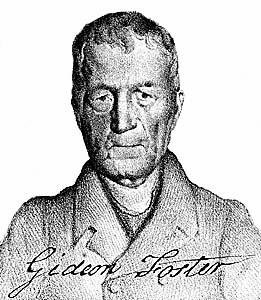
The engraving is particularly valuable because it provides a historical visual reference for Foster’s appearance in old age. His facial features, hairstyle, and clothing offer a more direct connection to the veteran than a modern artistic reconstruction alone.
The main portrait at the beginning of this biography is a modern AI-assisted interpretation informed by this historical engraving. It should not be mistaken for an original portrait or photograph.
The Gideon Foster House & Legacy
Gideon Foster’s name remains an important part of the history of Peabody, Massachusetts.
The General Gideon Foster House, now located at 35 Washington Street, serves as the headquarters of the Peabody Historical Society.
The house was constructed in 1810 by John Saunders and purchased by Foster in 1815. It originally stood elsewhere before being moved to its present location.
The Peabody Historical Society acquired the house in 1916, helping preserve a connection to the town’s Revolutionary War history. The building was listed on the National Register of Historic Places in 1976.
Foster Street was named in his honor in 1843, two years before his death. The street name preserves his association with the neighborhood where his family lived and operated mills.
The Historical Society also preserves artifacts associated with Foster and his family, including a tin chocolate mold used in the family’s manufacturing activities and a psalm book belonging to Foster in 1827.
These objects provide a broader picture of the man behind the military title. Foster was a soldier, businessman, public servant, and member of a community whose everyday life involved commerce, religion, manufacturing, and local government.
His surviving likeness, family artifacts, historic home, and Revolutionary War pension record allow modern readers to understand a life that extended far beyond the battlefields of 1775.
Original Sources & Historical Note
1. National Archives — Revolutionary War Pension Application
Gideon Foster.
National Archives Identifier: 54597374.
View National Archives record
2. Gideon Foster — Original Pension Declaration, Page One
View original manuscript image
3. Gideon Foster — Original Pension Declaration, Page Two
View original manuscript image
4. Peabody Historical Society — Happy Birthday Gideon!
Published February 2022. Documents Foster’s birth, family, command at Menotomy, military promotions, mills, destructive fires, retirement, and surviving historical engraving.
Read the Historical Society article
5. Peabody Historical Society — Peabody and the American Revolutionary War
Local research concerning the Lexington Alarm, Menotomy, and the community’s Revolutionary War experience.
Read Revolutionary War research
6. Peabody Historical Society — The Gideon Foster House
History of the house associated with Foster and its preservation.
Read the house history
7. Centennial Celebration at Danvers, Massachusetts, June 16, 1852
Nineteenth-century local history preserving biographical information about Foster.
Read historical account
8. Find a Grave — Gideon Foster
Memorial number 9689465. Cemetery and gravestone details require separate verification.
View Find a Grave memorial
Historical Note
This biography combines Gideon Foster’s Revolutionary War pension declaration with published local histories and research preserved by the Peabody Historical Society.
Firsthand testimony: Foster’s 1832 pension declaration provides the principal firsthand evidence for his Revolutionary War service. Accounts of the fighting at Menotomy and his later civilian career are supplemented by local historical research.
Bunker Hill: Foster’s documented connection to the battle concerns ammunition delivery. The evidence does not establish that he fought inside the American redoubt.
Military rank: Foster was a captain during the opening of the Revolution. His promotions to colonel in 1792, brigadier general in 1796, and major general in 1801 occurred after the war.
Birth and age discrepancies: The Peabody Historical Society gives February 24, 1749, as Foster’s birth date, while an older record gives February 13, 1748–49. The Historical Society also describes him as ninety-seven at death, although its stated dates indicate an age of ninety-six.
Family: The Peabody Historical Society identifies Foster’s parents as Gideon Foster and Lydia Goldthwaite. Published Danvers records identify marriages to Mercy Jacobs in 1771 and Mary Tapley in 1828. The available material does not establish a complete list of his children or a documented line of later descendants.
Business history: Details concerning the mills, fires, sale of his property, and retirement to Lynnfield Street derive from Peabody Historical Society research rather than his pension declaration.
Historical engraving: The historical likeness reproduced in this article is identified by the Peabody Historical Society as an engraving of Gideon Foster dated March 7, 1836, attributed to M. C. Torrey and B. F. Nutting. It is distinct from the modern reconstruction displayed in the infobox.
Burial: The supplied Find a Grave memorial is linked for reference, but its cemetery and grave details have not been independently verified for this article.
Portrait disclosure: The main portrait accompanying this article was generated using artificial intelligence, informed by the surviving 1836 engraving of Gideon Foster. It is an artistic reconstruction rather than an authenticated historical portrait. The mill setting, colors, clothing details, and photographic realism are interpretive and should not be understood as direct evidence of his actual appearance or surroundings.