
In This Article
John Alden’s Story
John Alden (about 1599–1687) sailed aboard the Mayflower in 1620 as a young cooper, a craftsman responsible for making and repairing the barrels used to store provisions. He was hired for the voyage rather than necessarily intending to settle permanently in America. His decision to remain with the passengers at Plymouth turned a shipboard job into a life closely intertwined with the colony’s history.
Alden survived the settlement’s dangerous early years, married fellow passenger Priscilla Mullins, and became a longtime participant in Plymouth Colony government. His family later established deep roots in Duxbury, where his descendants helped shape the history of New England.
Early Life in England
John Alden’s precise birthplace and parentage remain unproved. His estimated birth year of about 1599 is derived from later evidence rather than a securely identified English baptismal record. His trade as a cooper suggests practical experience in preparing wooden containers for travel and commerce, but no reliable account of his childhood or apprenticeship has been established.
The Mayflower Voyage and the Choice to Stay
In 1620, Alden joined the Mayflower as a hired cooper at Southampton. William Bradford later described him as a young man who could choose whether to return with the ship or remain in the colony. Alden chose to stay. He is counted among the signers of the Mayflower Compact, the agreement formed before the passengers established their settlement.
The first winter brought illness and heavy loss of life. Among those who died were members of Priscilla Mullins’s traveling family. The precise date of John’s marriage to Priscilla is uncertain, but they were married by the time their household appeared in early colony records.
Marriage, Plymouth, and Colonial Leadership
John and Priscilla’s household grew as Plymouth Colony moved beyond its first precarious years. In the 1627 Division of Cattle, the family was already recorded with their young children Elizabeth and John. Alden became one of the colony’s long-serving public figures, serving as an Assistant to the Governor and taking on other government and financial responsibilities.
His work connected him with the development of colonial laws and the colony’s commercial arrangements. These documented activities reveal a man whose responsibilities extended far beyond the cooper’s trade that first brought him across the Atlantic.
A New Home in Duxbury
As settlement spread beyond Plymouth, the Alden family became associated with Duxbury. The historic Alden property preserves evidence of the family’s early presence, although the dating of surviving buildings and earlier structures requires care. Duxbury became a center of the family’s life and the place where several descendants established households.
Later Life, Death & Burial
Alden lived to see Plymouth Colony change from a fragile settlement into an established network of communities. He died on September 12, 1687, in Duxbury. An estate inventory survives, offering documentary evidence of his possessions at the end of his life.
Find a Grave Memorial #15 associates him with Myles Standish Burying Ground in Duxbury, but the precise location of his grave has not been established. The memorial is a useful reference, not proof of the exact burial spot.
Family
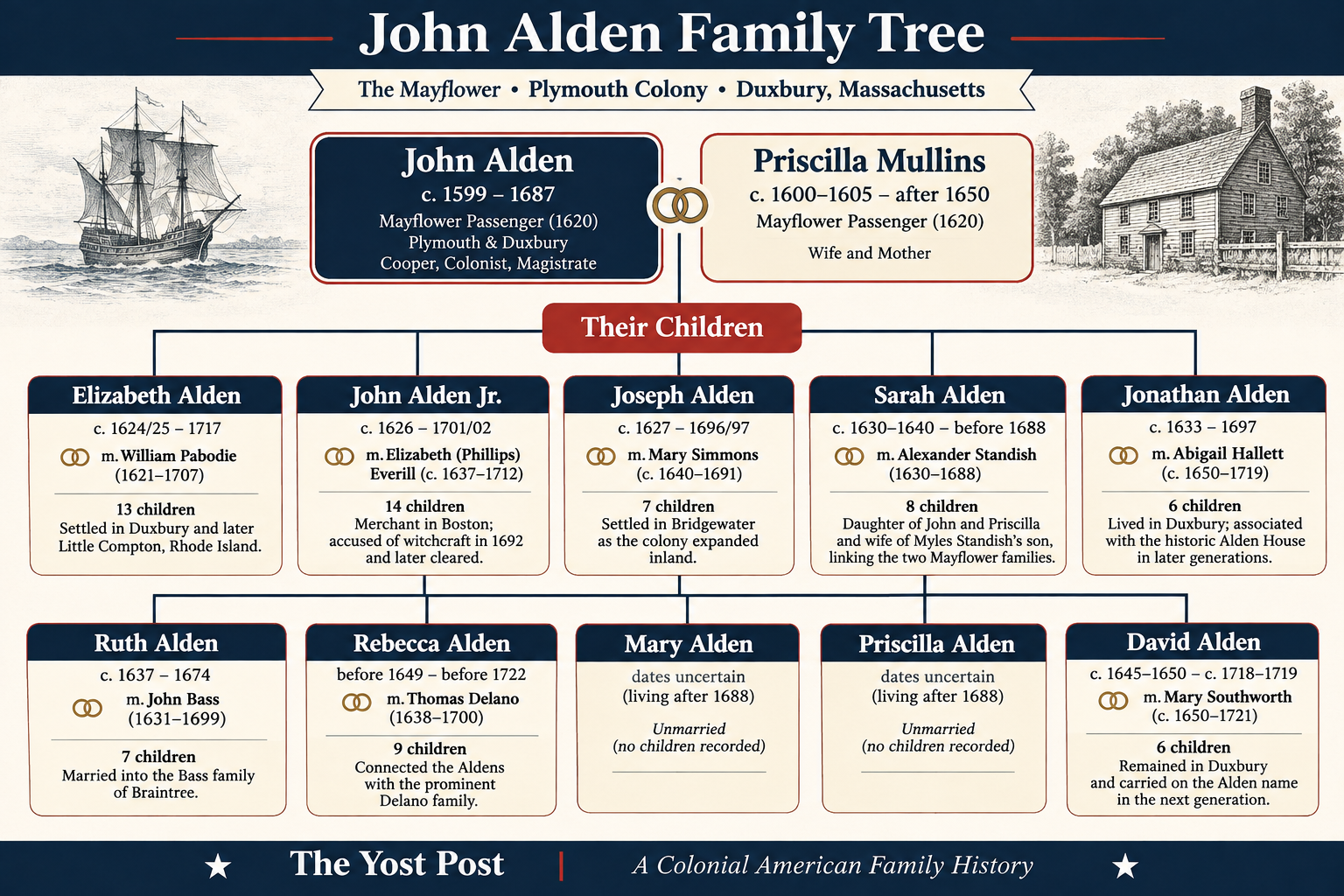
John and Priscilla Alden’s family became connected with communities across colonial New England. Their children and grandchildren formed ties with the Pabody, Standish, Bass, Delano, and Southworth families. The individual histories below distinguish established records from traditions and uncertainties.
Parents
Father — identity unproved. The General Society of Mayflower Descendants states that John Alden’s parentage and English origins remain unknown. Researchers have proposed connections to Alden families in Harwich, Essex, including families linked by marriage to the Mayflower‘s master, Christopher Jones. Such hypotheses do not establish the name of John’s father.
Mother — identity unproved. No mother can presently be named with confidence from the consulted authoritative passenger histories. Family-tree assertions assigning John particular parents should be treated as research leads rather than established relationships.
Spouse(s)
Priscilla Mullins (about 1600–1605; died after 1650, exact date unknown) — wife. Priscilla came aboard the Mayflower with her father William Mullins, Alice (her mother or possibly stepmother), and her brother Joseph. She alone among that traveling household survived the colony’s first winter and spring. She and John married at Plymouth, probably by 1623, and became parents of a large family. Some traditions place her at a funeral in 1680, but this detail is not supported by an identified contemporary record. The famous romantic rivalry involving Myles Standish belongs to later literary tradition, not documented Plymouth courtship history.
Children
Elizabeth Alden (about 1624/25–1717). Elizabeth married William Pabodie at Duxbury on 26 December 1644. They had thirteen children: John, Elizabeth, Mary, Mercy, Martha, two daughters named Priscilla (the first died young), Sarah, Ruth, Rebecca, Hannah, William and Lydia. Elizabeth later died in Little Compton, Rhode Island, on 31 May 1717.
John Alden Jr. (about 1626–1701/02). John moved into the commercial life of Boston and married Elizabeth (Phillips) Everill there on 1 April 1660. The Mayflower Society identifies fourteen children, including several who died young: Mary, two Johns, two Elizabeths, four Williams, two Zachariahs (recorded as Zachary and Zachariah), Nathaniel, Nathan and two Sarahs. During the Salem witchcraft crisis of 1692, he was accused of witchcraft and imprisoned; he subsequently escaped custody. His ordeal connects the Alden family to one of the most notorious episodes of colonial Massachusetts history. He died in Boston on 14 March 1701/02.
Joseph Alden (about 1627–1696/97). Joseph settled in Bridgewater and married Mary Simmons around 1660. Their seven recorded children were Sarah, Isaac, Joseph, Mercy, Hopestill, Elizabeth and John. He died at Bridgewater on 8 February 1696/97.
Sarah Alden (born between about 1630 and 1640; died before 1688). Sarah married Alexander Standish, son of Mayflower passenger Myles Standish, around 1660. Their eight children were Lorah, Lydia, Mercy, Elizabeth, Sarah, Miles, Ebenezer and David. This marriage created a documented family connection between the Alden and Standish households; it does not substantiate the later courtship legend.
Jonathan Alden (about 1633–1697). Jonathan married Abigail Hallett in Duxbury on 10 December 1672. Their six children were Elizabeth, Anna, Sarah, John, Andrew and Jonathan. He remained associated with Duxbury and died there on 14 February 1697. The history of the surviving Alden House has been associated with Jonathan’s generation, although published accounts differ on the building’s precise date.
Ruth Alden (about 1637–1674). Ruth married John Bass at Braintree on 3 February 1657. Their seven children were John, Samuel, Ruth, Joseph, Hannah, Mary and Sarah Bass. Ruth died at Braintree on 12 October 1674.
Rebecca Alden (born before 1649; died before 5 October 1722). Rebecca married Thomas Delano before 30 October 1667. Their nine children were Benoni, Thomas, Deborah, Jonathan, David, Mary, Sarah, Ruth and Joseph Delano. The Delano marriage linked the Aldens with another established Plymouth Colony family.
Mary Alden (dates uncertain; living after 13 June 1688). The Mayflower Society’s passenger profile lists Mary as unmarried. No spouse or children are established in that account. Her life is less fully documented than those of her married siblings.
Priscilla Alden (dates uncertain; living after 13 June 1688). Named for her mother, Priscilla is also listed as unmarried in the Mayflower Society’s passenger profile. A precise birth or death date and descendants are not established there.
David Alden (about 1645–1650 to about 1718–1719). David married Mary Southworth by 1674. Their six children were Ruth, Elizabeth, Priscilla, Benjamin, Alice and Samuel. He remained in Duxbury, where he died in the early eighteenth century.
Siblings
No brothers or sisters of John Alden have been securely identified. Because his English parents and birthplace remain unproved, assigning named siblings would risk joining unrelated Alden families. Any proposed sibling should be supported by a contemporary English parish, probate or comparable record linking both individuals to the same parents.
Sources & Genealogical Research Note
General Society of Mayflower Descendants: The Alden Family — family members, marriages and descendants; Guide to the Silver Books — differing child count.
Caleb Johnson, MayflowerHistory.com: John Alden — voyage, marriage, and colonial biography.
Pilgrim Hall Museum: John Alden — cooper, colonial leadership, estate, and courtship tradition; John Alden in 17th Century Documents — historical records and documentary context.
Find a Grave: John Alden, Memorial #15 — supplementary memorial reference, not proof of an exact grave location.
WikiTree: Alden-63 — collaborative genealogy; verify claims against primary records.
Published genealogy: Mayflower Families Through Five Generations, Volume 16, Part 1, compiled by Esther Littleford Woodworth-Barnes, edited by Alicia Crane Williams. Consult the printed volume for detailed line-by-line verification.
John Alden’s parents, siblings and exact English birthplace remain uncertain. The Mayflower Society passenger profile names ten children, while its Silver Books guide has been reported as counting nine; the discrepancy requires comparison with the printed genealogy. Priscilla’s date of death is not firmly established. Longfellow’s courtship story is later literature rather than contemporary proof. Memorial #15 does not establish the precise location of Alden’s grave.
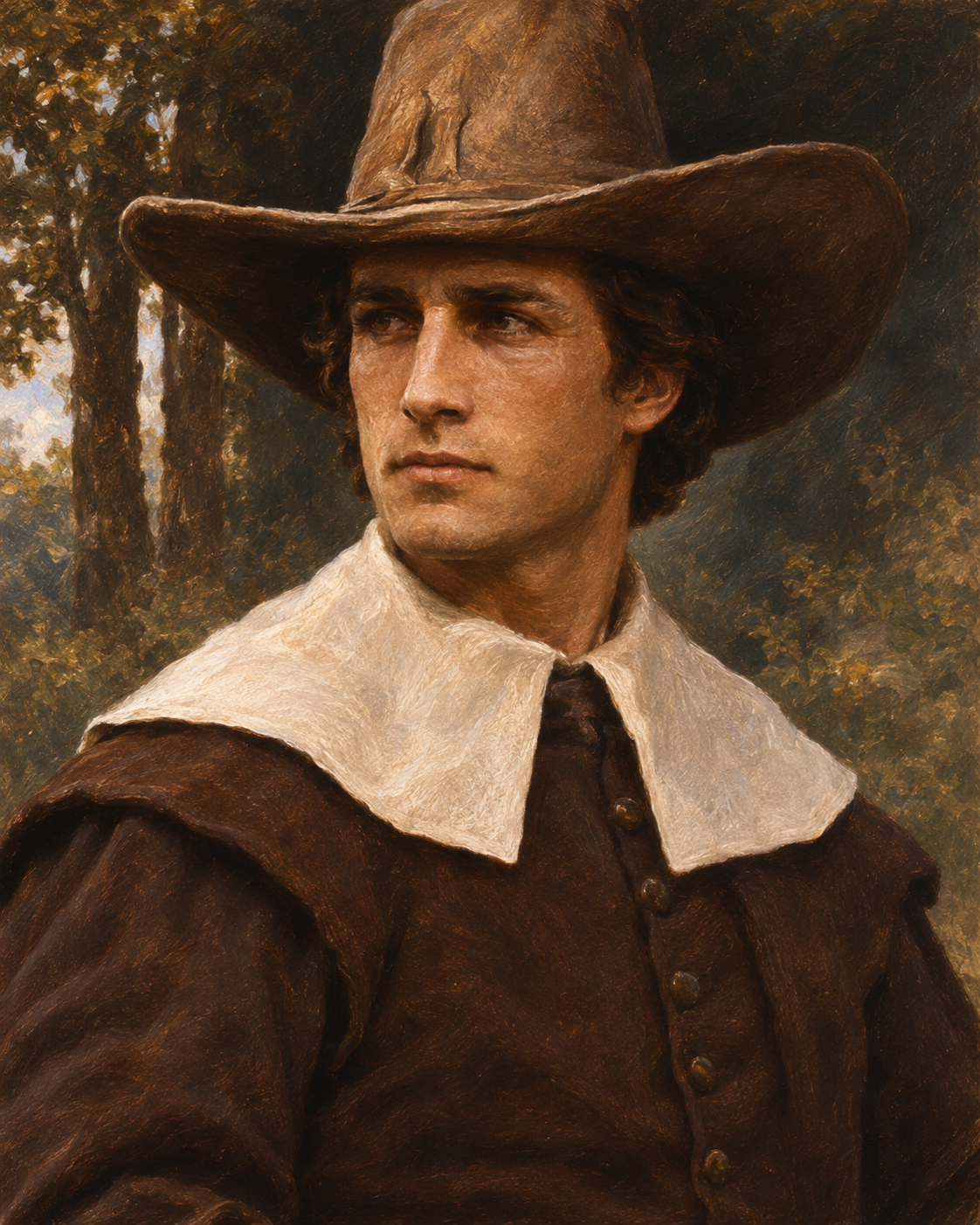
Historical context in the family narratives does not establish that a relative personally participated in every event mentioned. The portrait accompanying this article is an artistic historical interpretation, not an authenticated likeness of John Alden.
Genealogical Research Note
This family history has been compiled from various genealogical records, family trees, historical publications, cemetery records, and ancestral research. The information reflects what has been recorded or attributed to these individuals by previous researchers and may contain inaccuracies, conflicting dates, or unverified family connections.
The Yost Post presents this information as a historical and genealogical resource rather than a definitive account of family relationships. Readers are encouraged to consult original records and conduct additional research when tracing their own ancestry.