
In This Article
His Story
In May 1843, an elderly man named Joseph Hughes wrote to his son Thomas from Newberry District, South Carolina. He described his declining health, his difficulty obtaining the necessities of life, and his desire to pursue a pension for service during the American Revolution.
The letter, preserved in the pension papers, was signed as a message from a loving father. It provides an unusually personal glimpse into the final year of Hughes’s life. According to later records, he died on April 20, 1844, before the pension claim was resolved.
His son continued the effort. Thomas J. Hughes of Habersham County, Georgia, submitted declarations and supporting testimony describing his father as a South Carolina mounted soldier who had risen from private horseman to lieutenant and captain in Colonel Thomas Brandon’s regiment.
The claim drew upon a South Carolina military accounting record, recollections of elderly witnesses, and statements that Hughes had been recognized publicly as a veteran of the Revolution.
In July 1850, federal authorities approved the claim. The pension was calculated at $499.72 annually for the period beginning March 4, 1831, and ending with Joseph Hughes’s death in 1844.
But the story did not end with that approval.
In 1851, two Georgia men challenged Thomas Hughes’s assertion that he was his father’s only surviving child. They claimed that another son, also named Joseph Hughes, was alive and entitled to part of the money.
The dispute soon grew more serious. Correspondence in the pension file alleged that the deceased Joseph Hughes might not have been the Revolutionary War soldier identified in the South Carolina records at all.
Investigators questioned his age, his military identity, and the reliability of evidence submitted to obtain the pension. A federal attorney later described suspected fraud and discussed criminal proceedings, although the surviving transcriptions reviewed for this biography do not establish a final judicial determination resolving every allegation.
The resulting archive preserves both a documented South Carolina cavalry service account and a contested effort to connect that account to a particular man and his heirs.
Joseph Hughes’s story is therefore not simply a military biography. It is also a case study in how Revolutionary War service was remembered, documented, challenged, and sometimes disputed generations after independence.
Early Life
The precise birth date and birthplace of Joseph Hughes have not been securely established from the reviewed records.
The pension claim associates him with Newberry District, South Carolina, and with the backcountry communities that supplied mounted men to Patriot forces during the Revolution.
South Carolina’s interior differed significantly from its coastal plantation districts. Settlement expanded through river valleys and wooded uplands, where farms, mills, meetinghouses, and small communities were connected by difficult roads.
During the Revolution, the backcountry became a region of intense political and military conflict. Neighbors sometimes supported opposing sides, and the distinction between military service and defense of local communities could become blurred.
The records do not identify Joseph Hughes’s parents or establish his childhood residence.
There is also a major uncertainty concerning his age. Later opponents of the pension claim alleged that the deceased man was younger than the Revolutionary veteran described in the military records. That allegation must be distinguished from a verified birth record, which has not been established.
Revolutionary War Service
South Carolina Mounted Forces
The South Carolina backcountry produced numerous mounted Patriot companies during the Revolutionary War.
These forces were especially useful in a region where movement between settlements could be slow, British and Loyalist detachments operated across broad areas, and small military actions occurred frequently.
Mounted troops could travel quickly, gather intelligence, protect communities, pursue enemy parties, and assemble with other Patriot forces for larger operations.
The surviving pension file associates the name Joseph Hughes with service in Colonel Thomas Brandon’s regiment.
Thomas J. Hughes stated in an affidavit dated March 2, 1850, that his father had described entering service as a private horseman under Captain Joseph Palmer, transferring to Captain Benjamin Jolly’s company, becoming a lieutenant, and later being elected captain of horse.
This is the son’s account of what his father reportedly told him, not a surviving first-person wartime declaration by the soldier.
Service as a Horseman
A South Carolina Comptroller General’s certificate dated February 28, 1848, refers to an indent issued April 10, 1786, for service in Brandon’s regiment.
The certificate identifies 190 days of duty as a horseman, beginning February 3, 1779, and extending into February 1780, with service associated with Captain Jolly’s company.
The document is significant because it refers to an earlier state financial accounting of Revolutionary War military duty.
It supports the existence of a South Carolina service claim under the name Joseph Hughes. The separate question of whether the deceased man whose son sought the pension was that same soldier later became controversial.
Reported Promotion to Lieutenant
The pension claim describes a second period of mounted service in which Hughes held the rank of lieutenant.
A later federal summary identifies 415 days of lieutenant’s duty during 1780–1781.
Lieutenants in mounted companies could assist with leadership, supervision, and the organization of small detachments. In South Carolina’s irregular warfare, their responsibilities depended upon the organization and circumstances of service.
The records reviewed do not establish the exact date of Hughes’s commission or provide a contemporary commission document.
Reported Promotion to Captain
Thomas J. Hughes also reported that his father became a captain of horse and continued serving under Colonel Brandon.
A later summary identifies 374 days of service at captain’s rank.
These claimed periods formed the basis for calculating the pension allowance.
The title captain also appears in witness testimony. James Swinford recalled seeing a man identified as Joseph Hughes leading mounted men near a fortified refuge known as Brandon’s Bull Pen.
Swinford’s recollection is valuable but qualified: he explained that he understood the man to be in command because of his apparent leadership.
The distinction matters. An eyewitness’s memory of a man leading troops is not identical to a surviving military commission.
Battles and Campaigns
The South Carolina Backcountry War
The Revolutionary War in South Carolina was fought not only by large armies but also through a succession of raids, skirmishes, mounted patrols, and attacks on isolated posts.
British forces captured Charleston in May 1780, creating a major crisis for the Patriot cause. British commanders attempted to secure the interior through fortified outposts and cooperation with Loyalist militia.
Patriot resistance continued through mobile forces operating under leaders such as Thomas Sumter, Francis Marion, Andrew Pickens, and various local militia officers.
These groups relied upon their knowledge of roads, streams, farms, and wooded terrain. Their effectiveness often depended upon speed, surprise, and the ability to disperse before stronger enemy formations could respond.
Colonel Thomas Brandon was associated with South Carolina Patriot militia operations during this period.
The state service certificate places a Joseph Hughes in Brandon’s regiment. Witnesses later described the deceased pension claimant as a mounted soldier and officer in that organization.
However, the later identity challenge prevents treating those records as conclusive proof that every described military action belonged to the same individual.
Participation classification: Regimental service documented under the name Joseph Hughes; identification of the deceased pension claimant disputed.
Battle of Kings Mountain
The Battle of Kings Mountain was one of the decisive Patriot victories in the southern campaign.
In the autumn of 1780, British Major Patrick Ferguson commanded a force composed largely of Loyalist militia. Ferguson’s operations threatened Patriot communities in the Carolina backcountry and across the Appalachian frontier.
Patriot leaders gathered mounted riflemen from settlements west of the mountains and from communities in the Carolinas and Georgia. The force included men under commanders such as William Campbell, Isaac Shelby, John Sevier, Benjamin Cleveland, and James Williams.
On October 7, Patriot forces surrounded Ferguson’s position along the wooded ridge at Kings Mountain.
The Patriots advanced through the trees and attacked from several directions. Ferguson’s men attempted to repel them with musket fire and bayonet charges, but the attackers repeatedly regrouped and pressed forward.
Ferguson was killed during the fighting. The Loyalist force surrendered after suffering heavy casualties.
The victory weakened British plans for controlling the southern interior and encouraged Patriot resistance at a critical moment.
Joseph Hughes’s reported connection: A descendant writing to the Pension Office in February 1910 stated that Hughes participated at Kings Mountain.
That statement was written approximately 130 years after the battle. The reviewed pension records do not establish his presence through a contemporary muster, eyewitness battle account, or verified casualty record.
Participation classification: Reported by later family source; unverified.
Battle of Hammond’s Store
The fighting at Hammond’s Store formed part of the continuing struggle for control of South Carolina following the British occupation of Charleston and the Patriot victory at Kings Mountain.
Patriot mounted troops under Colonel William Washington attacked a Loyalist force near Hammond’s Store in December 1780.
Washington’s cavalry achieved a sharp victory, demonstrating the effectiveness of mounted Patriot forces against exposed Loyalist detachments.
The engagement was one of several operations that helped disrupt British communications and weaken Loyalist security in the backcountry.
These actions contributed to the conditions under which American commanders could challenge British forces more aggressively in early 1781.
Joseph Hughes’s reported connection: The same 1910 descendant’s letter that names Kings Mountain also lists Hammond’s Store among Hughes’s engagements.
No contemporary document reviewed for this biography independently identifies him as a participant.
Participation classification: Reported by later family source; unverified.
Battle of Cowpens
The Battle of Cowpens was a major American victory during the southern campaign.
Brigadier General Daniel Morgan commanded a mixed force of Continental soldiers, militia, and cavalry. British Lieutenant Colonel Banastre Tarleton led a force of regular infantry, cavalry, and supporting troops in pursuit of Morgan’s command.
Morgan selected ground near Cowpens and arranged his troops in successive lines. His plan used militia volleys, controlled withdrawal, Continental infantry resistance, and a mounted counterattack to disrupt the British advance.
As the battle developed, Tarleton’s forces became disorganized. American infantry and cavalry then counterattacked, surrounding substantial portions of the British force.
The victory severely damaged Tarleton’s command and strengthened American prospects in the Carolinas.
In a February 1910 letter, a descendant claimed that Joseph Hughes commanded a company at Cowpens and that Colonel Brandon credited him with helping save the battle.
The letter does not provide a contemporary document supporting the attributed statement. Its language must therefore be understood as family tradition rather than verified battlefield testimony.
There is also a chronological concern: the pension claim places Hughes’s promotion to captain in 1781, without establishing that he held that rank by January 17.
The surviving records reviewed do not demonstrate that Hughes commanded a company at Cowpens or that Colonel Brandon made the statement attributed to him.
Participation classification: Reported by later family source; claimed command and battlefield actions unverified.
Brandon’s Bull Pen and the Protection of Civilians
One of the most distinctive recollections in Joseph Hughes’s pension file concerns a fortified refuge remembered as Brandon’s Bull Pen.
During the southern war, families sometimes sought shelter in fortified settlements, blockhouses, or other defended locations when raids and local violence threatened their homes.
These places could provide temporary protection for women, children, and other civilians while armed men patrolled the surrounding countryside.
James Swinford testified on May 29, 1850, that he had been a boy of approximately ten or twelve when his family sought safety at Brandon’s Bull Pen.
He remembered seeing Joseph Hughes entering and leaving the refuge with mounted men. Swinford understood Hughes to be leading a company because of the role he appeared to perform.
John Wilson and Matthew Wilson supplied similar testimony in July 1850, recalling Hughes as a notable man associated with the mounted forces.
These statements describe the remembered appearance and activity of a mounted leader in the region. They do not establish the exact dates of the patrols or identify particular engagements.
Participation classification: Personally observed activity reported in later witness affidavits; identity and precise military status subsequently contested.
Military Records and the Identity Dispute
The South Carolina Comptroller General’s Certificate
The strongest military accounting evidence in the file is a certificate issued at Columbia, South Carolina, on February 28, 1848.
It refers to Indent Book X, number 2372, and an indent dated April 10, 1786, associated with Joseph Hughes’s duty in Brandon’s regiment.
The recorded amount was £300, 17 shillings, and 10 pence.
The certificate also describes service as a horseman beginning February 3, 1779.
This establishes that a South Carolina military accounting record existed for a man named Joseph Hughes.
It does not independently resolve the later question of whether the pension claimant’s father was that particular soldier.
The Challenge to the Soldier’s Identity
In September 1851, James Crocker and James Griggs wrote to federal officials concerning pension money received by Thomas J. Hughes.
They initially challenged Thomas’s assertion that he was the only surviving child of Joseph Hughes.
Their letter identified another son named Joseph Hughes, living in Franklin County, Georgia.
They further reported allegations that the deceased father had been too young to have performed the Revolutionary War service claimed in his name.
These allegations were serious because they raised the possibility that records belonging to one Revolutionary War veteran had been used to obtain a pension for another man of the same name.
The correspondence does not, by itself, prove that this occurred. It does establish that the identity of the veteran became a contested issue after the pension had been approved.
Federal Investigation and Allegations of Fraud
Additional letters from 1851 and later years describe attempts to investigate the pension claim and the distribution of its proceeds.
A federal attorney discussed criminal proceedings and alleged that Thomas Hughes had obtained money through false representations.
Some of the transcribed correspondence is difficult to read, and the surviving passages reviewed do not establish a final court judgment resolving the underlying military identity question.
Accordingly, the existence of allegations and proceedings must not be confused with proof of a completed fraud.
The case remains an important warning about the difficulties of identifying individuals who shared common names in nineteenth-century records.
Revolutionary War Pension
A Father’s Request in 1843
Joseph Hughes wrote to Thomas J. Hughes on May 7, 1843, describing poor health and financial hardship.
He asked his son to assist him in pursuing a pension for his Revolutionary War service.
The letter demonstrates that the elder Hughes himself was seeking financial recognition before his death.
It does not independently prove the military service he claimed.
The 1847 Application
On November 1, 1847, Thomas I. Hughes, also identified as Thomas J. Hughes elsewhere in the file, appeared before the Court of Ordinary in Habersham County, Georgia.
He stated that he was forty-six years old and was the only surviving child and heir of Joseph Hughes.
He described his father’s service as a horseman, lieutenant, and captain in South Carolina mounted forces.
His declaration was made after Joseph’s death and depended largely on information he stated he had received from his father.
Initial Rejection and Reconsideration
The claim did not receive immediate approval.
On March 28, 1850, Secretary of the Interior Thomas Ewing informed the Commissioner of Pensions that the claim had been rejected.
Additional testimony was subsequently submitted.
On July 18, 1850, Ewing reversed the earlier position, explaining that the new evidence removed the objection that had supported rejection.
The claim was therefore allowed.
The Pension Award
A pension record identifies Joseph Hughes as a South Carolina cavalry lieutenant and captain.
It records an annual allowance of $499.72 beginning March 4, 1831, and ending April 20, 1844.
The certificate was issued July 23, 1850.
Because Joseph had already died, the award concerned accrued benefits claimed by his surviving heir or heirs, rather than continuing payments to the veteran himself.
Disputed Distribution to the Heirs
Thomas Hughes’s claim to be the only surviving child became a central issue after payment.
Crocker and Griggs asserted that another son, Joseph Hughes, remained alive and had assigned them his claim to part of the money.
The dispute produced litigation and correspondence with federal officials.
A January 1859 Pension Office letter confirmed the annual rate and dates of the award while discussing the question of who might have a legal right to the proceeds.
The reviewed records do not establish the final disposition of every civil claim or government recovery proceeding.
Original Documents and Testimony
Joseph Hughes’s Letter — May 7, 1843
Writing from Newberry District, Joseph told his son that he was in poor health and struggling to obtain necessities.
He asked Thomas to help him seek a pension for his claimed Revolutionary War service.
The letter was written less than a year before his reported death.
Source: 4159606_01145.jpg. Paraphrased from the supplied transcription.
Thomas Hughes’s Declaration — November 1, 1847
Thomas identified himself as Joseph’s only surviving child and described service under Captains Palmer and Jolly and Colonel Brandon.
He reported successive service as horseman, lieutenant, and captain.
Source: 4159606_01055.jpg. This is later family testimony, not Joseph’s own military declaration.
South Carolina Service Certificate — February 28, 1848
The Comptroller General certified information from an earlier indent relating to Joseph Hughes’s military duty in Brandon’s regiment.
The document refers to £300, 17 shillings, and 10 pence and identifies a period of mounted service beginning in February 1779.
Source: 4159606_01153.jpg.
William Loveless and Garnett White — June 20, 1849
Both witnesses stated that they had known Joseph Hughes for many years and had heard him recount Revolutionary War experiences.
They also described his public reputation as a veteran.
Their affidavit supported the pension claim but relied partly on what they had heard rather than on their own observation of wartime service.
Source: 4159606_01059.jpg.
James Swinford — May 29, 1850
Swinford recalled seeing Hughes associated with mounted men at Brandon’s Bull Pen when Swinford was a child.
He understood Hughes to be leading the company because of his apparent role.
Source: 4159606_01111.jpg.
John and Matthew Wilson — July 4, 1850
The Wilson brothers described knowing Hughes and remembering him in connection with a fortified refuge during the war.
They stated that he was known by the title captain of horse.
Source: 4159606_01147.jpg.
Crocker and Griggs — September 16, 1851
The two Georgia correspondents challenged Thomas Hughes’s assertion that he was the only surviving heir.
They also reported doubts that the deceased Joseph Hughes was old enough to have performed the Revolutionary War service claimed.
Source: 4159606_01050.jpg. These were allegations requiring investigation, not established findings.
The 1910 Descendant’s Letter
A descendant identified Hughes with Kings Mountain, Hammond’s Store, and Cowpens and attributed a favorable battlefield statement to Colonel Brandon.
The letter was written many generations after the events and does not provide a contemporary source for those claims.
Sources: 4159606_01073.jpg and 4159606_01074.jpg.
Military Service Record
| Full name | Joseph Hughes |
|---|---|
| State of service | South Carolina |
| Reported organization | Colonel Thomas Brandon’s Regiment |
| Reported officers | Captains Joseph Palmer and Benjamin Jolly |
| Horseman service | 190 days, beginning February 3, 1779, according to South Carolina accounting evidence |
| Lieutenant service | 415 days, according to later pension summaries |
| Captain service | 374 days, according to later pension summaries |
| Reported battles | Kings Mountain, Hammond’s Store, Cowpens — later family claims only |
| Military identity | Subsequently disputed; connection between the recorded soldier and deceased pension claimant not conclusively resolved |
| Wife | Sarah Shaw Hughes |
| Marriage | September 20, 1790, according to later certified account |
| Children | Five reported; identities of all five not established |
| Wife’s death | 1807, according to marriage and family certification |
| Joseph’s death | April 20, 1844, according to pension record |
| Pension rate | $499.72 annually |
| Pension certificate | Issued July 23, 1850, after the reported veteran’s death |
| Pension file | S7047 |
| National Archives ID | 54953695 |
Later Life and Burial
Life in Newberry District
Joseph Hughes was associated with Newberry District, South Carolina, in the years preceding his death.
Witnesses later described him as a familiar figure in the community who had been publicly recognized as a Revolutionary War veteran.
These recollections help explain why his son’s pension claim initially attracted support.
However, the reviewed records do not establish a complete account of his occupation, property holdings, or household circumstances across his adult life.
His Final Years
The May 1843 letter to Thomas Hughes provides the clearest personal evidence of Joseph’s later circumstances.
He described ill health and difficulty obtaining basic necessities and asked his son to assist him with a pension application.
That account documents hardship near the end of his life. It does not establish that he lived in poverty throughout his earlier years.
Death in 1844
A South Carolina certification and the federal pension record identify Joseph Hughes’s death as April 20, 1844.
The reviewed evidence does not establish the precise circumstances of his death.
Burial: No verified cemetery or grave has been established from the reviewed records.
Family History
Sarah Shaw Hughes — Wife
A certification from Newberry District, South Carolina, states that Joseph Hughes married Sarah Shaw on September 20, 1790.
The marriage was reportedly performed by Magistrate John Speak.
The same certification states that Sarah died in 1807.
The record reports five children from the marriage, although it does not identify all five by name.
Thomas I. or Thomas J. Hughes — Son
Thomas Hughes lived in Habersham County, Georgia, when he applied for his father’s pension arrears in 1847.
His given middle initial appears as I or J in different transcriptions.
He stated that he was forty-six years old and the only surviving child of Joseph Hughes.
He pursued the pension through several years of correspondence and supplied statements concerning his father’s claimed military service.
His assertion that he was the sole surviving heir was later challenged.
Joseph Hughes — Reported Son
Correspondence from September 1851 identifies another son named Joseph Hughes, reportedly living in Franklin County, Georgia.
James Crocker and James Griggs stated that this younger Joseph had assigned them his claim to a portion of the pension money.
His existence was central to the dispute over Thomas Hughes’s assertion that he was the only surviving child.
Additional records are needed to establish the younger Joseph’s full birth and death dates and to reconstruct the legal outcome of his inheritance claim.
Other Children and Family Relationships
The Newberry District certification reports that Joseph and Sarah Hughes had five children.
The reviewed documents do not securely establish the names and life histories of all five.
Joseph Hughes’s parents and siblings have likewise not been reliably identified.
Because the pension file contains a significant dispute over identity and inheritance, genealogical connections should be supported by independent family, probate, and vital records before being treated as established.
Original Sources
- National Archives, Revolutionary War Pension Application File S7047, Joseph Hughes. National Archives Catalog, NAID 54953695.
- Newberry District marriage and family certification, February 1, 1848. Image 4159606_01049.jpg. Marriage to Sarah Shaw, five children, Sarah’s death, and Joseph’s reported death.
- Joseph Hughes, letter to Thomas Hughes, May 7, 1843. Image 4159606_01145.jpg. Health, financial circumstances, and request for pension assistance.
- Thomas I. Hughes, pension declaration, November 1, 1847. Image 4159606_01055.jpg. Claimed military service and sole-heir status.
- South Carolina Comptroller General’s certificate, February 28, 1848. Image 4159606_01153.jpg. References Indent Book X, number 2372, and mounted service in Brandon’s regiment.
- William Loveless and Garnett White, affidavit, June 20, 1849. Image 4159606_01059.jpg. Veteran reputation and reported military service.
- Thomas J. Hughes, supplementary declaration, March 2, 1850. Image 4159606_01139.jpg. Reported service under Palmer, Jolly, and Brandon.
- James Swinford, affidavit, May 29, 1850. Image 4159606_01111.jpg. Recollections of mounted men at Brandon’s Bull Pen.
- John Wilson and Matthew Wilson, affidavit, July 4, 1850. Image 4159606_01147.jpg. Recollections of Hughes and the fortified refuge.
- Department of the Interior, pension rejection, March 28, 1850. Image 4159606_01124.jpg.
- Department of the Interior, pension reconsideration, July 18, 1850. Image 4159606_01130.jpg. Reversal of earlier rejection following additional evidence.
- Joseph Hughes pension roll entry. Image 4159606_01054.jpg. Annual pension rate, commencement and termination dates, and certificate issuance.
- James Crocker and James Griggs, letter, September 16, 1851. Image 4159606_01050.jpg. Disputed heir and military identity allegations.
- Correspondence concerning suspected fraud, October 1851. Images 4159606_01082.jpg and 4159606_01083.jpg.
- Federal attorney correspondence concerning the disputed pension. Images 4159606_01068.jpg and 4159606_01069.jpg.
- Pension Office correspondence, January 8, 1859. Image 4159606_01090.jpg. Pension calculation and questions concerning distribution to heirs.
- Mrs. C. W. Hughes, descendant’s inquiry, February 1910. Images 4159606_01073.jpg and 4159606_01074.jpg. Later claims concerning Kings Mountain, Hammond’s Store, and Cowpens.
Historical Research Note
This biography is based on the supplied transcriptions associated with National Archives pension file S7047, Joseph Hughes, National Archives identifier 54953695.
Major identity uncertainty: A South Carolina service certificate documents military duty under the name Joseph Hughes. However, correspondence beginning in 1851 challenged whether the deceased man whose son received pension money was the same Revolutionary War soldier. The reviewed records do not conclusively resolve that dispute.
Military service: The service accounting and later pension summaries identify duty as horseman, lieutenant, and captain in Colonel Thomas Brandon’s regiment. Those records must be read alongside the subsequent identity challenge.
Battles: Kings Mountain, Hammond’s Store, and Cowpens are named in a 1910 descendant’s letter. No contemporary evidence reviewed here independently establishes Hughes’s presence at those engagements. The claimed statement by Colonel Brandon concerning Cowpens is not authenticated.
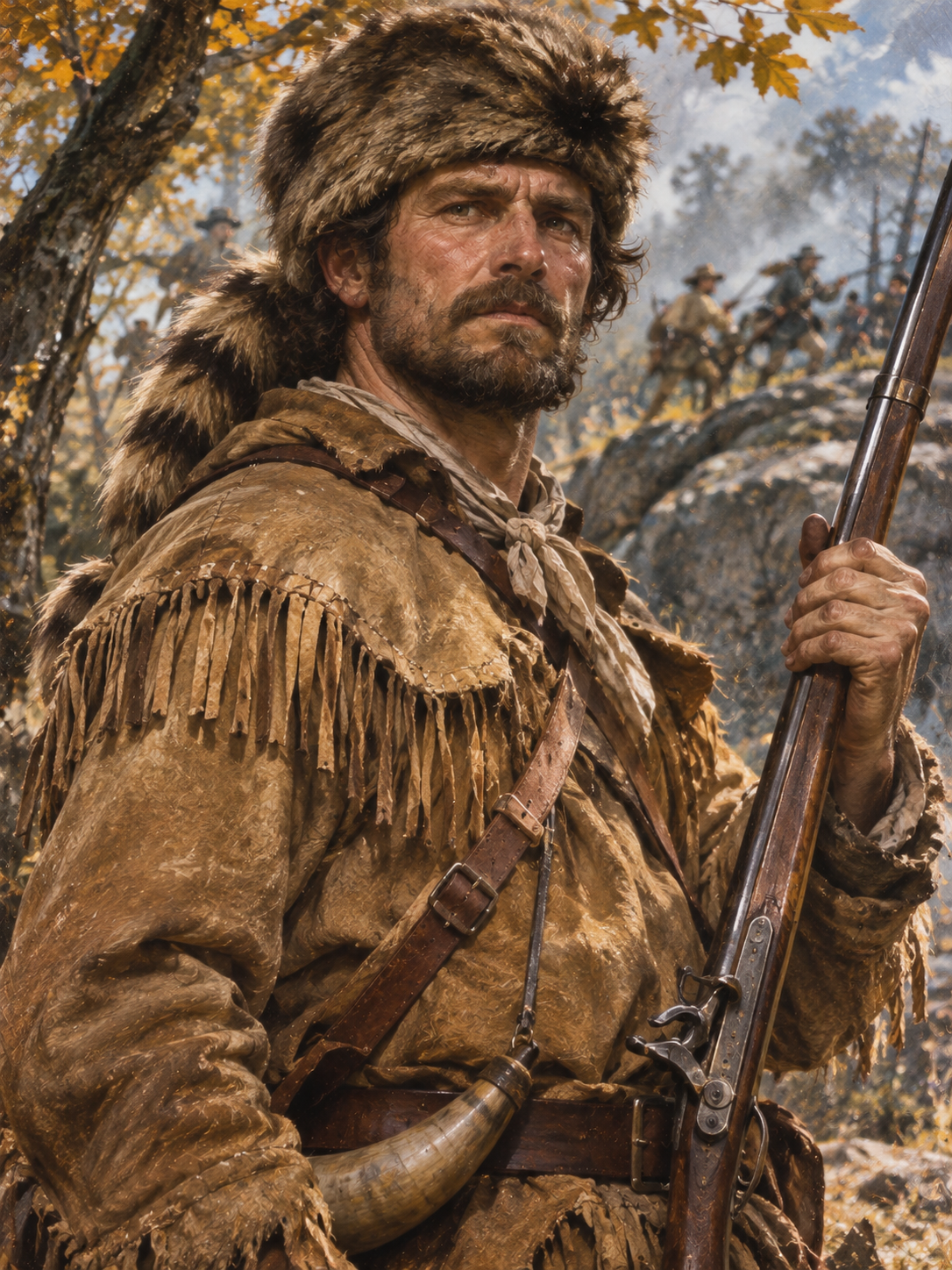
Portrait: The image accompanying this article is a modern AI-generated artistic interpretation of a frontier rifleman wearing clothing associated with the southern and Appalachian backcountry during the Revolutionary War. It is not an authenticated likeness of Joseph Hughes, and the setting does not establish that he fought at Kings Mountain. His actual facial appearance and clothing are unknown.
Pension: The claim was rejected in March 1850 and allowed following additional evidence in July 1850. The certificate was issued after Joseph’s death. Subsequent correspondence raised allegations of fraud and disputed distribution of the money. Those allegations are not presented as proven criminal findings.
Family: The record reports five children from Joseph Hughes’s marriage to Sarah Shaw. Thomas Hughes claimed to be the only surviving child, but later correspondence identified another son named Joseph. The complete family structure and final inheritance distribution require further research.
Death and burial: April 20, 1844, is recorded as the date of death. No verified burial location has been established.
Source limitations: This article relies on archival transcriptions that have not all been compared with original manuscript images. Some entries contain uncertain readings, inconsistent initials, and illegible passages. No definitive conclusion should be drawn from an ambiguous transcription alone.
Research priorities: The most important next steps are identifying the original 1786 South Carolina indent and its associated supporting documents; locating independent birth and age evidence for the deceased Joseph Hughes; examining the Georgia litigation and federal investigation; and establishing the identities of all five children.