
In This Article
His Story
In April 1775, as British troops advanced toward Lexington and Concord, warnings spread through the Massachusetts countryside. Among the men later remembered as carrying that alarm was Martin Herrick, a physician whose life would become closely connected to the American Revolution.
Herrick’s wartime career was unusual. Rather than serving exclusively as an infantryman, he applied his medical knowledge to the Continental Army and later to Massachusetts naval service. His surviving pension declaration describes service as a surgeon’s mate, work aboard an American armed vessel, capture by British forces, and imprisonment at Halifax, Nova Scotia.
His story connects several different experiences of the Revolutionary generation: the local alarm network that mobilized Massachusetts in 1775, the medical needs of Washington’s army, and the dangers faced by Americans serving at sea.
Decades after the fighting ended, Herrick sought financial assistance from the government he had served. Following his death, his widow Sarah continued the family’s involvement with the federal pension system. Together, their declarations preserve important evidence of a physician’s service and a family’s struggle for recognition.
Early Life & Education
Martin Herrick was reportedly born in Massachusetts in 1747. A Genealogical History of the Felton Family identifies his parents as Benjamin Herrick and Sarah Potter. According to that genealogy, his paternal ancestry included an earlier Martin Herrick and Ruth Endicott, connecting him to families established in Essex County.
Published historical accounts describe Herrick as a graduate of Harvard in 1772. He subsequently practiced medicine in the communities north of Boston, including Reading and Lynnfield.
Medical education in eighteenth-century America differed considerably from modern professional training. Physicians learned through a combination of formal study, apprenticeship, reading, and practical experience. They often traveled between households and treated patients with limited medicines, instruments, and scientific knowledge.
Herrick’s medical career became particularly important when the American colonies entered a prolonged war. The growing Continental Army needed men capable of treating wounds, managing disease, and caring for soldiers under difficult conditions.
A Midnight Alarm in Massachusetts
On the night of April 18–19, 1775, British regulars marched from Boston toward Lexington and Concord. Their movement triggered a network of warnings that spread through the surrounding countryside, an event remembered as the Lexington Alarm.
Paul Revere became the most famous of the riders associated with that night, but the warning depended upon many individuals carrying news between communities. Some traveled on horseback, while others spread the alarm locally. Militia companies began assembling as the news reached their towns.
Martin Herrick was remembered as one of these messengers.
In an October 2023 interview published by The Reading Post, local historian Alan Foulds discussed a memorial inscription in Lynnfield’s old burial ground stating that Herrick met Paul Revere and carried the alarm in another direction.
The tradition connects Herrick with the communities of Medford, Stoneham, Reading, and the area later known as Lynnfield. These places formed part of the network through which warnings could move outward from Boston.
At the time of the alarm, the area now called Lynnfield remained part of Lynn, Massachusetts. Lynnfield became a separate district in 1782.
Herrick’s reported involvement is particularly interesting because he was a physician. The alarm network included individuals from several professions, and physicians played important roles in both the mobilization of local communities and the medical support that followed.
Nevertheless, the surviving pension records do not independently establish the precise circumstances of Herrick’s reported meeting with Revere. The memorial inscription was erected generations after the event and should be understood as evidence of local historical memory rather than a contemporary eyewitness account.
Whether or not every detail of the encounter can be verified, the tradition reflects a broader historical truth: the events of April 19, 1775, depended upon a network of lesser-known messengers whose contributions were often overshadowed by the fame of Paul Revere.
A Physician in Lynnfield
Historical accounts describe Herrick as a physician who practiced in the Lynnfield area for many years. Local historian Alan Foulds has discussed his medical career, while a published history of Lynnfield also associates him with schoolteaching.
Physicians in eighteenth-century Massachusetts commonly served communities spread across considerable distances. They were called upon to treat illnesses, injuries, childbirth-related emergencies, and other conditions without the benefit of modern diagnostic equipment or effective treatments for many diseases.
Herrick’s reputation as a physician appears in later historical literature. Joseph M. Toner’s nineteenth-century study of Revolutionary War medical personnel identifies Martin Herrick as a medical officer and associates him with a distinguished surgical career.
Because Toner’s account was written long after the Revolution and contains biographical details that conflict with other records, it is most useful when read alongside Herrick’s own pension declaration and military records.
His professional experience nevertheless helps explain his military assignments. As the colonies organized an army, men with medical knowledge were urgently needed to care for the sick and wounded.
From Physician to Army Surgeon
Martin Herrick’s contribution to the American Revolution was shaped by his medical profession. Although remembered locally as a participant in the alarm of April 19, 1775, his subsequent service placed him among the physicians and surgeons who supported the American war effort.
In his pension declaration of March 30, 1818, Herrick described entering Continental Army service in March 1776 as a surgeon’s mate in Colonel Daniel Hitchcock’s regiment, attached to General Nathanael Greene’s brigade. He reported remaining in that position until January 1777.
The distinction between a surgeon and a surgeon’s mate is important. A surgeon’s mate assisted with medical treatment, while a regimental surgeon held greater responsibility for the care of soldiers. Both positions were essential in an army where wounds, infectious diseases, shortages of medicines, and poor sanitation created persistent challenges.
Herrick’s service under Hitchcock is supported by the pension material. The file also contains later testimony and administrative records concerning his military career.
Additional historical literature broadens the picture. Joseph M. Toner’s The Medical Men of the Revolution (1876) associates Herrick with the Battle of Bunker Hill and identifies medical service connected with Colonel Hitchcock and Colonel Frye.
These references are valuable research leads, but the exact dates and capacities in which Herrick served require verification against contemporary military records. In particular, a report that he was present at Bunker Hill should not automatically be interpreted as proof that he held a medical appointment during that battle.
The historical medical literature also identifies Herrick as a surgeon, supporting the broader understanding of his wartime professional role. His own pension account remains the principal source for the specific Continental Army assignment described here.
His service illustrates the importance of Revolutionary War medical personnel. The Continental Army needed not only men capable of fighting but also individuals who could care for soldiers, prevent the spread of disease, and help preserve the army’s fighting strength.
A Surgeon at Sea
Herrick’s military experience eventually extended beyond the Continental Army. His pension account describes subsequent service in Massachusetts naval operations, and historical accounts identify him as a surgeon aboard the armed vessel Tyrannicide.
The Tyrannicide belonged to the maritime struggle against British power. Armed American vessels operated in dangerous waters where capture, injury, disease, and shortages of supplies were constant concerns.
Life aboard an eighteenth-century warship presented medical challenges different from those encountered on land. Surgeons could be required to treat battle wounds, accidents, fevers, infections, and other illnesses in cramped quarters, sometimes with very limited supplies.
Herrick’s pension declaration describes his capture by British forces and his imprisonment at Halifax, Nova Scotia. His account reports approximately three months in captivity before an exchange allowed him to return.
Halifax was an important British naval and military center during the Revolution. American prisoners taken at sea could be transported there and held while authorities arranged exchanges or determined their status.
For Herrick, captivity was a personal consequence of the war. The physician responsible for caring for others became a prisoner himself, dependent upon the decisions of the opposing military authorities.
Some later local histories suggest that Herrick experienced more than one capture during the war. Those accounts should be distinguished from the particular imprisonment described in his pension declaration until additional documentation can be identified.
His naval service demonstrates that Revolutionary War medicine extended beyond military camps and battlefields. Physicians and surgeons serving aboard armed vessels faced the same dangers of capture and imprisonment as other members of their crews.
Military Service
| Conflict | American Revolutionary War |
|---|---|
| Allegiance | American revolutionary cause |
| Service | Continental Army and Massachusetts naval service |
| Medical Positions | Surgeon’s mate; surgeon |
| Army Regiment | Colonel Daniel Hitchcock’s Regiment |
| Brigade | General Nathanael Greene’s brigade |
| Army Service Dates | March 1776 – January 1777, according to his pension declaration |
| Additional Service | Colonel Frye’s regiment, reported in later medical history; details require verification |
| Naval Vessel | Massachusetts armed vessel Tyrannicide, identified in historical accounts |
| Captivity | British prisoner at Halifax, Nova Scotia; approximately three months according to the pension account |
| Bunker Hill | Reported participation; precise role unverified |
| Midnight Alarm | Reported participant in the April 19, 1775 warning network |
| Pension File | W.5101 |
| National Archives ID | 54858270 |
Pension Records & Testimony
One of the most important sources for Martin Herrick’s life is his surviving Revolutionary War pension file, preserved by the National Archives under pension number W.5101.
The file contains Herrick’s own account of his service, documents concerning his pension, testimony supporting his military record, and later declarations and correspondence involving his widow and family.
Martin Herrick’s Declaration of 1818
On March 30, 1818, Herrick submitted a pension declaration describing his Revolutionary War service. He identified his Continental Army medical assignment under Colonel Daniel Hitchcock and discussed his subsequent naval service and British captivity.
The declaration is particularly valuable because it records Herrick’s own recollections. Although prepared more than forty years after the events, it provides a direct statement from the veteran rather than relying entirely upon later local histories or family traditions.
His application also reflects the financial difficulties experienced by some Revolutionary War veterans in old age. Congress had enacted the pension legislation of March 18, 1818, to provide assistance to qualifying veterans in reduced circumstances.
From His Account: Medical Service and Imprisonment
In his 1818 declaration, Herrick described service as a surgeon’s mate in Colonel Daniel Hitchcock’s regiment, followed by medical service associated with Massachusetts naval operations.
He also recounted his capture by the British, confinement at Halifax, and eventual exchange.
These statements establish the central outline of a military career that included both land and maritime service.
Source: Martin Herrick’s pension declaration, March 30, 1818, Revolutionary War Pension File W.5101.
Editorial note: This passage summarizes the pension declaration and is not a verbatim transcription.
Supporting Military Testimony
The pension file contains additional statements concerning Herrick’s Revolutionary War service. Among the individuals appearing in the surviving material are William Blanchard and Daniel Flint.
Blanchard’s testimony discusses service associated with Colonel Hitchcock’s regiment and provides additional evidence connecting Herrick to the military establishment of the Revolution.
Flint’s statement also concerns Herrick’s military service. The surviving handwritten testimony is important because it may clarify assignments and circumstances that are only briefly described elsewhere.
These documents should be read alongside Herrick’s own declaration. They represent supporting testimony, not necessarily firsthand confirmation of every event reported in later historical accounts.
Sarah Herrick’s Widow’s Pension
Following Martin Herrick’s death, his widow Sarah pursued pension benefits based upon her husband’s Revolutionary War service.
Her surviving declaration and the accompanying administrative records preserve information about their marriage, Martin’s military history, and the family’s efforts to establish her entitlement to assistance.
The pension file contains material from the 1830s and 1840s, including correspondence, affidavits, pension-office notations, and records of the federal government’s consideration of her claim.
Some records refer to an annual widow’s pension of $272, while other summary material appears to record a different allowance. These figures should be reconciled against the applicable pension acts and original payment registers before a single amount is presented as definitive.
Sarah’s testimony is historically significant because it preserves family information that might otherwise have disappeared. Her application demonstrates how the consequences of Revolutionary War service continued to affect veterans’ households long after the war ended.
Marriage and Family Evidence
Documents within the pension file provide evidence concerning Martin Herrick’s marriage to Sarah Wright and identify individuals connected to Sarah’s family.
A later certificate appears to name several daughters or female heirs, including women associated with the surnames Hartshorn, Hood, Swain, and Hay.
These records offer important opportunities for genealogical research. However, the exact spellings, relationships, and marital connections require verification from enlarged original images and supporting vital records.
Later Correspondence and Family Claims
The surviving file also contains correspondence concerning the rights of Sarah Herrick’s children and the continued administration of pension benefits.
A letter dated March 30, 1844, concerns an application by Sarah’s children for an adjustment or increase in pension benefits. This demonstrates that the family’s efforts to secure recognition continued after Sarah’s death.
Another document, dated February 21, 1919, records a descendant’s inquiry about Martin Herrick. The correspondent described him as a surgeon in the Revolutionary Army and sought information about his military career.
The 1919 inquiry is valuable evidence of family memory and genealogical interest, but its statements about dates and military service must be checked against the earlier records.
Taken together, the pension documents reveal more than the outline of a soldier’s service. They preserve a history of military duty, captivity, financial hardship, widowhood, and the efforts of later generations to recover the family’s Revolutionary past.
The complete pension file is available through the National Archives, Catalog Identifier 54858270.
Later Life & Burial
Following the Revolution, Martin Herrick returned to civilian life in Massachusetts. He remained associated with Reading and Lynnfield, where historical accounts describe his work as a physician and, at times, a schoolteacher.
His medical career continued during the decades after independence. Later historical writers remembered him as a skilled practitioner, particularly in surgery.
By 1818, Herrick was experiencing financial difficulties and sought assistance through the federal pension system. His application reflects the circumstances of veterans who had contributed to the Revolution but did not necessarily enjoy financial security in old age.
Herrick died in July 1820, according to several local and genealogical accounts. His precise death date remains disputed. A published transcription of Lynnfield death records gives July 10, while other sources report July 4 or July 5.
One nineteenth-century medical history provides a substantially different death date. Because that account conflicts with other evidence, its biographical details require careful comparison with original records.
A published history of Lynnfield states that Herrick requested burial in the town’s old burying ground and that his funeral included Masonic honors.
The town history describes the reported location of his grave as a short distance from the entrance, in a straight line, but indicates that the burial place had no individual marker. The author stated that its location had been identified by someone who attended Herrick’s funeral.
In August 1901, a memorial obelisk was erected to commemorate Herrick and the local tradition that he had met Paul Revere and carried the alarm in another direction.
The memorial preserves the community’s remembrance of Herrick’s Revolutionary role. It should not, however, be confused with an authenticated marker identifying the precise location of his remains.
Family
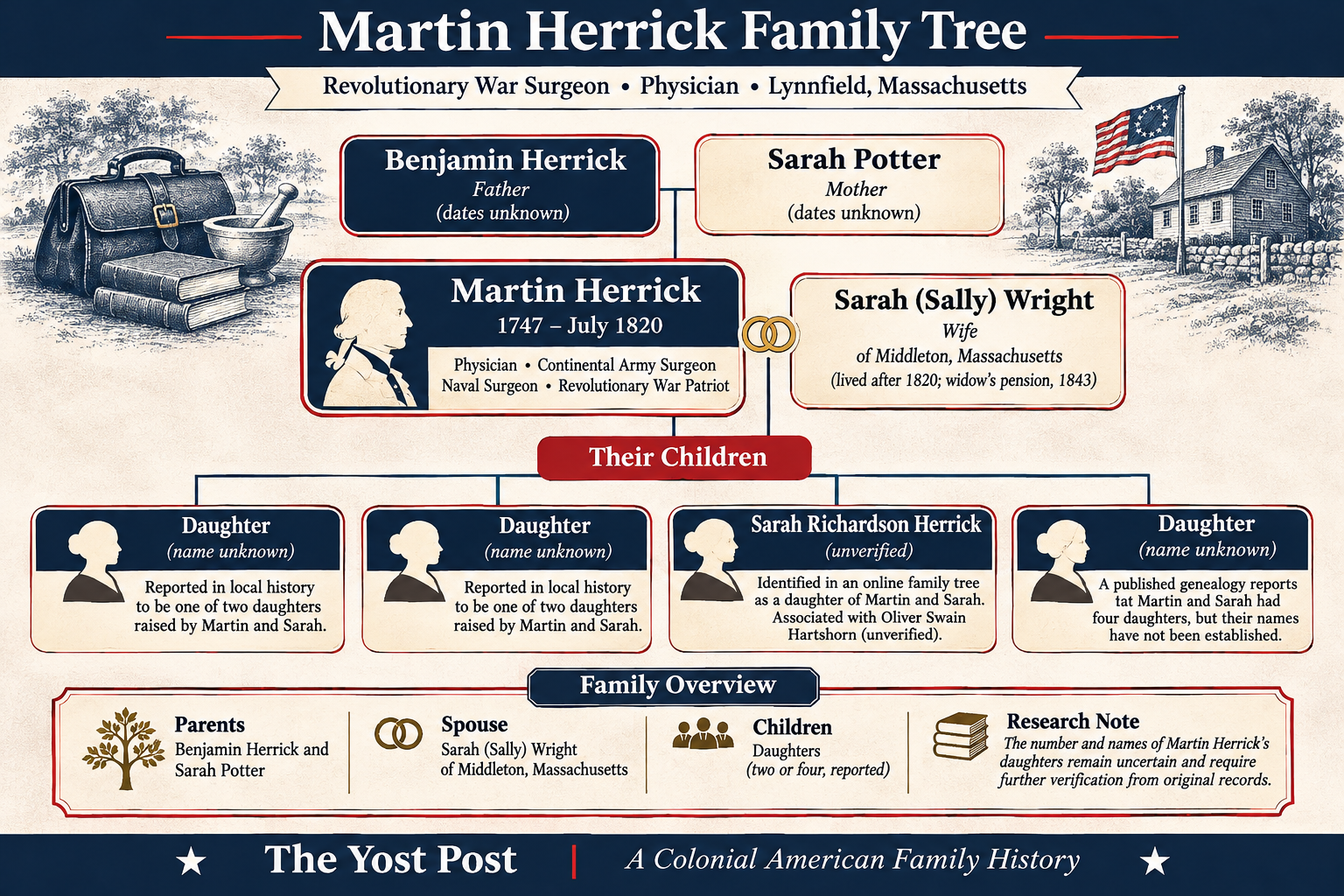
Martin Herrick’s family history connects him with the Herrick, Potter, Wright, and possibly Endicott families of colonial Massachusetts.
Published genealogies, local histories, and the surviving pension records provide valuable information, although some relationships remain uncertain.
Parents
Benjamin Herrick — Father (identified in published genealogy).
A Genealogical History of the Felton Family identifies Benjamin Herrick as the father of Martin Herrick, the Revolutionary War physician.
According to that genealogy, Benjamin was a son of an earlier Martin Herrick and Ruth Endicott. This would connect the younger Martin with families established in Essex County before the Revolution.
The relationship is reported in a published genealogy rather than independently established here through original birth, baptismal, or probate records.
Sarah Potter — Mother (identified in published genealogy).
The same Felton family genealogy identifies Sarah Potter as Martin Herrick’s mother.
Additional examination of Essex County vital records, church registers, and probate documents may clarify her dates, parentage, and marriage to Benjamin Herrick.
Spouse(s)
Sarah (Sally) Wright — Wife.
Martin Herrick married Sarah Wright, also known as Sally Wright, of Middleton, Massachusetts.
Their marriage is supported by the widow’s pension material and later historical accounts. The pension file contains testimony concerning their marriage, although the precise date should be verified against the original record before publication as a confirmed fact.
Sarah survived Martin and pursued federal pension benefits based upon his Revolutionary War service.
Her surviving records are especially important because they preserve evidence about the marriage, military service, and later family circumstances.
Correspondence from 1844 indicates that Sarah had died by that time and that her children were pursuing pension-related matters.
Children
The number of Martin and Sarah Herrick’s daughters is not consistent across the published historical accounts.
Local historian Alan Foulds stated that the couple raised two daughters, while A Genealogical History of the Felton Family reports that they had four.
The newly examined pension material offers additional evidence. A certificate associated with Sarah Herrick’s surviving family appears to identify four women connected with the surnames Hartshorn, Hood, Swain, and Hay.
These names may help resolve the discrepancy, but their exact identities and relationships must be checked against the original handwritten certificate and independent family records.
Sarah Richardson Herrick — Possible Daughter (unverified).
An online genealogical compilation identifies Sarah Richardson Herrick as a daughter of Martin Herrick and associates her with Oliver Swain Hartshorn.
The pension material includes a woman associated with the Hartshorn surname, making this a promising research lead. However, the records examined have not yet established that the two references identify the same individual.
A reliable connection would require original birth, marriage, probate, or other family documentation.
Other Daughters — Further Research Required.
The pension records appear to identify women associated with the surnames Hood, Swain, and Hay. Their given names, relationships, and marital histories require further verification.
Rather than treating uncertain handwritten names as established facts, The Yost Post records them as research leads until the relevant documents can be transcribed and corroborated.
The pension file provides stronger evidence for the identities of Sarah Herrick’s children than was available in the original biography. It may help reconcile the conflicting reports of two and four daughters.
However, the distinction between children born to Martin and Sarah, children raised by the couple, and surviving heirs must be established before a definitive family list can be published.
Siblings
The names and identities of Martin Herrick’s brothers and sisters have not been established from the records consulted for this article.
The proposed parentage in the Felton genealogy provides a starting point for further investigation, but reliable identification would require documentary evidence connecting individuals to Benjamin Herrick and Sarah Potter.
Later Generations & Descendants
The surviving pension correspondence demonstrates that members of the Herrick family continued to pursue records and benefits connected with Martin’s Revolutionary War service.
The 1919 genealogical inquiry is particularly interesting because it shows that later generations continued to identify Herrick with Revolutionary War medical service.
However, identifying a specific living descendant requires a documented chain connecting each generation through original records.
The most promising sources for further research include Massachusetts vital records, church registers, marriage records, probate documents, and the pension file’s statements concerning Sarah’s children.
No living descendant is identified here as verified without such documentation.
Sources & Genealogical Research Note
1. Revolutionary War Pension File W.5101
Martin Herrick and Sarah Wright Herrick.
National Archives Identifier: 54858270.
Contains the veteran’s declaration, widow’s testimony, military affidavits, and later family correspondence.
View the complete pension file
2. Martin Herrick’s Pension Declaration (1818)
Herrick’s account of his Continental Army medical service, naval service, capture, and imprisonment.
View the original declaration
3. Sarah Herrick’s Widow’s Declaration (1843)
Testimony concerning Martin Herrick’s Revolutionary War service and the couple’s marriage.
View the widow’s declaration
4. The Reading Post — Martin Herrick Met Paul Revere and Gave the Alarm in the Other Direction (2023)
Interview with local historian Alan Foulds, conducted by Robert Allison. Discusses Herrick’s reported warning ride, marriage, family, medical career, and burial.
Read the historical interview
5. A Genealogical History of the Felton Family
Published genealogy identifying Benjamin Herrick and Sarah Potter as Martin Herrick’s parents and reporting four daughters.
Read the genealogy
6. History of the Town of Lynnfield, Massachusetts
Historical town account discussing Herrick’s medical career, Revolutionary War traditions, death, and burial.
Read the town history
7. Lynnfield Death Records — Published Transcription
Transcription giving Herrick’s death as July 10, 1820, aged seventy-four, conflicting with other published dates.
View the death-record transcription
8. Lynnfield Old Burying Ground — Memorial Inscription
Cemetery inscription transcription recording the 1901 memorial commemorating Herrick’s reported meeting with Paul Revere.
View the memorial transcription
9. Revolution 250 — Stories from Lynnfield with Alan Foulds
Historical discussion of Herrick’s later life, family, burial, and difficulties tracing descendants.
Listen to the historical discussion
10. WikiTree — Martin Herrick (Herrick-1702)
Collaborative genealogical profile. Relationships and dates require verification against original records.
View the WikiTree profile
11. Find a Grave — Martin Herrick, Memorial #99912722
Supplementary memorial and burial research reference.
View the memorial
12. Joseph M. Toner — The Medical Men of the Revolution (1876)
Historical account identifying Martin Herrick as a Revolutionary War medical officer. Reports participation at Bunker Hill and service connected with Hitchcock’s and Frye’s regiments. Some biographical details conflict with other records and require verification.
View the historical medical study
13. Louis C. Duncan — Medical Men in the American Revolution, 1775–1783 (1931)
Historical study of Revolutionary War medical personnel, including a roster identifying Martin Herrick of Massachusetts as a surgeon.
View the U.S. Army medical roster
14. U.S. Navy — Born in Harm’s Way: The Advent of Navy Medicine in the Revolutionary War
Historical background concerning shipboard surgeons, medical responsibilities, and naval medicine during the American Revolution. Used for general context, not as independent proof of Herrick’s individual assignments.
Read the naval medical history
Midnight Alarm: Herrick’s reported meeting with Paul Revere is preserved in local historical accounts and commemoration. The pension file does not independently establish the encounter.
Medical Service: His 1818 pension declaration provides the principal evidence for his service as a surgeon’s mate. Historical medical literature also identifies him as a surgeon. Additional claims concerning Bunker Hill and Colonel Frye require comparison with original military records.
Naval Service: The pension account and historical sources describe maritime medical service, capture, and imprisonment at Halifax. The precise naval chronology and any claims of multiple captures require further verification.
Pension Testimony: The surviving file includes Martin’s declaration, Sarah’s widow-pension records, supporting affidavits, and later family correspondence. These documents were created at different times and for different purposes and should not be treated as equally direct evidence of every wartime event.
Death and Burial: Published sources disagree on Herrick’s precise death date. Local histories place his death in July 1820 and describe burial in Lynnfield’s old burying ground. The commemorative obelisk is not established as his personal gravestone.
Family: A published genealogy identifies Benjamin Herrick and Sarah Potter as his parents. His marriage to Sarah Wright is supported by widow-pension evidence. The pension file offers additional information about Sarah’s children, but the names and relationships require careful transcription and corroboration.
Family Tree Infographic: The infographic is a visual interpretation of available genealogical evidence. It includes relationships that remain under investigation and should not be treated as a definitive pedigree.
Descendants: No later descendant is identified as verified without a reliable documentary chain connecting the generations.
Portrait Disclosure: The accompanying portrait is an AI-generated historical interpretation, not an authenticated likeness of Martin Herrick.
Genealogical Research Note
This family history has been compiled from genealogical records, family trees, historical publications, cemetery records, military pension documents, and ancestral research. The information reflects what has been recorded or attributed to these individuals by previous researchers and may contain inaccuracies, conflicting dates, or unverified family connections.
The Yost Post presents this information as a historical and genealogical resource rather than a definitive account of family relationships. Readers are encouraged to consult original records and conduct additional research when tracing their own ancestry.