
In This Article
His Story
On February 1, 1781, North Carolina militiaman William Thomas stood among the American troops attempting to prevent the British army of Lord Cornwallis from crossing the Catawba River. The confrontation at Cowan’s Ford ended in an American withdrawal and the death of Brigadier General William Lee Davidson. Thomas later remembered seeing Davidson only minutes before the general was killed.
Thomas had already experienced the dangers of the Southern Campaign. During the summer of 1780, he marched from North Carolina into South Carolina with militia forces intended to support the American army commanded by Major General Horatio Gates. After being detached to join Brigadier General Thomas Sumter, he became involved in the operations that ended with the defeat of Sumter’s command at Fishing Creek.
His service was not one uninterrupted enlistment. Like many southern militiamen, Thomas was repeatedly called into the field for limited tours, sometimes against British regular troops and sometimes against Loyalist forces operating in the Carolinas.
He served under a succession of officers, including James Purviance, Martin Armstrong, Griffith Rutherford, Hugh Brevard, William Lee Davidson, and Francis Locke. His account connects his individual experience to several important phases of the Southern Campaign, from the American defeats of 1780 to the retreat and maneuvering that followed the Battle of Cowpens.
After the Revolution, Thomas moved west with the growing population of the early United States. He left North Carolina for Tennessee in 1791, subsequently lived in Sumner and Wilson Counties, and settled in Dyer County around 1830.
In the final months of his life, he attempted to secure a federal pension under the Act of June 7, 1832. His declaration was returned because of a procedural defect, and he died before he could correct it.
His executor, Edwin A. McCorkle, continued the proceedings. His widow Elizabeth and his brother James also supplied evidence. Their testimony preserved the details of a soldier whose own pension declaration no longer survives in the transcribed file.
Early Life
William Thomas was born September 3, 1761, in Rowan County, North Carolina. The date was supported by a copy of a birth entry taken from his father’s family Bible, which Thomas possessed when he prepared his pension declaration.
The surviving pension transcription does not identify his father or mother by name. It does identify a brother, James Thomas, who later testified concerning William’s Revolutionary War service.
During Thomas’s childhood, Rowan County occupied an important position in North Carolina’s expanding backcountry. Settlement had spread through the Piedmont, where farms, local markets, churches, and county institutions developed amid continuing disputes over land, representation, and colonial government.
Thomas was thirteen years old when the Revolutionary War began in April 1775. By the time the conflict reached the Carolinas with renewed intensity in 1780, he was approaching nineteen.
His pension testimony places him in Rowan County during the Revolution. He subsequently lived in Iredell County before leaving North Carolina in 1791.
His education, childhood occupation, and the precise location of his family home have not been established.
Revolutionary War Service
Drafted for the Southern Campaign, 1780
Sometime in 1780, William Thomas was drafted for a three-month militia tour in South Carolina. He served in a company commanded by Captain James Purviance, with Abel Armstrong as lieutenant and John Lucky as ensign.
The company assembled at Salisbury, North Carolina, where Colonel Martin Armstrong assumed command of the regiment. The troops joined General Griffith Rutherford before marching southward to meet the American army under General Horatio Gates.
Thomas recalled that the militia joined Gates’s army after crossing the Pee Dee River in South Carolina. They proceeded toward Rugeley’s Mills, near Camden.
Detached to General Thomas Sumter
Near Camden, Thomas was detached under Colonel Isaacs to join General Thomas Sumter, whose command was operating near the Catawba River.
Sumter led a mobile force conducting operations against British posts, supply movements, and Loyalist supporters in South Carolina.
While Thomas was with this force, news arrived of Gates’s defeat at Camden. Sumter’s troops subsequently moved along the Catawba River, where British forces overtook and defeated them at Fishing Creek.
Thomas returned home following the defeat, but his original term of service had not yet expired.
Service Under General Davidson
He was called out again under General William Lee Davidson and marched to Mecklenburg County, North Carolina.
Thomas stated that he remained there until his term expired and that Major John Johnston discharged him. The written discharge was later lost.
Operations Against Loyalists
During another tour in 1780, Thomas served under Colonel Hugh Brevard in an expedition against Loyalist forces in North Carolina.
The troops marched toward the South Fork of the Catawba River, where they engaged Loyalist opponents, captured some prisoners, and dispersed others.
The pension account does not identify a specific named battle for this expedition.
Opposing Cornwallis at the Catawba
Late in 1780 or early in 1781, Thomas was again drafted to serve under General Davidson.
Following the American victory at Cowpens on January 17, 1781, Cornwallis pursued Brigadier General Daniel Morgan’s forces toward the Catawba River.
Davidson’s militia was ordered to oppose the British crossing. Thomas recalled taking position at a ford and witnessing the fighting that followed when the British attempted to cross at daybreak.
During the American withdrawal, Thomas saw Davidson shortly before the general was killed. He stated that Major William Polk subsequently ordered the troops to retreat.
Service Under Colonel Francis Locke
Thomas later served under Colonel Francis Locke, whose troops marched from the Yadkin River to join Major General Nathanael Greene.
Thomas reported remaining with Greene’s army until his three-month tour expired. He was discharged in North Carolina and returned home.
The surviving transcription does not establish his presence at a specific engagement during this final reported tour.
Battles and Campaigns
The Camden Campaign
In the summer of 1780, the British army under Lieutenant General Charles Cornwallis sought to consolidate control over South Carolina following the capture of Charleston.
General Horatio Gates advanced southward with Continental troops and militia in an attempt to challenge the British occupation. The campaign culminated in the Battle of Camden on August 16, 1780, where the American army suffered a severe defeat.
William Thomas reported marching south from Salisbury with the North Carolina militia and joining Gates’s army after crossing the Pee Dee River. His command subsequently proceeded toward Rugeley’s Mills.
Thomas was detached to Sumter’s force before Gates’s defeat. His account states that he learned of the disaster at Camden while serving with Sumter.
Participation: Personally reported participation in the campaign. The record does not establish that Thomas fought in the Battle of Camden itself.
The Battle of Fishing Creek
After the American defeat at Camden, General Thomas Sumter’s command remained active in South Carolina. His force included mounted men and militia who had been conducting raids against British positions and supply movements.
Lieutenant Colonel Banastre Tarleton pursued Sumter with British mounted troops. On August 18, Tarleton surprised the American force near Fishing Creek.
The attack scattered Sumter’s troops and resulted in substantial American losses and captures. The defeat weakened organized Patriot resistance in the region at a critical moment.
Thomas recalled moving up the Catawba River after hearing of Gates’s defeat. British forces overtook the American troops, attacked them, and defeated them.
His account corresponds to the action at Fishing Creek, which the pension transcription identifies in an editorial annotation.
Participation: Personally reported in the pension account preserved by his executor. The identification of the engagement as Fishing Creek is supported by the described sequence and the transcription’s annotation.
Operations Against North Carolina Loyalists
Throughout the Southern Campaign, the Revolution was also a civil conflict between Patriot and Loyalist communities.
Local militia companies conducted patrols and expeditions against opposing forces, attempted to secure important crossings, and sought to prevent armed Loyalist groups from assisting British operations.
Thomas reported serving under Colonel Hugh Brevard during an expedition toward the South Fork of the Catawba River.
He stated that the troops engaged Loyalists, took prisoners, and dispersed other opponents before returning home.
Participation: Personally reported military expedition. No specific named battle has been independently established.
The Battle of Cowan’s Ford
Following the American victory at Cowpens, Cornwallis moved northward in pursuit of Daniel Morgan’s army. The British commander hoped to overtake the American forces before they could unite with General Nathanael Greene.
The Catawba River formed an important obstacle along the route. General William Lee Davidson and his North Carolina militia were assigned to defend crossings and delay the British advance.
At Cowan’s Ford, British troops attempted to cross the river in the early morning darkness. The defenders opened fire, but the British eventually gained the far bank and forced the Americans to withdraw.
Davidson was killed during the engagement. His death deprived the American forces of an experienced militia commander at a crucial stage of the campaign.
Thomas’s account places him at the defended crossing. He described the British approach, the beginning of the action, and the subsequent retreat.
He also reported seeing Davidson a few minutes before the general was killed and stated that Major William Polk ordered the retreat.
Participation: Personally reported in the veteran’s pension account. This is the strongest individually described battle experience in the surviving transcription.
The Campaign of Nathanael Greene
After the American forces escaped Cornwallis’s pursuit, Nathanael Greene continued maneuvering through the Carolinas and Virginia.
Greene’s strategy depended on preserving his army, gathering reinforcements, and compelling British forces to operate across difficult terrain and extended supply lines.
Thomas reported marching from the Yadkin River under Colonel Francis Locke to join Greene’s army.
He stated that he remained with the army until his three-month term expired and was discharged in North Carolina.
The pension account does not identify his precise arrival date or a specific battle during this tour. Participation at Guilford Courthouse or another named engagement therefore cannot be established from this evidence.
Participation: Personally reported service with Greene’s army; individual battlefield participation not established.
Military Honors and Recognition
William Thomas’s service was recognized through the federal Revolutionary War pension process.
The pension file records an annual rate of twenty dollars for six months of credited service as a private in the North Carolina militia.
His executor and family witnesses supplied testimony concerning his military service after his death.
No individual battlefield decoration, special commendation, or promotion beyond the rank of private has been established from the surviving transcription.
Original Military Records
William Thomas’s Pension Declaration
Prepared: Before April 1, 1833
Status: Original declaration not included in the available transcription.
Thomas applied for a pension under the Act of June 7, 1832. His declaration was returned for a procedural deficiency, but he died before he could amend it.
The details of his service survive principally through the account presented by his executor.
Edwin A. McCorkle’s Statement
Date: September 24, 1833
Location: Dyer County, Tennessee
McCorkle, one of Thomas’s executors, testified concerning the deceased veteran’s service and reproduced the substance of his earlier declaration.
He stated that he had known Thomas for many years and had heard him describe his military experiences well before the pension legislation of 1832.
James Thomas’s Affidavit
Date: July 2, 1834
Location: Dyer County, Tennessee
James Thomas, the veteran’s brother, confirmed that William had served in the Revolutionary War.
He recalled two three-month drafts and stated that William had also stood as a minute man.
James acknowledged that age, illness, and failing memory prevented him from recalling the exact dates of the drafts.
Elizabeth Thomas’s Widow’s Declaration
Document: Widow’s supporting affidavit
Elizabeth identified herself as William’s widow and reported that they had married May 19, 1791, in North Carolina.
Her statement also recounted the service claimed by her husband. The available transcription summarizes this affidavit rather than reproducing it in full.
Revolutionary War Pension
Application Under the Act of 1832
William Thomas sought a pension under the Act of June 7, 1832, which expanded eligibility for surviving Revolutionary War veterans.
His declaration was returned because it did not satisfy the required formalities. Before he could correct the application, he died on April 1, 1833.
The Executor’s Testimony
On September 24, 1833, Edwin A. McCorkle appeared before the Dyer County Court of Pleas and Quarter Sessions.
He explained the circumstances of Thomas’s death and reproduced the veteran’s description of his military service.
McCorkle stated that Thomas had long been regarded by his acquaintances as a Revolutionary War soldier of good character.
Supporting Family Testimony
James Thomas subsequently corroborated the veteran’s militia service, recalling two three-month tours.
Elizabeth Thomas supplied a widow’s declaration and confirmed their marriage in 1791.
Pension Allowance
The pension transcription records that William Thomas was pensioned at twenty dollars annually, commencing March 4, 1831, for six months of credited service as a private in the North Carolina militia.
Because Thomas died before completing the amended application, the precise administrative sequence and any payment to his estate or widow should be checked against the complete original pension file.
From His Account
William Thomas’s original pension declaration is not reproduced in the available transcription. The following passages summarize the account preserved in Edwin A. McCorkle’s sworn statement of September 24, 1833. They are paraphrases rather than direct quotations from Thomas.
His First Militia Tour
Thomas reported that he was drafted in 1780 for three months of service against the British in South Carolina. His company was commanded by James Purviance and assembled at Salisbury before joining the forces under General Rutherford.
Source: Pension S.3780, McCorkle statement, September 24, 1833.
The Defeat at Fishing Creek
After being detached to Sumter’s command, Thomas learned of Gates’s defeat at Camden. His troops moved along the Catawba River before British forces overtook and defeated them.
Source: Pension S.3780, McCorkle statement, September 24, 1833.
The Death of General Davidson
Thomas described defending a Catawba River crossing against Cornwallis’s army and seeing General Davidson shortly before the general was killed. He recalled that Major William Polk ordered the American retreat.
Source: Pension S.3780, McCorkle statement, September 24, 1833.
His Final Reported Tour
Thomas stated that he marched from the Yadkin River under Colonel Francis Locke, joined General Greene’s army, and remained in service until his three-month term expired.
Source: Pension S.3780, McCorkle statement, September 24, 1833.
Military Service Record
| Conflict | American Revolutionary War |
|---|---|
| Allegiance | United States |
| Military Organization | North Carolina Militia |
| Rank | Private |
| Reported Service | Intermittent tours during 1780–1781 |
| Initial Captain | James Purviance |
| Lieutenant | Abel Armstrong |
| Ensign | John Lucky |
| Regimental Commander | Martin Armstrong |
| Additional Commanders | Griffith Rutherford; Thomas Sumter; William Lee Davidson; Hugh Brevard; Francis Locke |
| Other Officers Named | Colonel Isaacs; Major John Johnston; Major William Polk |
| Campaign | Camden Campaign, 1780 |
| Battle | Fishing Creek, August 18, 1780 |
| Battle | Cowan’s Ford, February 1, 1781 |
| Additional Service | Expedition against Loyalists; service with Greene’s army |
| Discharge Papers | Reported lost |
| Credited Pension Service | Six months |
| Pension | S.3780 |
| Annual Pension Rate | $20 |
Later Life and Burial
From North Carolina to Tennessee
After the Revolution, William Thomas remained in Iredell County, North Carolina, until 1791.
That year he moved to Sumner County, Tennessee, where he remained until 1799. He then relocated to Wilson County, Tennessee.
Thomas lived in Wilson County for approximately thirty-one years before moving to Dyer County in 1830.
His movements followed a broader pattern of migration from the Carolina Piedmont into Tennessee during the decades following American independence.
His Final Residence
Thomas spent the last three years of his life in Dyer County.
By 1832, he was seventy-one years old. He had applied for a Revolutionary War pension but died before he could correct a procedural defect in his declaration.
Death
William Thomas died April 1, 1833, in Dyer County, Tennessee.
The date and location were reported by Edwin A. McCorkle in September 1833 and confirmed by James Thomas in July 1834.
Burial
His burial location has not been verified from the pension transcription. No cemetery or grave memorial should be assigned without additional evidence.
Family History
The Yost Post · Family DirectoryWilliam Thomas’s pension proceedings preserve several important family details, including his birth date, his marriage to Elizabeth, and the testimony of his brother James. The available transcription does not identify his parents or children.
Family Name & Heritage Thomas Explore surname origins and historical context
Meaning and Etymology
Thomas developed as a surname from the personal name Thomas, ultimately derived from an Aramaic word meaning twin. The name became widespread in European Christian communities.
Although the surname was common in England and Wales, its occurrence in North Carolina does not establish the ancestry of this particular family.
The identities of William Thomas’s parents and earlier ancestors require independent documentation.
His Parents
William’s parents have not been identified by name. His pension account refers to a family Bible belonging to his father that recorded William’s birth on September 3, 1761.
His Marriage
Elizabeth identified herself as William’s widow and stated that they married in North Carolina on May 19, 1791.
View Additional Research
Widow’s Declaration
Elizabeth supplied testimony in the pension proceedings following William’s death.
Marriage Evidence
The date is preserved in the pension transcription. Her maiden name and original marriage record have not been established.
His Siblings
James Thomas lived in Gibson County, Tennessee, and testified on July 2, 1834, that he was William’s brother.
View Additional Research
Military Testimony
James recalled that William was drafted twice for three-month tours and also stood as a minute man.
Limits of Recollection
James acknowledged that illness, age, and declining memory prevented him from supplying precise dates.
His Children
The available pension transcription does not identify William and Elizabeth’s children. No specific descendants can be assigned to the family without further evidence.
Other Family and Associates
Edwin A. McCorkle was one of William’s executors and a longtime acquaintance. The available records do not establish that he was a relative.
Family Research Update
Further research should focus on the original Thomas family Bible, North Carolina marriage records, and probate and land records in Sumner, Wilson, and Dyer Counties, Tennessee.
James Thomas’s residence in Gibson County also offers a potential avenue for identifying the wider family.
Original Sources
The principal accessible source for this biography is the transcription of pension application S.3780 prepared by Will Graves. It reproduces and summarizes documents from the original pension file. The original manuscript images have not been independently checked for this article.
-
William Thomas, Revolutionary War Pension Application S.3780
North Carolina militia. Transcribed by Will Graves, revised March 6, 2017. Southern Campaigns American Revolution Pension Statements & Rosters.
Read Pension Transcription -
Edwin A. McCorkle, Executor’s Statement
Dyer County Court of Pleas and Quarter Sessions, September 24, 1833. Reproduces the substance of William Thomas’s pension declaration and military service account. Pension S.3780, transcription pages 1–2.
-
James Thomas, Supporting Affidavit
Dyer County, Tennessee, July 2, 1834. Confirms family relationship, militia drafts, and William Thomas’s death. Pension S.3780, transcription pages 2–3.
-
Elizabeth Thomas, Widow’s Declaration
Summarized in pension S.3780, transcription page 3. Identifies the marriage date of May 19, 1791, in North Carolina.
-
Federal Pension Allowance Notation
Pension S.3780, transcription page 3. Records twenty dollars annually for six months of credited service as a North Carolina militia private, commencing March 4, 1831.
Historical Research Note
Identity: This biography concerns William Thomas, born September 3, 1761, in Rowan County, North Carolina, and deceased April 1, 1833, in Dyer County, Tennessee. His pension number is S.3780. He must not be confused with other Revolutionary War soldiers named William Thomas.
Primary Evidence: His original pension declaration is not reproduced in the available transcription. The military narrative survives through Edwin A. McCorkle’s sworn account of its contents, prepared after Thomas’s death.
Birth: The birth date was supported by a copied entry from his father’s family Bible. The original Bible has not been examined.
Military Service: Thomas described multiple militia tours during 1780–1781. His brother corroborated two three-month drafts. The federal pension notation credits six months of service.
Fishing Creek: The veteran’s account describes being overtaken and defeated by British forces after the defeat at Camden. The transcription identifies this engagement as Fishing Creek.
Cowan’s Ford: Thomas personally described the crossing, the fighting, Davidson’s death, and the retreat. The account is preserved through McCorkle’s 1833 statement.
Other Campaigns: Thomas reported serving against Loyalists and later joining Greene’s army. No additional named battle can be confidently assigned to him from the available evidence.
Discharge: Thomas reported receiving a discharge from Major John Johnston during one tour, but the document had been lost.
Pension: The transcription records an allowance of twenty dollars annually for six months of credited service. The exact administrative sequence following Thomas’s death requires examination of the complete original file.
Family: Elizabeth Thomas and James Thomas are directly identified. His parents’ names, Elizabeth’s maiden name, and the identities of any children remain unverified.
Death: April 1, 1833, in Dyer County, Tennessee, is supported by both the executor’s statement and his brother’s affidavit.
Burial: No verified cemetery or grave has been established.
Source Limitations: The published transcription includes editorial corrections, annotations, and summaries. Quotations and ambiguous readings should be verified against the original pension images before being treated as diplomatic transcriptions.
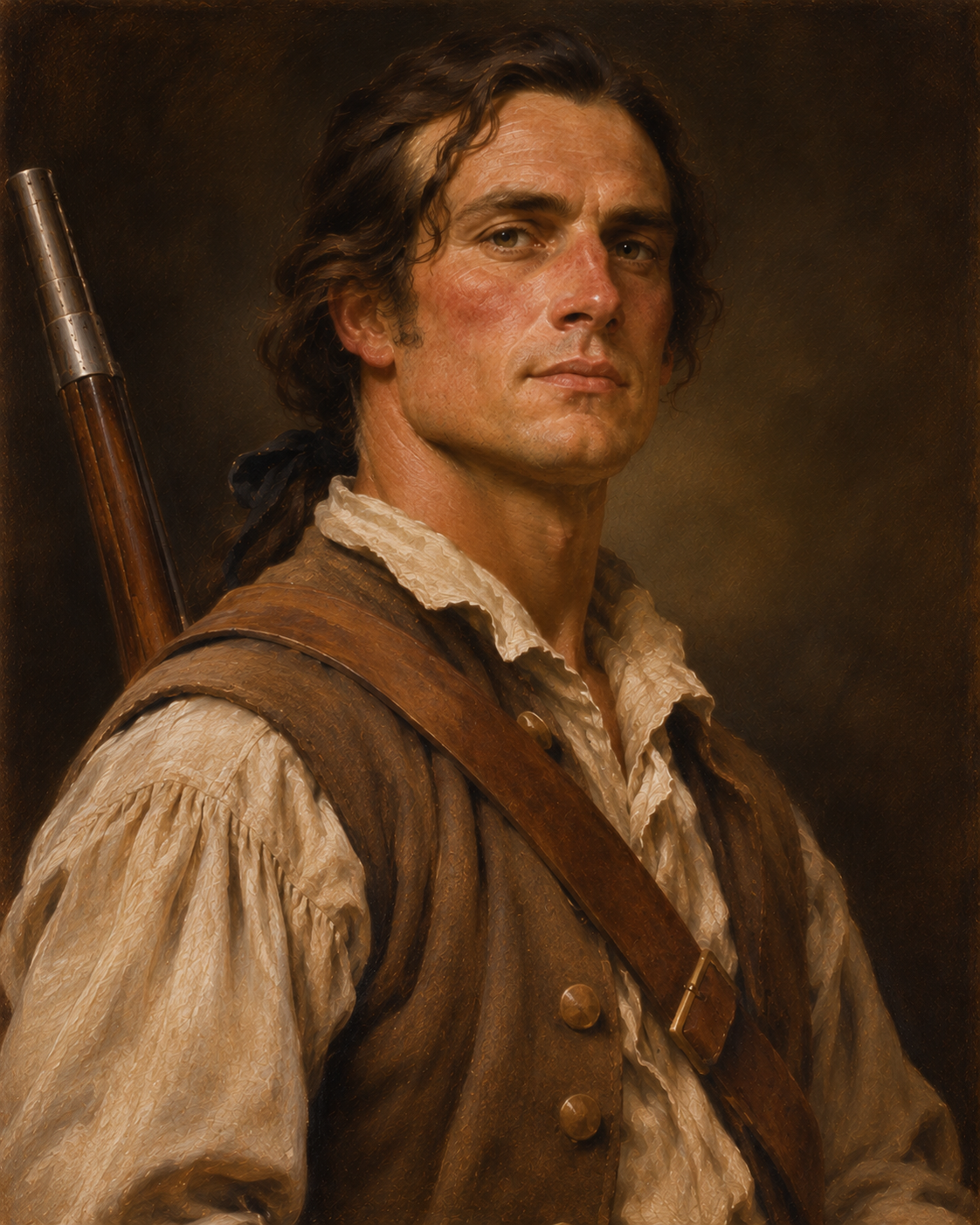
Portrait Disclosure: The accompanying portrait is a modern AI-generated historical interpretation and is not an authenticated likeness of William Thomas.
Genealogical Research Note
William Thomas’s surviving pension evidence offers a useful framework for further research because it identifies his birth date, his brother, his marriage, and a sequence of residences across North Carolina and Tennessee.
His father’s family Bible is an especially important potential source. If located, it may reveal his parents, siblings, and other family relationships.
Additional research should compare Rowan and Iredell County records with Tennessee land, probate, marriage, and census records. The original pension file should also be examined to clarify the final pension determination and the contents of Elizabeth Thomas’s declaration.