
In This Article
His Story
On June 13, 1783, Corporal Abner Poland received a military discharge bearing the signature of General George Washington. The document recorded seven years and six months of faithful service in the Continental Army, an extraordinary period of commitment during the American Revolutionary War.
The discharge also recorded that Poland had been honored with the Badge of Merit, a distinction established by Washington to recognize enlisted soldiers and noncommissioned officers whose prolonged service demonstrated fidelity and good conduct.
For Abner Poland, the certificate marked the conclusion of a military career that had consumed much of his youth. Born in Massachusetts in 1761, he had entered Revolutionary service while still a teenager and remained in the Continental Army through the closing years of the conflict.
Published accounts of his pension testimony associate him with four important engagements: Hubbardton, Stillwater, Monmouth, and Yorktown. If confirmed by the original pension papers, those accounts would place him in military operations extending from the northern campaigns of 1777 to the decisive siege of Yorktown in 1781.
His surviving discharge provides an unusually direct connection to his service. It preserves his rank, regiment, credited years, commanding officer, and formal military recognition.
Yet Abner’s story extended well beyond the army. He belonged to a Massachusetts family whose history included maritime occupations, farming, military service, and eventual migration into New Hampshire. His father, also named Abner Poland, was himself a Revolutionary War veteran.
The two men’s shared names have created an important genealogical challenge. Their separate military and cemetery records must be distinguished carefully to reconstruct their individual lives.
Early Life in Massachusetts
Abner Poland Jr. was born May 17, 1761, in Chebacco Parish, then part of Ipswich, Massachusetts, according to published descendant research. The parish later became part of the town of Essex.
His father, Abner Poland Sr., had been born in 1736. His mother, Dorothy Burnham, belonged to another established Massachusetts family.
The younger Abner grew up in a coastal community where farming, fishing, shipbuilding, and maritime trade shaped everyday life.
Published family research describes him as a mariner and fisherman. Military descriptive records cited in that research also identify farming as an occupation.
His father and mother married in the spring of 1761, the same year Abner Jr. was born.
The elder Abner’s later family memorial identifies seven children from his marriage to Dorothy Burnham. Abner Jr. was the eldest child in that list.
As the Revolution began, father and son were both associated with the Massachusetts communities that supplied soldiers and resources to the American cause.
Revolutionary War Service
Published genealogical research attributes an early enlistment beginning January 15, 1776, to Abner Poland Jr., in Captain Abraham Dodge’s company under Colonel Moses Little. That period reportedly ended in May 1776.
Because both father and son served during the Revolution, the early enlistment records require careful examination to ensure that service is assigned to the correct individual.
The younger Abner’s surviving discharge directly establishes his later service as a corporal in the Eighth Massachusetts Regiment.
The regiment was commanded by Colonel Michael Jackson, whose endorsement appears on the discharge certificate.
The document credits Abner with seven years and six months of faithful service and identifies his enlistment as one undertaken for the duration of the war.
Corporals were junior noncommissioned officers responsible for assisting with discipline, organization, and supervision of enlisted soldiers.
Abner’s final military record places him among the experienced Continental soldiers who remained in service through the closing stages of the American Revolution.
Battles and Campaigns of the American Revolution
Abner Poland Jr.’s military career has been associated with four important Revolutionary War engagements: Hubbardton, Stillwater, Monmouth, and Yorktown.
These battles are reported in published genealogical research summarizing his pension testimony. The original 1783 discharge confirms his lengthy Continental Army service but does not identify individual battles.
The following accounts explain the historical importance of each engagement while distinguishing reported participation from independently verified military activity.
Battle of Hubbardton
In the summer of 1777, British General John Burgoyne advanced south from Canada in an attempt to divide New England from the other American states.
Following the American evacuation of Fort Ticonderoga, British troops pursued the retreating Continental forces.
At Hubbardton, an American rear guard fought a determined engagement intended to protect the withdrawing army.
British and German troops under General Simon Fraser and Baron Friedrich Riedesel confronted American forces that included Continental soldiers and militia.
The fighting was intense, particularly around the wooded hills and elevated ground surrounding the battlefield.
Although the British eventually held the field, the American resistance delayed the pursuit and helped protect the larger retreating force.
Abner Poland’s reported participation would place him in this northern campaign. His precise position and duties during the battle, however, have not been established from the surviving discharge.
Battles of Saratoga (Stillwater)
The battles near Stillwater, New York, became one of the decisive turning points of the American Revolution.
General Burgoyne continued his advance southward, expecting British forces to secure control of the Hudson River corridor.
On September 19, American and British troops fought at Freeman’s Farm. Although the British retained the immediate battlefield, the engagement inflicted substantial casualties on Burgoyne’s army.
A second major battle occurred on October 7 at Bemis Heights, when American forces attacked British positions and forced Burgoyne to retreat.
Surrounded and unable to obtain sufficient supplies or reinforcements, Burgoyne surrendered his army on October 17, 1777.
The victory helped convince France that the United States could successfully resist British military power. France subsequently entered the conflict openly as an American ally.
Published accounts associate Abner Poland with the fighting at Stillwater. They do not establish whether he participated in the September engagement, the October engagement, or both.
Battle of Monmouth
In June 1778, British forces evacuated Philadelphia and began marching across New Jersey toward New York City.
General George Washington followed with the Continental Army, seeking an opportunity to strike the British column.
The opposing armies met near Monmouth Court House on June 28.
The battle took place during exceptionally hot weather, creating severe physical difficulties for soldiers on both sides.
After confusion and an American withdrawal early in the fighting, Washington reorganized his troops and established a defensive position.
The Continental Army resisted repeated British attacks before the battle ended without a decisive battlefield victory for either side.
Monmouth demonstrated the improving discipline of the Continental Army following its winter training at Valley Forge.
Abner Poland’s reported presence would place him among American forces involved in the campaign. His individual actions during the engagement have not been documented in the surviving discharge.
Siege of Yorktown
In the autumn of 1781, American and French forces converged on Yorktown, Virginia, where British General Charles Cornwallis had established defensive positions.
General George Washington and French General Jean-Baptiste de Rochambeau directed the allied land forces.
Meanwhile, the French fleet under Admiral François Joseph Paul de Grasse prevented British naval forces from effectively relieving Cornwallis.
Beginning September 28, the allied army surrounded Yorktown and constructed siege works to bring artillery closer to the British defenses.
On October 14, American and French troops captured important British redoubts, allowing the allied siege lines to advance.
Cornwallis’s position became increasingly untenable, and the British army surrendered on October 19, 1781.
Yorktown was the last major land campaign of the Revolution. The surrender weakened British support for continuing the war and helped open the way toward the peace settlement of 1783.
Abner’s reported participation would place him among Continental soldiers serving during this decisive campaign, although his precise assignment remains unverified.
These four reported engagements illustrate the breadth of the military campaigns associated with Abner Poland’s Revolutionary War service.
His documented service continued until June 1783, when his discharge recognized seven years and six months of faithful duty.
Battle Participation — Evidence Status
Hubbardton, Stillwater, Monmouth, and Yorktown are reported in secondary accounts of Abner Poland’s pension testimony.
The original pension manuscript has not yet been independently examined for this biography. The battles should therefore be described as reported participation, not as engagements conclusively established by the discharge certificate.
George Washington’s Badge of Merit
One of the most significant details preserved in Abner Poland’s discharge is the endorsement recording his receipt of the Badge of Merit.
On August 7, 1782, George Washington issued general orders establishing military distinctions for enlisted soldiers and noncommissioned officers.
Washington recognized that prolonged faithful service deserved formal acknowledgment, even among soldiers who did not hold commissioned rank.
A Reward for Faithful Service
The system established cloth chevrons to recognize soldiers who had completed extended periods of honorable service.
Revolutionary War Service Chevrons
More than three years: One cloth chevron worn on the left sleeve.
More than six years: Two cloth chevrons worn on the left sleeve.
Abner Poland’s credited service: Seven years and six months.
Recorded distinction: Badge of Merit for faithful service.
Abner’s credited service exceeded the period required for the double-chevron distinction.
The endorsement by Colonel Michael Jackson confirms that his long service received official recognition.
The Badge of Merit Was Not the Purple Heart
Washington also established a separate decoration known as the Badge of Military Merit.
Although the names were similar, the distinctions served different purposes.
The long-service Badge of Merit recognized faithful and honorable military service through cloth chevrons.
The Badge of Military Merit was a purple, heart-shaped decoration awarded for extraordinary military merit. It became historically associated with the origins of the modern Purple Heart.
| Badge of Merit | Recognized extended faithful and honorable service through uniform chevrons. |
|---|---|
| Badge of Military Merit | Recognized extraordinary military merit through a purple, heart-shaped decoration. |
| Abner Poland’s distinction | The long-service Badge of Merit documented on his 1783 discharge. |
Abner Poland should not be described as a recipient of the original Purple Heart. His documented distinction was the long-service Badge of Merit.
The 1783 Military Discharge Signed by George Washington
Abner Poland’s original military discharge was dated June 13, 1783.
The certificate identified him as a corporal of the Eighth Massachusetts Regiment and credited him with seven years and six months of faithful service.
It bore the signature of General George Washington, Commander in Chief of the Continental Army.
An additional endorsement signed by Colonel Michael Jackson recorded Abner’s Badge of Merit.
Original Military Discharge
Soldier: Corporal Abner Poland
Regiment: Eighth Massachusetts Regiment
Date: June 13, 1783
Credited service: Seven years and six months
Discharge authority: George Washington
Badge endorsement: Colonel Michael Jackson
National Archives Identifier: 5752257
The certificate is especially valuable because it is a contemporary military record rather than a recollection prepared decades after the Revolution.
The Bounty-Land Warrant of 1795
A later handwritten notation on Abner Poland’s discharge refers to a military bounty-land warrant.
The notation identifies warrant number 4871, includes the name Joseph Fosdick, and records 700 acres associated with Abner Poland.
The notation is dated November 2, 1795.
Bounty-land warrants were used to compensate qualifying military personnel through grants or claims to land. Such warrants could sometimes be transferred or assigned.
The notation does not establish that Abner personally occupied 700 acres or identify the final location of the land.
Additional federal land records would be necessary to determine the ultimate disposition of the claim.
Military Service Record
| Conflict | American Revolutionary War |
|---|---|
| Allegiance | United States |
| Military | Continental Army |
| Rank at discharge | Corporal |
| Regiment | 8th Massachusetts Regiment |
| Commanding officer | Colonel Michael Jackson |
| Reported earlier service | Captain Abraham Dodge’s company under Colonel Moses Little |
| Credited service | Seven years and six months |
| Discharge | June 13, 1783 |
| Discharge authority | George Washington |
| Military distinction | Badge of Merit |
| Reported battles | Hubbardton, Stillwater, Monmouth, Yorktown |
| Bounty-land notation | Warrant 4871, 700 acres |
| National Archives ID | 5752257 |
From His Account and Surviving Military Documents
The surviving discharge is an official military certificate rather than a personal narrative written by Abner Poland.
The following summaries distinguish contemporary military documentation from later accounts of his pension testimony.
Military Discharge — June 13, 1783
The original certificate identifies Abner Poland as a corporal in the Eighth Massachusetts Regiment and credits seven years and six months of faithful service.
Source: National Archives Identifier 5752257.
Archival image reference: 23853_a.jpg.
Badge of Merit Endorsement — 1783
An endorsement signed by Colonel Michael Jackson records Abner Poland’s Badge of Merit for faithful military service.
Source: Original military discharge.
Bounty-Land Notation — November 2, 1795
A handwritten notation records warrant number 4871, Joseph Fosdick, and 700 acres associated with Abner Poland.
Source: Later notation on the original discharge.
Reported Pension Testimony
Published genealogical research attributes participation at Hubbardton, Stillwater, Monmouth, and Yorktown to Abner Poland’s pension testimony.
Because the original pension manuscript has not yet been independently examined here, no words are presented as a direct quotation from Abner’s personal testimony.
Later Life and Burial
Following the American Revolution, Abner Poland returned to civilian life in Massachusetts.
Published family research identifies his marriage to Sarah Burnham in 1783 and describes his involvement in maritime occupations.
He was associated with the communities of Essex County before eventually relocating to New Hampshire.
Published genealogical research reports that on May 4, 1812, Abner Poland, identified as Abner Poland the second of Ipswich, purchased a farm in Enfield, New Hampshire, from William Williams Jr. for $850.
The transaction is attributed to Grafton County deed records.
Abner was reportedly living in Enfield by the 1830 federal census.
He died January 14, 1835, in Enfield, New Hampshire, according to published descendant research.
Burial at Oak Grove Cemetery
Descendant research places Abner Poland Jr.’s burial at Oak Grove Cemetery in Enfield, New Hampshire, reportedly in Lot 46 behind the Community Church.
Find a Grave memorial 172280288 is associated with Oak Grove Cemetery and identifies family members consistent with the younger Abner’s genealogy.
The memorial lists his father, Abner Poland Sr.; his wife, Sarah Burnham Poland; siblings Asa and Hepzibah; and children Ednor Poland Gove and Thomas Emerson Poland.
The memorial is therefore treated as a strong probable identification. The original cemetery records and the subject’s complete memorial dates should still be checked.
Abner Poland Jr. — Burial Memorial
Find a Grave ID: 172280288
Cemetery: Oak Grove Cemetery
Location: Enfield, Grafton County, New Hampshire
Identification: Strong probable match
Family History
Abner Poland Jr. belonged to a Massachusetts family whose history extended across the colonial period, the American Revolution, and the early decades of the United States.
His father shared his name and also served during the Revolutionary War, making the distinction between the two men especially important.
Newly identified cemetery information helps clarify the family structure, particularly the elder Abner’s two marriages and the children of his first marriage.
Father: Abner Poland Sr. (1736–1824)
Abner Poland Sr. was born in 1736 in Chebacco Parish, Ipswich, Essex County, Massachusetts, according to the biographical information recorded on Find a Grave memorial 245700745.
The memorial reports that he was baptized October 17, 1736.
His parents are identified as John Poland and Abigail Davis.
Abner Sr. lived in the Chebacco Parish community during a period when coastal Massachusetts families depended on farming, fishing, and maritime occupations.
He married Dorothy Burnham in late March or early April 1761.
The marriage produced at least seven children, including Abner Poland Jr., who was born that same year.
Published family research also identifies the elder Abner as a Revolutionary War soldier.
His service must be distinguished from the younger Abner’s documented Continental Army career.
After Dorothy’s death in 1789, Abner Sr. married Deborah Burnham Emerson on December 5, 1792.
Deborah was the widow of Nathaniel Emerson, who had died during the Revolutionary War, according to the memorial biography.
Abner Sr. died in 1824.
His 1804 will provides valuable evidence concerning the identities of his children and their family relationships.
Abner Poland Sr. — Find a Grave
Born: 1736
Died: 1824
Baptized: October 17, 1736
Parents: John Poland and Abigail Davis
First wife: Dorothy Burnham
Second wife: Deborah Burnham Emerson
Memorial ID: 245700745
Identification clarification: Memorial 245700745 belongs to the elder Abner Poland, not the Revolutionary War corporal who died in 1835.
Mother: Dorothy Burnham (d. 1789)
Dorothy Burnham married Abner Poland Sr. in late March or early April 1761, according to the elder Abner’s Find a Grave memorial.
Published genealogical research identifies her parents as John Burnham and Rachel Smith.
Dorothy and Abner raised a family of at least seven children in Massachusetts.
Their eldest listed child, Abner Poland Jr., was born in 1761 and later served in the Continental Army.
Dorothy died in 1789, according to published family research.
Her family connections are significant because the Burnham surname appears repeatedly in the Poland family’s marriage relationships.
Stepmother: Deborah Burnham Emerson
Following the death of Dorothy Burnham, Abner Poland Sr. married Deborah Burnham Emerson on December 5, 1792.
The elder Abner’s Find a Grave memorial identifies Deborah as the widow of Nathaniel Emerson, who had died during the Revolutionary War.
Deborah became the stepmother of Abner Poland Jr. and the other children of Abner Sr.’s first marriage.
Because Abner Jr. was already an adult and married by 1792, Deborah’s place in his life should be understood as a later family relationship rather than part of his childhood household.
The memorial does not establish additional children from this second marriage.
Wife: Sarah Burnham Poland (1760–1846)
Abner Poland Jr. married Sarah Burnham on March 20, 1783, according to published genealogical research.
The marriage took place during the closing months of the Revolutionary War, before Abner received his formal military discharge in June.
Sarah was born in 1760 and died in 1846, according to the family information associated with Find a Grave memorial 172280288.
Following Abner’s death in 1835, Sarah reportedly applied for a Revolutionary War widow’s pension in 1837.
Her application may preserve additional evidence concerning their marriage, family circumstances, and Abner’s military career.
Children of Abner Poland Jr. and Sarah Burnham
Published descendant research attributes eight children to Abner Poland Jr. and Sarah Burnham. A complete list has not yet been independently reconciled against original birth, marriage, probate, and pension records.
The following children have been identified in available secondary sources.
Ednor Poland Gove (1793–1865)
Ednor Poland Gove is identified as a child of Abner Poland on Find a Grave memorial 172280288.
Her reported lifespan was 1793–1865.
Original vital and probate records would provide stronger confirmation of the relationship.
Thomas Emerson Poland (1795–1864)
Thomas Emerson Poland is identified as another child on the same Find a Grave memorial.
His reported lifespan was 1795–1864.
His middle name is of genealogical interest, although it does not by itself establish a specific relationship to the Emerson family.
Abner Poland III — Reported Son
Published family research identifies a younger Abner Poland in the next generation and associates him with maritime activity during the War of 1812.
His precise parentage and the details of his military or maritime career require verification through original records.
Sally Poland — Reported Daughter
Published family accounts identify Sally Poland and report a marriage to Henry Burnham in 1805.
Her dates and parentage require additional verification before the relationship can be considered fully established.
The remaining children reported in the family research have not been sufficiently identified here to present a complete verified list of eight.
Siblings of Abner Poland Jr.
The elder Abner Poland’s Find a Grave memorial identifies seven children from his marriage to Dorothy Burnham.
The names are also broadly consistent with the children identified in the elder Abner’s 1804 will.
| Child of Abner Sr. and Dorothy | Dates Reported on Father’s Memorial |
|---|---|
| Abner Poland Jr. | 1761–1835 |
| Asa Poland | 1762–1853 |
| Parker Poland | Born 1765 |
| Hepzibah Poland | 1767–1856 |
| Rachel Poland | 1768–1798 |
| Eunice Poland | 1770–1810 |
| Anna Poland | Born 1774 |
Asa Poland (1762–1853) — Brother
Asa Poland was born in 1762, according to the elder Abner’s memorial.
He appears among the children named in the 1804 will and is also linked as a sibling on the younger Abner’s Find a Grave memorial.
Published family research associates Asa with Revolutionary War service, although his military records must be examined separately.
Parker Poland (born 1765) — Brother
Parker Poland is listed as a son of Abner Sr. and Dorothy Burnham.
He also appears in the elder Abner’s will.
The supplied memorial information gives his birth year as 1765 but does not establish a death date.
Hepzibah Poland (1767–1856) — Sister
Hepzibah Poland is listed as a daughter of Abner Sr. and Dorothy Burnham.
The elder Abner’s memorial gives her lifespan as 1767–1856.
Her name also appears in family records under variant spellings, including Hephzibah and Epsabah.
An earlier family memorial reports a birth year of 1766. The difference between 1766 and 1767 remains unresolved and should be checked against an original birth or baptismal record.
Rachel Poland Burnham (1768–1798) — Sister
Rachel Poland is listed among the children of Abner Sr. and Dorothy Burnham.
The father’s memorial reports her lifespan as 1768–1798.
She appears in the elder Abner’s will under the surname Burnham, indicating a marriage connection to that family.
Eunice Poland (1770–1810) — Sister
Eunice Poland is identified in the father’s memorial with a reported lifespan of 1770–1810.
She is also named in the elder Abner’s will.
Additional records are needed to reconstruct her adult life.
Anna Poland Spillar (born 1774) — Sister
Anna Poland is listed as the youngest child in the father’s memorial, with a reported birth year of 1774.
The elder Abner’s will identifies a daughter Anna under the married surname Spillar.
Published family research also uses the spelling Spiller.
Her death date has not been established from the supplied memorial information.
Find a Grave Records and Family Identification
Two separate Find a Grave memorials are relevant to the Poland family. They concern different individuals who shared the same name.
Abner Poland Jr. (1761–1835)
Memorial ID: 172280288
Individual: Abner Poland Jr.
Reported cemetery: Oak Grove Cemetery
Location: Enfield, Grafton County, New Hampshire
Family connections: Abner Poland Sr., Sarah Burnham Poland, Asa Poland, Hepzibah Poland, Ednor Poland Gove, and Thomas Emerson Poland.
Identification status: Strong probable match, pending direct confirmation of the memorial subject’s dates and cemetery records.
Abner Poland Sr. (1736–1824)
Memorial ID: 245700745
Individual: Abner Poland Sr.
Born: 1736, Chebacco Parish, Ipswich, Massachusetts
Baptized: October 17, 1736
Parents: John Poland and Abigail Davis
First marriage: Dorothy Burnham, spring 1761
Second marriage: Deborah Burnham Emerson, December 5, 1792
Children of first marriage: Abner Jr., Asa, Parker, Hepzibah, Rachel, Eunice, and Anna.
Identification status: The memorial biography explicitly identifies the elder Abner through his birth year, parents, marriages, and children.
The two memorials should not be merged or treated as interchangeable.
Memorial 245700745 identifies the father, while memorial 172280288 is associated with the son who served as a corporal in the Continental Army.
The elder Abner’s memorial also provides additional genealogical information concerning the parents of Abner Sr., his second marriage, and the reported birth and death dates of his children.
Because Find a Grave biographies and family links are contributor-maintained, these details remain secondary evidence until confirmed by original church, vital, probate, or cemetery records.
Original Sources and Historical Research Notes
- Abner Poland, Military Discharge, June 13, 1783. National Archives Identifier 5752257. Documents the soldier’s rank, regiment, credited service, discharge, and military distinction. National Archives Catalog.
- Abner Poland, Badge of Merit Endorsement, 1783. Signed by Colonel Michael Jackson and preserved with the discharge certificate. National Archives Catalog.
- Abner Poland, Bounty-Land Notation, November 2, 1795. Records warrant number 4871, Joseph Fosdick, and 700 acres. National Archives Catalog.
- George Washington, General Orders, August 7, 1782. Orders establishing military distinctions for enlisted soldiers and noncommissioned officers. Founders Online, National Archives.
- George Washington, General Orders, August 11, 1782. Additional instructions concerning military distinctions. Founders Online.
- Museum of the American Revolution, Jeremiah McGowan’s Continental Army Discharge. Historical example of a Continental Army discharge recording a long-service distinction. Museum Collection.
- Heather Wilkinson Rojo, “My Revolutionary War Patriots — Abner Poland, Jr. of Essex, Massachusetts.” Published descendant research concerning the younger Abner’s military service, marriage, migration, death, and burial. Nutfield Genealogy.
- Heather Wilkinson Rojo, “My Revolutionary War Patriots — Abner Poland of Essex, Massachusetts.” Research concerning Abner Poland Sr. and the need to distinguish the father from his son. Nutfield Genealogy.
- Abner Poland Sr., Last Will and Testament, May 17, 1804. Published transcription identifying the elder Abner’s children. Probate Transcription.
- Find a Grave, Abner Poland Jr., Memorial 172280288. Memorial associated with Oak Grove Cemetery, Enfield, New Hampshire, and the younger Abner’s family relationships. View Memorial.
- Find a Grave, Abner Poland Sr., Memorial 245700745. Memorial identifying the elder Abner’s birth and baptism, parents John Poland and Abigail Davis, marriages to Dorothy Burnham and Deborah Burnham Emerson, and seven children. View Memorial.
- Massachusetts Soldiers and Sailors of the Revolutionary War. Published Massachusetts military records useful for distinguishing service attributed to members of the Poland family. Massachusetts Research Guide.
Historical Research Note
Soldier identification: This biography concerns Abner Poland Jr. (1761–1835), not his father, Abner Poland Sr. (1736–1824). Both men were associated with Revolutionary War service.
Original military documentation: The June 13, 1783 discharge directly establishes Abner Jr.’s rank as corporal, his service in the Eighth Massachusetts Regiment, seven years and six months of credited service, and his Badge of Merit endorsement.
Reported battles: Participation at Hubbardton, Stillwater, Monmouth, and Yorktown is attributed to published accounts of pension testimony. The original pension manuscript has not yet been independently examined for this article.
Military distinction: The documented award was the long-service Badge of Merit associated with service chevrons. It was not the purple, heart-shaped Badge of Military Merit.
Father’s memorial: Find a Grave memorial 245700745 is identified as belonging to Abner Poland Sr. Its biography names his parents, both wives, and seven children. This information corrects the earlier description of the memorial as unresolved.
Son’s burial: Memorial 172280288 remains a strong probable identification for Abner Poland Jr. The cemetery identification should be checked against original burial records and the complete memorial details.
Family chronology: The elder Abner’s memorial reports Hepzibah’s birth in 1767, while other genealogical information reports 1766. The discrepancy is preserved pending examination of original records.
Family relationships: Memorial biographies and family links are secondary genealogical evidence. The elder Abner’s will, vital records, church registers, marriage records, and probate files should be used to confirm relationships.
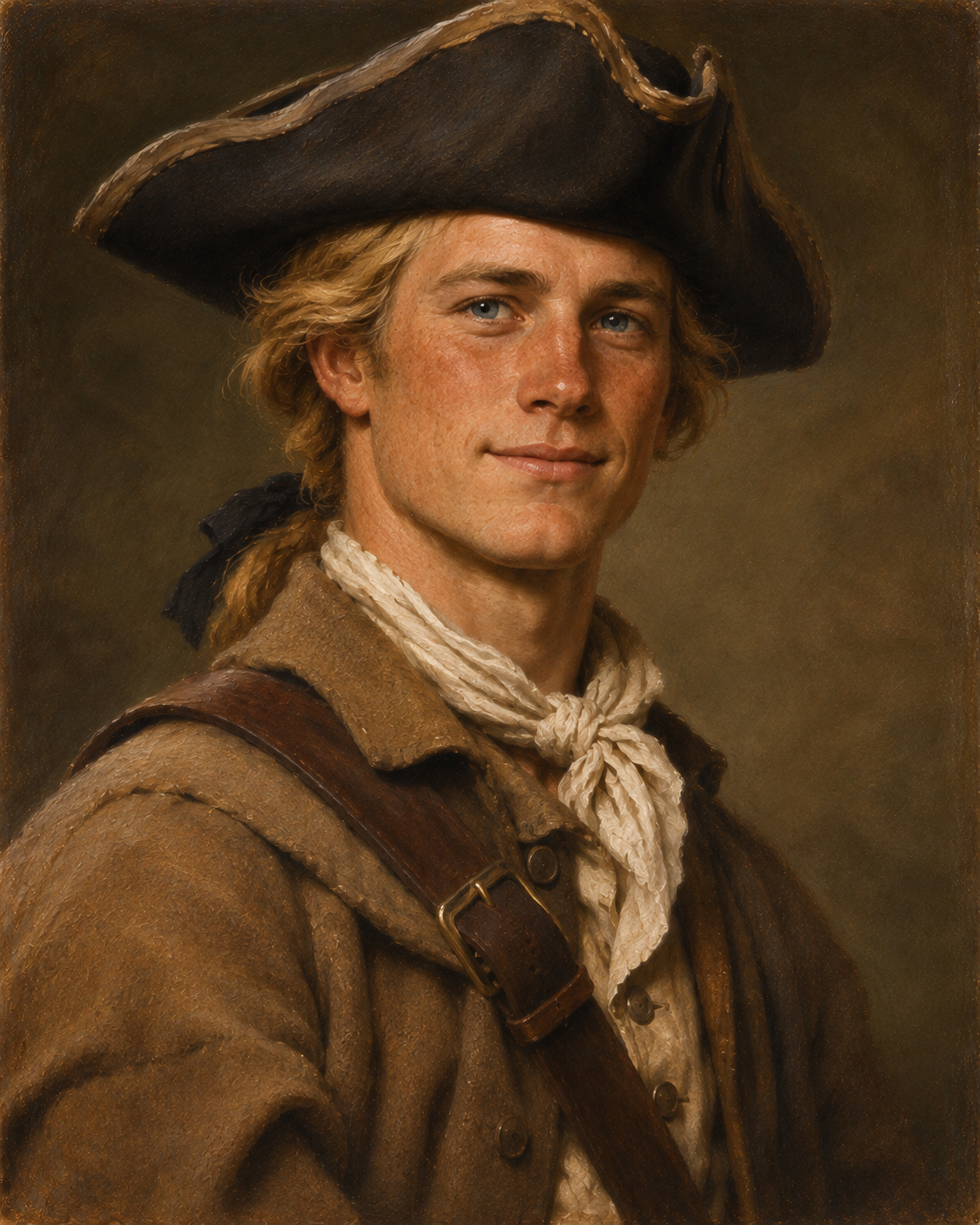
Portrait: The portrait accompanying this biography is a modern artistic interpretation of Abner Poland Jr. It is not an authenticated contemporary likeness.
Genealogical Research Note
The Poland family presents an unusual identification challenge because father and son shared the name Abner Poland and both lived during the American Revolution.
Separating their military records, marriage histories, children, and burial memorials is essential to avoiding mistaken family relationships.
The elder Abner’s Find a Grave memorial and the published transcription of his 1804 will provide important starting points for reconstructing the family.
Further research should prioritize the original probate file, church baptismal registers, Massachusetts vital records, New Hampshire cemetery records, and the younger Abner’s complete Revolutionary War pension file.