

In This Article
His Story
A Massachusetts Beginning
Asa Briggs was born on June 22, 1755, in Bristol County, Massachusetts, during the final decades of British colonial rule in America. His birthplace is identified in his Revolutionary War pension records as a place written or later transcribed as “Barclay,” generally understood to refer to Berkley, Massachusetts. The birth date was preserved in federal pension records examined by the Veterans Administration in 1939.
Published genealogical research identifies Asa as the son of Silas Briggs and Esther Soper Briggs, members of a New England family whose descendants would eventually spread across the developing United States. This parentage comes from later family research rather than Asa’s surviving pension application. A 1939 federal response specifically noted that the pension papers did not name his parents.
According to published family history, Briggs was apprenticed to the carpenter’s trade in Providence, Rhode Island, in 1772. The young tradesman would have encountered a world of workshops, timber, waterfront commerce, and increasingly heated discussions about British authority. Within a few years, the conflict between Great Britain and the colonies would become a war.
On December 27, 1777, Asa Briggs married Elizabeth Paul, also recorded as Elizabeth Paull, at Dighton, Massachusetts, according to genealogical accounts. Their marriage took place while the Revolutionary War was still underway. Together they established a family whose later history would connect Massachusetts, Vermont, and Michigan.
Called Into the Revolution
Asa Briggs belonged to the generation of young New England men whose lives were redirected by the American Revolution. His pension records refer to military service associated with Rhode Island, Massachusetts, and Vermont, reflecting the complicated wartime experience of men who served through different enlistments and military organizations.
One of the most valuable surviving accounts of his service was provided by Daniel Martin, a fellow veteran who gave sworn testimony in 1832. Martin recalled entering the Revolutionary Army in May 1775 in Captain John Field’s company under Colonel Daniel Hitchcock of the Rhode Island Line. He described becoming acquainted with Asa Briggs and remembered Briggs serving as a sergeant in the same regiment.
Martin’s affidavit connects Briggs to the period when the American army was stationed around Boston. It also refers to later military activity involving Rhode Island and Vermont. The testimony is particularly useful because it came from a man who claimed personal knowledge of Briggs, although the events he described had occurred more than fifty years earlier.
Other pension-related materials describe several periods of Continental and militia service. A later federal summary lists enlistments and appointments extending across the Revolutionary years. The surviving handwritten records, however, do not permit every officer, regiment, and date to be identified with equal certainty.
The pension-file classification also includes a reference to Rhode Island sea service. A later cemetery memorial describes Briggs as a carpenter’s mate in Revolutionary naval service. That specific naval rating has not been independently established from an original naval record among the materials examined here, and no particular vessel has been securely identified.
For soldiers like Briggs, the Revolution was not necessarily one continuous enlistment. Service might involve a Continental regiment, a return to civilian life, and later calls to defend a community or frontier settlement. His surviving records reflect this broader and sometimes fragmented pattern of Revolutionary military duty.
A Life in Vermont
Following the Revolution, Asa Briggs became associated with Vermont, particularly the communities of Putney and Plymouth, the latter formerly known as Saltash. These towns were part of the expanding network of New England settlements during the decades after American independence.
Published genealogical accounts describe Briggs as a carpenter, landholder, and sawmill owner. They also associate him with civic responsibilities, including service as a justice of the peace, and with later militia officer appointments. These descriptions suggest a man whose practical skills and local standing were valued by his community, although individual offices and commissions require verification against town and militia records.
His pension proceedings provide firmer evidence of his residence and reputation. Sewall Fullam of Reading, Vermont, and Thomas Brown of Plymouth certified that they were well acquainted with Briggs and believed him to be a Revolutionary War veteran. Their sworn statement described him as seventy-seven years old and respected in the neighborhood where he lived.
The certificate, sworn on May 23, 1833, shows that Briggs’s neighbors were willing to testify on his behalf. More than half a century after the Revolution began, his service remained part of his public identity.
The Journey to Michigan
In the final years of his life, Briggs became associated with Schoolcraft in Kalamazoo County, Michigan Territory. A letter dated August 3, 1833, written at Schoolcraft by James Smith, requested that pension correspondence for Briggs be directed to Schoolcraft, Prairie Ronde, Michigan Territory. This provides contemporary evidence of his connection with the settlement.
A 1919 inquiry stated that Briggs had moved from Plymouth, Vermont, to Schoolcraft around 1832. A later family-history letter placed his arrival in Michigan in May 1831. The exact timing is therefore uncertain, but the surviving records consistently place his westward move in the early 1830s.
For a man born before the Revolution, the move was remarkable. Briggs had witnessed the transformation of British colonies into an independent republic, the growth of Vermont’s settlements, and the opening of Michigan Territory to increasing migration from the East.
He reached Michigan as an elderly veteran, carrying with him a lifetime of experiences that connected the frontier of the 1830s with the Revolutionary generation of the 1770s.
From His Account
Asa Briggs’s pension file preserves testimony about his Revolutionary War service, including statements from men who knew him. One of the most significant is the affidavit of Daniel Martin, made in 1832. This document is not Briggs’s own first-person account; it is a fellow veteran’s sworn recollection submitted in support of his pension claim.
Daniel Martin’s testimony, summarized: Martin stated that he entered the Revolutionary Army in May 1775, served in Captain John Field’s company under Colonel Daniel Hitchcock, and became acquainted with Asa Briggs. He remembered Briggs serving as a sergeant in the same regiment and recalled later military activity involving Rhode Island and Vermont.
Source: Daniel Martin affidavit, 1832, Revolutionary War pension application of Asa Briggs, S.29031, National Archives.
Martin’s recollections included the period around the siege of Boston and later wartime movements. His testimony helps explain why Briggs’s pension records refer to multiple locations and forms of military service rather than a single regiment or uninterrupted enlistment.
Additional support came from Sewall Fullam and Thomas Brown. On May 23, 1833, they swore that they were well acquainted with Briggs, believed him to be seventy-seven years old, and regarded him as a credible Revolutionary War veteran.
Their statement did not independently establish every enlistment or battle. Instead, it documented the standing of Briggs in his community and the willingness of neighbors to affirm his reputation under oath.
Military Service
The following summary draws from Asa Briggs’s pension application, supporting testimony, and later federal correspondence. Because several men named Asa Briggs appear in Revolutionary War-era records, individual assignments must be evaluated carefully.
| Period | Service or Event | Historical Evidence |
|---|---|---|
| May 1775 | Revolutionary service associated with the Rhode Island Line and the army around Boston. | Daniel Martin’s 1832 affidavit and later pension summaries. Martin remembered Briggs as a sergeant in the regiment in which Martin served. |
| 1775–1776 | Additional Continental and regional military service. | Periods appear in the federal pension summaries; individual dates and assignments require comparison with original military rolls. |
| 1776–1778 | Service associated with Massachusetts and Vermont, including additional periods of duty. | Later pension-office summaries list multiple periods and ranks, although some handwritten entries remain difficult to read. |
| Revolutionary War | Rhode Island sea service. | Referenced in pension-file classification; no specific vessel or naval rating has been independently confirmed. |
| 1779 | Possible Vermont militia service connected with northern-frontier defense. | A 1939 research inquiry cites payroll entries under Captains Thomas Sawyer and Jesse Burke. Identity verification remains necessary. |
| Postwar | Later militia officer appointments, including lieutenant and captain. | Reported in published family histories; original commissions have not been established from the pension pages reviewed. |
Identification caution: A different Revolutionary War veteran named Asa Briggs was born in 1752, the son of Ebenezer Briggs and Abigail Bryant. His records include Vermont communities and military events that can easily be confused with those of Asa Briggs, born in 1755. This biography does not automatically assign the other man’s service to the subject of pension file S.29031.
Asa Briggs’s federal pension application is numbered S.29031 and is preserved by the National Archives under Identifier 54047902.
Pension Records & Historical Testimony
The Pension Law of 1832
On June 7, 1832, Congress passed legislation expanding pensions for surviving Revolutionary War veterans. Applicants were required to establish their military service through declarations, supporting testimony, and other available evidence.
The printed regulations preserved in Briggs’s pension file describe the kinds of information pension officials sought: birthplace, residence at enlistment, length and manner of service, commanding officers, military units, and witnesses who could attest to the applicant’s character and service.
These regulations explain the process Briggs faced, but they do not themselves establish his individual military history. That evidence comes from the specific documents in his pension file.
The 1832 Application and 1833 Proceedings
Later federal correspondence identifies August 1832 as the period in which Briggs pursued his pension application. Supporting proceedings continued into 1833 and included sworn certificates before Vermont officials.
One certificate, dated May 23, 1833, contains the testimony of Sewall Fullam and Thomas Brown. The two men affirmed their acquaintance with Briggs, their belief that he was seventy-seven years old, and their confidence in his reputation as a Revolutionary soldier.
The court proceedings include the name of Judge Jabez Proctor and certification by Reuben Washburn, register of the probate court for the District of Windsor, Vermont. These official endorsements helped establish the legal validity of the supporting testimony.
On August 3, 1833, James Smith wrote from Schoolcraft, Michigan Territory, enclosing a certificate and requesting that Briggs’s pension correspondence be sent to him there. This document provides a direct link between the Vermont pension proceedings and Briggs’s later Michigan residence.
The Pension Award
Later pension-related correspondence reports that Asa Briggs was entered on the pension roll in 1833, with his pension calculated from March 4, 1831. A 1939 research letter gives his annual allowance as approximately $66.66.
These details come from later summaries and inquiries within the pension file. They are useful for understanding the claim, but they should be distinguished from direct examination of the original pension payment ledger.
By the time Briggs’s pension was being processed, more than half a century had passed since the Revolution began. His claim became both a request for financial recognition and a record of the military service remembered by him and his contemporaries.
The 1919 and 1939 Investigations
Long after Briggs’s death, descendants and researchers continued to seek information about his life. On February 26, 1919, C. B. Cumings wrote to the Commissioner of Pensions asking about Asa Briggs of Plymouth, Vermont, who had later moved to Schoolcraft, Michigan. Cumings reported that Briggs had died about 1834.
In January 1939, Mrs. Fred Rogers of Jackson, Michigan, requested information about Briggs’s parentage and Revolutionary War service. Her inquiry included references to Vermont military payrolls, town history, and family traditions.
Some of the Vermont records she cited involve Sherburne, later Killington, and may concern the other Revolutionary War veteran named Asa Briggs. These records are therefore treated as research leads rather than confirmed events in the life of the Asa Briggs born in 1755.
On February 6, 1939, the Veterans Administration replied that pension file S.29031 identified Asa Briggs as born June 22, 1755, in Bristol County, Massachusetts, but did not name his parents. This response provides important independent support for the birth date while showing the limits of the pension file as a genealogical source.
Later Life & Burial
The Final Years in Michigan
Asa Briggs spent his final years in Kalamazoo County, Michigan Territory. His pension correspondence connects him with Schoolcraft by 1833, and later inquiries place his move from Vermont in the early 1830s.
The exact year of his death remains uncertain. A 1919 pension inquiry and a 1939 family-history letter indicate approximately 1834, while his Find a Grave memorial records 1835. Until a contemporary death record or securely dated gravestone inscription resolves the discrepancy, the most careful conclusion is that he died circa 1834–1835.
The Story of His Last Horseback Journey
One of the most memorable documents associated with Asa Briggs is a later historical inquiry describing a family tradition about the circumstances of his death.
According to the account, Briggs rode away on horseback, reportedly intending to collect his pension, but did not return when expected. His horse came home without him. Family members then searched for Briggs and eventually found him several hours later.
The writer wondered whether Briggs had received the pension payment he was supposedly traveling to collect. The correspondence preserves the family’s recollection of the event, but it does not provide a contemporary eyewitness account or establish the exact circumstances of his death.
The story is therefore best understood as family tradition preserved in later correspondence. It offers a human glimpse into the memory of an elderly veteran without providing enough evidence to reconstruct his final hours as historical fact.
Gourdneck Prairie Cemetery
Asa Briggs is memorialized at Gourdneck Prairie Cemetery in Vicksburg, Kalamazoo County, Michigan. His Find a Grave memorial identifies his burial in Lot 63 and gives his death year as 1835.
A later historical inquiry in the pension file also refers to the Gourdneck Prairie burial ground and describes efforts to locate or mark his grave. Together, these sources support a longstanding association with the cemetery, although an original cemetery register or documented gravestone inscription would provide stronger confirmation of the precise burial location and death date.
The cemetery memorial describes Briggs as a carpenter’s mate in Revolutionary naval service. Because no original naval document confirming that specific rating has been established here, the description is attributed to the memorial rather than presented as a proven military assignment.
View Asa Briggs’s Find a Grave memorial.
Family
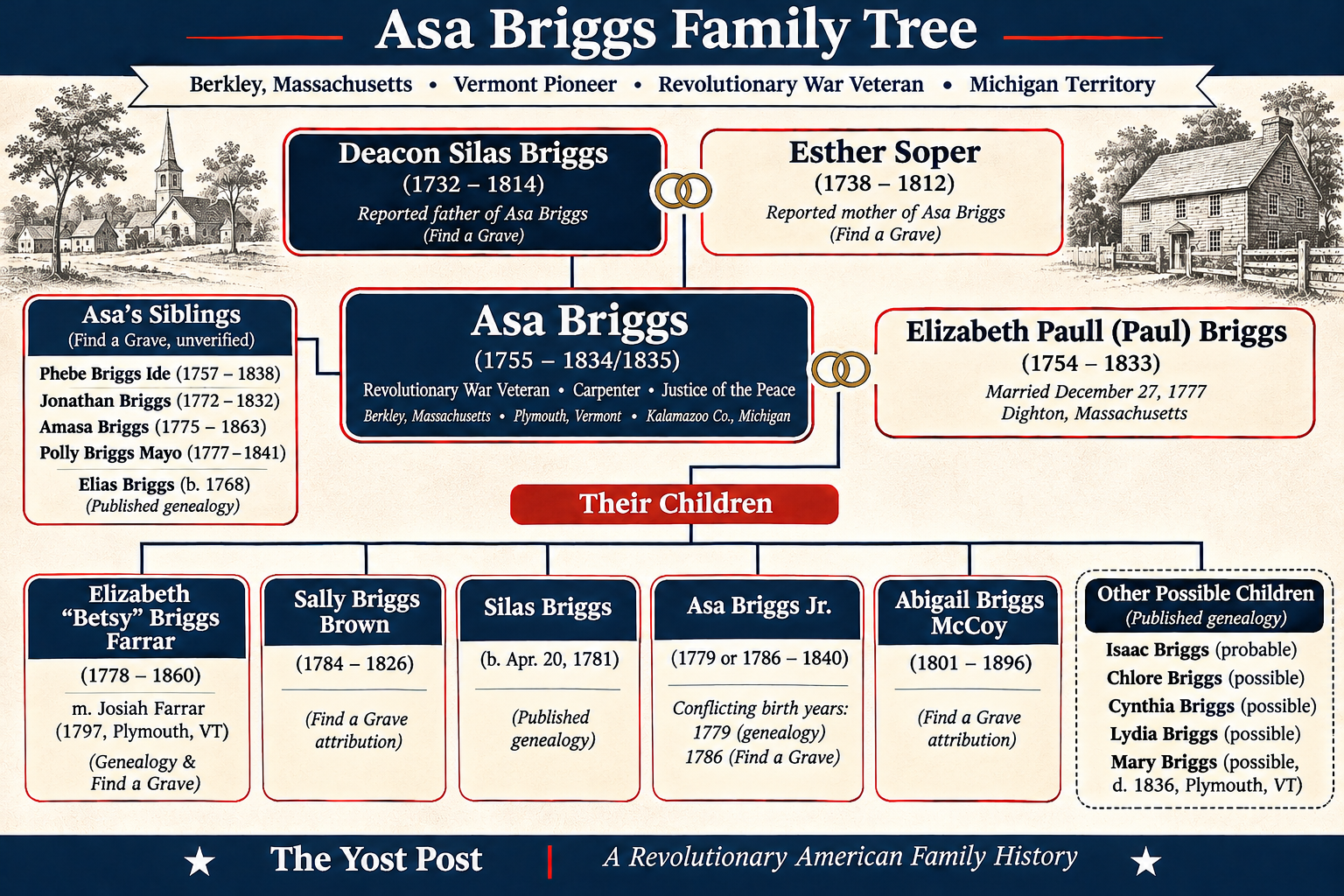
The family of Asa Briggs is reconstructed from published genealogical histories, cemetery memorials, and later research correspondence. His pension file supplies valuable biographical evidence but does not contain a complete list of his parents, siblings, or children.
Some relationships are well established in published family research, while others remain uncertain because of conflicting dates, incomplete records, or the existence of another Revolutionary War veteran named Asa Briggs.
Parents
Silas Briggs (1732–1814). Published genealogical research identifies Silas Briggs, sometimes styled Deacon Silas Briggs, as Asa’s father. This relationship is reported in family histories and cemetery records rather than in Asa’s surviving pension application.
Esther Soper Briggs (1738–1812). Esther Soper is identified in genealogical research as Asa’s mother and the wife of Silas Briggs. The middle name “Soper,” sometimes attached to Asa in modern family databases, has not been established as part of his name in the pension documents examined.
Wife
Elizabeth Paul (Paull) Briggs (1754–1833). Genealogical accounts identify Elizabeth as Asa’s wife and report their marriage on December 27, 1777, at Dighton, Massachusetts. Both Paul and Paull appear as surname spellings in family research.
Children
Elizabeth “Betsey” Briggs Farrar (1778–1860). Identified in published genealogical research as a daughter of Asa and Elizabeth Briggs, born September 14, 1778. She married Josiah Farrar. She is also included among the family connections on Asa’s cemetery memorial.
Asa Briggs Jr. (birth date disputed; died 1840). Family research identifies a son named Asa Briggs Jr., but the reported birth dates conflict. One genealogical account gives October 28, 1779, while the Find a Grave family connection gives 1786. These entries require further examination of original records.
Silas Briggs (born April 20, 1781). Listed as a son in published Briggs genealogical research. His relationship and birth date are attributed to that source.
Sally Briggs Brown (1784–1826). Identified as a daughter in the family connections attached to Asa Briggs’s Find a Grave memorial. Independent confirmation remains desirable.
Abigail Briggs McCoy (1801–1896). Also identified as a daughter in the cemetery memorial’s family connections. Her parentage and dates should be checked against original genealogical records.
Other possible children. Genealogical compilations also associate Isaac Briggs, Chlore Briggs, Cynthia Briggs, Lydia Briggs, and Mary Briggs with the family. Reported spouses include Lucy French for Isaac, Elijah Willis for Chlore, Jonathan Pinney for Cynthia, and Lewis Carlile for Lydia. Mary is reported to have died in 1836 at approximately twenty-four years of age. These relationships remain provisional pending stronger documentary confirmation.
Excluded pending verification: A later inquiry mentions Luther Briggs, born in Sherburne, Vermont, in 1790. Because the Sherburne records may concern a different Asa Briggs, Luther is not treated here as a confirmed son.
Siblings
Phebe Briggs Ide (1757–1838). Identified as a sibling in cemetery memorial family connections.
Elias Briggs (born 1768). Listed among the children of Silas and Esther Briggs in published genealogical research.
Jonathan Briggs (1772–1832). Named as a sibling in cemetery-based family connections and related genealogical material.
Amasa Briggs (1775–1863). Identified as a brother in genealogical and memorial records.
Polly Briggs Mayo (1777–1841). Listed among the family connections on Asa Briggs’s Find a Grave memorial. The relationship remains subject to independent verification.
The Calvin Coolidge Family Connection
Asa Briggs’s cemetery memorial describes him as a third great-grandfather of President Calvin Coolidge. This is an interesting reported genealogical connection, but the memorial alone does not document the full line of descent. The relationship should remain qualified until the intervening generations have been verified.
Asa Briggs Family Tree
The following family-tree infographic illustrates the reported family connections of Revolutionary War veteran Asa Briggs. It should be read alongside the genealogical notes above, particularly where published sources disagree about birth dates or family relationships.
Original Sources & Historical Research Notes
- Revolutionary War Pension Application of Asa Briggs, S.29031. National Archives, Revolutionary War Pension and Bounty-Land Warrant Application Files, National Archives Identifier 54047902. View archival catalog record.
- Daniel Martin affidavit, 1832. Sworn testimony describing Martin’s recollections of Asa Briggs’s Revolutionary War service. Preserved in pension file S.29031. View original manuscript image.
- Pension file cover and administrative endorsements. Identifies Asa Briggs and pension claim S.29031. View original file image.
- Pension calculation and administrative records. Supporting federal pension material within S.29031. View original document image.
- C. B. Cumings to Commissioner of Pensions, February 26, 1919. Inquiry reporting Asa Briggs’s move to Michigan and approximate death in 1834. View original letter.
- Veterans Administration to Mrs. Fred Rogers, February 6, 1939. Federal response confirming Briggs’s birth information and noting that his parents were not named in the pension papers. View original letter.
- Edna Anne Hannibal and Claude W. Barlow, Clement Briggs of Plymouth Colony and His Descendants, 1621–1965 (1966), especially pages 163–165. View digitized genealogy.
- Crossman Genealogy, compiled family-history material referencing the Briggs family. View genealogical compilation.
- Find a Grave, “Asa Briggs,” Memorial ID 10708278, Gourdneck Prairie Cemetery, Kalamazoo County, Michigan. View cemetery memorial.
Historical Research Note
The principal archival source for this biography is Asa Briggs’s Revolutionary War pension file, S.29031, preserved by the National Archives. Its supporting affidavits, court certificates, administrative papers, and later correspondence provide evidence of his Revolutionary War service, Vermont residence, pension claim, and final association with Michigan Territory.
The documents vary in evidentiary strength. Sworn testimony from 1832–1833 was recorded during Briggs’s lifetime or shortly thereafter, while the letters from 1919 and 1939 preserve later research and family traditions. These later accounts are valuable historical sources but cannot automatically confirm every event or relationship they describe.
The story of Briggs’s last horseback journey is presented as family tradition, not as a documented eyewitness account. His death year remains uncertain between approximately 1834 and 1835. His association with Gourdneck Prairie Cemetery is supported by memorial and family-history sources, but an original burial register or securely dated grave inscription would strengthen the identification.
Special caution is necessary because Revolutionary War records contain another man named Asa Briggs, born in 1752. Records from Sherburne and Killington, Vermont, and certain military payroll entries cannot be attributed to the Asa Briggs born in 1755 without further verification.
The portrait accompanying this biography is an AI-generated artistic interpretation intended to evoke the period. It is not an authenticated likeness of Asa Briggs and should not be treated as documentary evidence of his appearance, uniform, or rank.
Genealogical Research Note
The identification of Silas Briggs and Esther Soper as Asa’s parents, his marriage to Elizabeth Paul or Paull, and the list of his children are drawn primarily from published genealogical research and cemetery-family connections. The federal pension office stated in 1939 that his parents were not named in the pension application.
Several genealogical questions remain unresolved, including conflicting birth dates for Asa Briggs Jr., additional children associated with the family, the possible connection with Luther Briggs of Sherburne, and the reported descent of President Calvin Coolidge. These claims should be evaluated against original birth, marriage, probate, land, and town records before being treated as conclusively established.
The accompanying family-tree infographic is a visual summary of genealogical research, not an independent primary source. Where its relationships or dates conflict with documentary evidence, the underlying records should take precedence.
The Yost Post presents this biography to preserve the life of a Revolutionary War veteran while distinguishing documented history, genealogical interpretation, and family tradition. Uncertainty in the surviving record is acknowledged rather than replaced with unsupported detail.