
In This Article
His Story
John Sullivan was a lawyer, Revolutionary War major general, member of the Continental Congress, governor of New Hampshire, and one of the first federal judges appointed under the United States Constitution.
His career began in the small communities of colonial New England and eventually carried him into some of the most important events of the American Revolution. He served under George Washington, was captured by the British at Long Island, participated in the campaigns around Trenton and Princeton, commanded American forces in Rhode Island, and led a major military expedition into western New York in 1779.
After leaving the army, Sullivan returned to public service. He helped guide New Hampshire through the years following independence, presided over the state’s convention to ratify the Constitution, and received a federal judicial appointment from President Washington.
His life is documented through government records, military correspondence, early biographies, family histories, and the pension applications of soldiers who served under his command. Those pension accounts preserve details of Sullivan’s military leadership from the perspectives of men who participated in his campaigns.
Irish Family Roots and Early Life
John Sullivan was born in Somersworth, New Hampshire, generally recorded as February 17, 1740. He was the son of John Owen O’Sullivan, an Irish-born schoolmaster, and Margery Brown.
His father had emigrated from Ireland to colonial New England in the early eighteenth century. Family histories associate the elder Sullivan with the O’Sullivan families of County Kerry and the broader O’Sullivan Beare lineage, although the precise connections to earlier generations require examination of the surviving Irish genealogical evidence.
The elder John Sullivan established himself as a teacher in the region around Berwick, Maine, and Somersworth, New Hampshire. His profession gave the family an important connection to education in communities where formal schooling was often limited.
Young John received much of his early instruction from his father. He later studied law under Samuel Livermore of Portsmouth, New Hampshire, beginning around 1758.
Law offered Sullivan an opportunity to establish a profession in the growing communities of northern New England. After completing his studies, he began practicing in the Berwick area and subsequently moved his legal career to Durham, New Hampshire.
Durham would remain the center of his family life and public career for more than three decades.
Marriage, Family and a Growing Legal Career
In 1760, Sullivan married Lydia Remick Worster, a member of a family associated with Kittery and Berwick in what is now Maine.
The couple established a household during a period of expanding settlement and commercial activity in the Piscataqua River region. Sullivan’s legal practice brought him into disputes involving property, debts, and local business affairs.
His professional methods were not universally welcomed. Contemporary accounts describe disagreements between Sullivan and some of his neighbors over debt collection and legal proceedings. Complaints against him reached the New Hampshire legislature, and Sullivan defended his conduct.
Despite these disputes, he became a successful and increasingly prominent lawyer.
In 1763, Sullivan moved to Durham. During the following years he acquired property and established the home that would remain associated with his family.
John and Lydia had six children. Four survived infancy, while two daughters, both named Margery, died young.
The Road to Revolution
Before the Revolution, Sullivan maintained a relationship with New Hampshire’s royal governor, John Wentworth. In 1772, Wentworth appointed him a major in the provincial militia.
As tensions increased between Great Britain and the American colonies, Sullivan became active in opposition to British imperial policies.
In 1774, New Hampshire selected him as a delegate to the First Continental Congress in Philadelphia. There he participated in the developing effort by colonial representatives to coordinate their response to Parliament and the Crown.
That December, Sullivan and other New Hampshire Patriots took part in the seizure of military supplies at Fort William and Mary near Portsmouth.
The action occurred months before the fighting at Lexington and Concord and demonstrated how the political dispute was increasingly becoming an armed confrontation.
When the Second Continental Congress assembled in 1775, Sullivan again represented New Hampshire. His involvement in the provincial militia and revolutionary political movement soon brought him into Continental military service.
A General in the Continental Army
On June 22, 1775, Congress appointed Sullivan a brigadier general in the Continental Army.
He joined the American forces surrounding British-occupied Boston and commanded troops at Winter Hill, part of the military positions established outside the city.
Following the British evacuation of Boston in March 1776, Sullivan was ordered north to reinforce the American army retreating from Canada.
In June 1776, he assumed temporary command of the Northern Army after the death of General John Thomas. His command was subsequently transferred to Horatio Gates.
Sullivan’s military responsibilities changed repeatedly as the Continental Army responded to British operations in different theaters of the war.
In August 1776, he was promoted to major general and sent to participate in the defense of New York.
The Battle of Long Island and British Captivity
On August 27, 1776, British forces attacked American positions on Long Island in one of the largest engagements of the Revolutionary War.
Sullivan commanded American troops during the battle. British movements around the American positions contributed to the defeat of the Continental forces, and Sullivan was captured.
His captivity interrupted his command at a critical moment in the defense of New York.
The British subsequently released Sullivan, and he was exchanged for British General Richard Prescott.
He returned to the Continental Army and resumed service under Washington during the difficult campaign that followed the loss of New York City.
The Long Island campaign remained one of the major events of Sullivan’s military career. Later pension applications by Revolutionary War veterans preserve additional recollections of the battle and the movements of American troops associated with his command.
Trenton, Princeton and the Campaigns of 1777
During the winter of 1776–1777, Sullivan served with Washington’s army in New Jersey.
He participated in the operations surrounding Washington’s crossing of the Delaware River and the American attack on Trenton on December 26, 1776.
The victory at Trenton was followed by further operations in New Jersey, including the Battle of Princeton in January 1777.
During 1777, Sullivan continued serving as a major general. His command responsibilities included operations in New Jersey and participation in the Philadelphia campaign.
In August, he directed an expedition against British positions on Staten Island. Later that year he served in the campaigns associated with the battles of Brandywine and Germantown.
Sullivan spent the winter of 1777–1778 with Washington’s army at Valley Forge.
By the following spring, he would receive a major independent command in Rhode Island.
The Rhode Island Campaign of 1778
In 1778, Sullivan was assigned command of American forces operating against the British occupation of Newport, Rhode Island.
The campaign was undertaken during the first year of the formal alliance between the United States and France. French naval cooperation created an opportunity for American forces to attempt the recovery of Newport.
Sullivan assembled Continental troops and militia for operations on Aquidneck Island. French naval forces under the Comte d’Estaing initially cooperated with the American effort, but changes in naval circumstances and storm damage disrupted the planned joint attack.
The British retained their position at Newport, and Sullivan ultimately withdrew his army from the island.
On August 29, 1778, American and British forces fought the Battle of Rhode Island. Sullivan’s army resisted British attacks before completing its withdrawal.
The campaign is particularly well represented in The Yost Post’s Revolutionary War pension transcriptions.
Several veterans remembered serving in Sullivan’s command, including men assigned to his personal guard. Their testimony describes military movements, combat, wounds, and the circumstances of their service.
Sullivan’s Life Guard
One of the most revealing surviving accounts comes from Daniel Bowen, a Revolutionary War veteran who later became the proprietor of Boston’s Columbian Museum.
Bowen reported that in 1778 he joined a rifle company commanded by Aaron Mann and organized to serve as General Sullivan’s personal guard.
Bowen stated that he served for nine months and performed the duties of an orderly sergeant for much of that period.
His account describes skirmishes with British troops during the Rhode Island campaign and recalls wounded American soldiers being carried away from the fighting.
More importantly, Bowen’s pension file includes sworn statements from two officers who served in the guard.
Primary Source: Captain Aaron Mann, September 24, 1818
Captain Mann testified that his company had been raised in June 1778 by order of Major General John Sullivan to serve as his bodyguard while Sullivan was stationed at Providence, Rhode Island.
Mann confirmed that Daniel Bowen served nine months and was honorably discharged.
Source: Daniel Bowen, Revolutionary War Pension File W.25261, National Archives Identifier 54019128.

Ensign John Westcott provided a separate sworn statement confirming the same service.
The pension papers also preserve a copy of Sullivan’s September 12, 1778, military orders commending members of his guard and recording promotions.
These documents establish that Sullivan maintained a specially organized guard during the Rhode Island campaign and that the service of its members remained important to their pension claims decades later.
The Sullivan Expedition of 1779
In 1779, George Washington selected Sullivan to command a major expedition into the frontier regions of Pennsylvania and western New York.
The expedition followed a period of destructive frontier warfare involving British-allied Loyalist and Native American forces and American frontier settlements.
Raids in the Wyoming Valley of Pennsylvania and Cherry Valley in New York during 1778 had resulted in deaths, captivity, destruction of property, and the abandonment of settlements.
Washington planned an offensive intended to disrupt the military capabilities and supply resources of Native American nations allied with the British.
On May 31, 1779, Washington issued detailed instructions to Sullivan. The orders directed the army to destroy settlements and agricultural supplies belonging to the hostile nations of the Haudenosaunee, or Six Nations, and to take prisoners when possible.
The instructions also required the establishment of military posts and the protection of supply routes during the advance.
Original Military Orders: George Washington to John Sullivan, May 31, 1779
Washington instructed Sullivan to conduct an expedition against the British-allied nations of the Six Nations Confederacy, targeting their settlements and supplies.
The letter identifies the Continental formations assigned to the operation, including the brigades of James Clinton, William Maxwell, Enoch Poor, and Edward Hand.
Primary source: George Washington Papers, Library of Congress.
Sullivan assembled an army of approximately 4,000 to 4,500 Continental troops and supporting forces. His main column advanced from Pennsylvania, while Brigadier General James Clinton led another force southward from the Mohawk Valley.
The columns joined near Tioga, at the meeting of the Susquehanna and Chemung rivers.
Supply shortages and the difficulty of moving troops, artillery, wagons, and provisions through the region delayed the campaign.
Once assembled, Sullivan’s army moved north and west into the territory of the Six Nations.
The Battle of Newtown
On August 29, 1779, Sullivan’s troops encountered a combined force of Loyalists, British troops, and Native American warriors near Newtown, close to present-day Elmira, New York.
The opposing force had prepared defensive positions along a ridge overlooking the American line of advance.
American reconnaissance identified the position. Sullivan directed artillery and infantry against the front while other troops maneuvered against the defenders’ flank.
The American army gained control of the battlefield, and the opposing force withdrew.
Newtown was the largest organized battle of the expedition.
The Advance Through the Six Nations’ Country
After Newtown, Sullivan continued westward through the Finger Lakes region.
The army entered and destroyed numerous settlements, including communities associated with the Seneca and Cayuga nations. Houses, stored provisions, cornfields, orchards, and other agricultural resources were burned or otherwise destroyed.
Many residents had departed before the American troops arrived. Some moved toward British-held Fort Niagara, where displaced families sought food and shelter.
By September, Sullivan’s troops had reached the Genesee River region. At Chenussio, a large Seneca settlement, the army destroyed houses and extensive cultivated fields.
Contemporary military accounts describe the destruction of more than forty settlements over the course of the campaign, although figures vary among historical records.
The expedition inflicted substantial damage on the agricultural resources and settlements of the affected nations. It did not permanently end frontier warfare; British-allied forces continued raids during the remaining years of the Revolution.
Following the campaign, Sullivan returned east. Poor health contributed to his decision to resign his Continental Army commission later in 1779.
Governor, Statesman and Federal Judge
Sullivan’s retirement from military command did not end his public career.
He returned to the Continental Congress in 1780 and 1781, participating in national affairs during the closing years of the Revolutionary War.
From 1782 to 1786, Sullivan served as attorney general of New Hampshire.
He also served in the state legislature and was elected speaker of the New Hampshire House of Representatives.
In 1786, Sullivan became president of New Hampshire, the title then used for the state’s chief executive. He continued in office during the following year and returned for another term in 1789.
His administration dealt with questions of public finance, state security, and economic development during the difficult years following independence.
In 1788, Sullivan presided over the New Hampshire convention that considered ratification of the proposed United States Constitution.
New Hampshire ratified the Constitution on June 21, 1788, becoming the ninth state to approve it. Under Article VII, ratification by nine states was sufficient to establish the new Constitution among the ratifying states.
In September 1789, President George Washington nominated Sullivan as judge of the United States District Court for the District of New Hampshire.
The Senate confirmed the nomination on September 26, 1789, and Sullivan received his commission that day.
His appointment placed him among the first generation of federal judges serving under the new Constitution.
Later Life, Death and Burial
John Sullivan continued serving as a federal district judge during the early years of the American republic.
His final years were affected by declining health, but he remained in judicial office until his death.
Sullivan died at Durham, New Hampshire, on January 23, 1795, aged fifty-four.
He was buried in the Sullivan family cemetery in Durham, overlooking the Oyster River.
His wife, Lydia, survived him and lived into the nineteenth century.
By the time of his death, Sullivan had served in colonial government, the Continental Congress, the Continental Army, the government of New Hampshire, and the federal judiciary.
His surviving papers and the testimony of soldiers under his command provide an unusually extensive record of a man whose career spanned the transition from British colonial government to the constitutional United States.
Military Service
John Sullivan served as a Continental Army general from 1775 until his resignation in 1779. His assignments included the siege of Boston, the Northern Army, the defense of New York, the New Jersey and Philadelphia campaigns, Rhode Island, and the 1779 expedition into western New York.
| Conflict | American Revolutionary War |
| Allegiance | United States / Continental Army |
| Earlier service | Major, New Hampshire militia, appointed 1772 |
| Brigadier general | Appointed June 22, 1775 |
| Major general | Promoted August 1776 |
| Continental service | 1775–1779 |
| Commander in chief | George Washington |
| Major commands | Continental brigades and divisions; Rhode Island forces; 1779 expeditionary army |
| 1775–1776 | Siege of Boston; Northern Army; Battle of Long Island |
| 1776–1777 | New Jersey campaign; Trenton; Princeton; Staten Island; Brandywine; Germantown |
| 1777–1778 | Winter encampment at Valley Forge |
| 1778 | Rhode Island campaign and Battle of Rhode Island |
| 1779 | Sullivan Expedition; Battle of Newtown |
| Captured | August 27, 1776, Battle of Long Island |
| Military retirement | Resigned in 1779 because of declining health |
| Archival collection | John Sullivan Papers, 1769–1792, New Hampshire Historical Society |
Soldiers’ Pension Records and Firsthand Accounts
John Sullivan did not leave the kind of federal Revolutionary War pension application commonly associated with enlisted veterans. His career is instead documented through military correspondence, public records, and the recollections of men who served under his command.
The Yost Post’s Revolutionary War transcription collection contains numerous references to Sullivan. Some describe direct service in his units, while others refer to battles, campaigns, or supply operations under his command.
These accounts were often recorded decades after the Revolution. They are valuable testimony, but their dates and details should be compared with contemporary military records.
Daniel Bowen: Sullivan’s Personal Guard
Daniel Bowen stated that he enlisted in Providence, Rhode Island, in 1778 and served in Captain Aaron Mann’s rifle company, organized as Sullivan’s Life Guard.
His testimony describes nine months of service and participation in skirmishes during the Rhode Island campaign.
Bowen’s pension file contains corroborating affidavits from Captain Mann and Ensign John Westcott, both of whom identified the company as Sullivan’s bodyguard.
Archive: National Archives, pension file W.25261, identifier 54019128.
Read Daniel Bowen’s original pension record
Charles Scott: Wounded in Sullivan’s Guard
Charles Scott reported that he served in Rhode Island during 1778 and was detached to Sullivan’s Life Guard.
His pension declaration states that he received a musket-ball wound in his hip during August 1778.
Scott further reported that the ball remained in his body many years later.
This account provides an individual soldier’s description of a lasting injury associated with service in Sullivan’s command.
Primary Source: Charles Scott’s Recollection
Scott’s pension transcription records his assignment to Sullivan’s guard in August 1778 and his statement that a musket ball remained in his hip.
Archive: National Archives Identifier 53827716, transcription image 53827716_0457.jpg.
John Handy: An Officer at Rhode Island
John Handy’s pension materials identify him as serving in a staff capacity during the Rhode Island campaign.
His account places him at the Battle of Rhode Island on August 29, 1778, and associates his service with Sullivan’s command.
Such testimony offers a perspective different from that of enlisted soldiers, reflecting the work of officers responsible for military organization and communication.
Archive: National Archives Identifier 54783967.
View John Handy’s pension file
Veterans of the 1779 Expedition
Other pension transcriptions describe service in Sullivan’s 1779 campaign.
One record refers to the Battle of Newtown and additional operations in the expedition. Another describes the transportation of supplies toward Wyoming, Pennsylvania, in preparation for Sullivan’s army.
The latter testimony illustrates an important aspect of the campaign: the expedition depended on men transporting provisions and military stores, as well as the soldiers who advanced into western New York.
National Archives Identifier 54028069 — 1779 campaign references
National Archives Identifier 54052820 — supply transportation account
How These Accounts Are Used
The statements above are drawn from Revolutionary War pension transcriptions associated with individual veterans. They are not statements made by John Sullivan himself.
The descriptions are paraphrases unless expressly identified as direct quotations. Each veteran’s complete pension file should be consulted when establishing precise dates, units, and individual participation.
Family
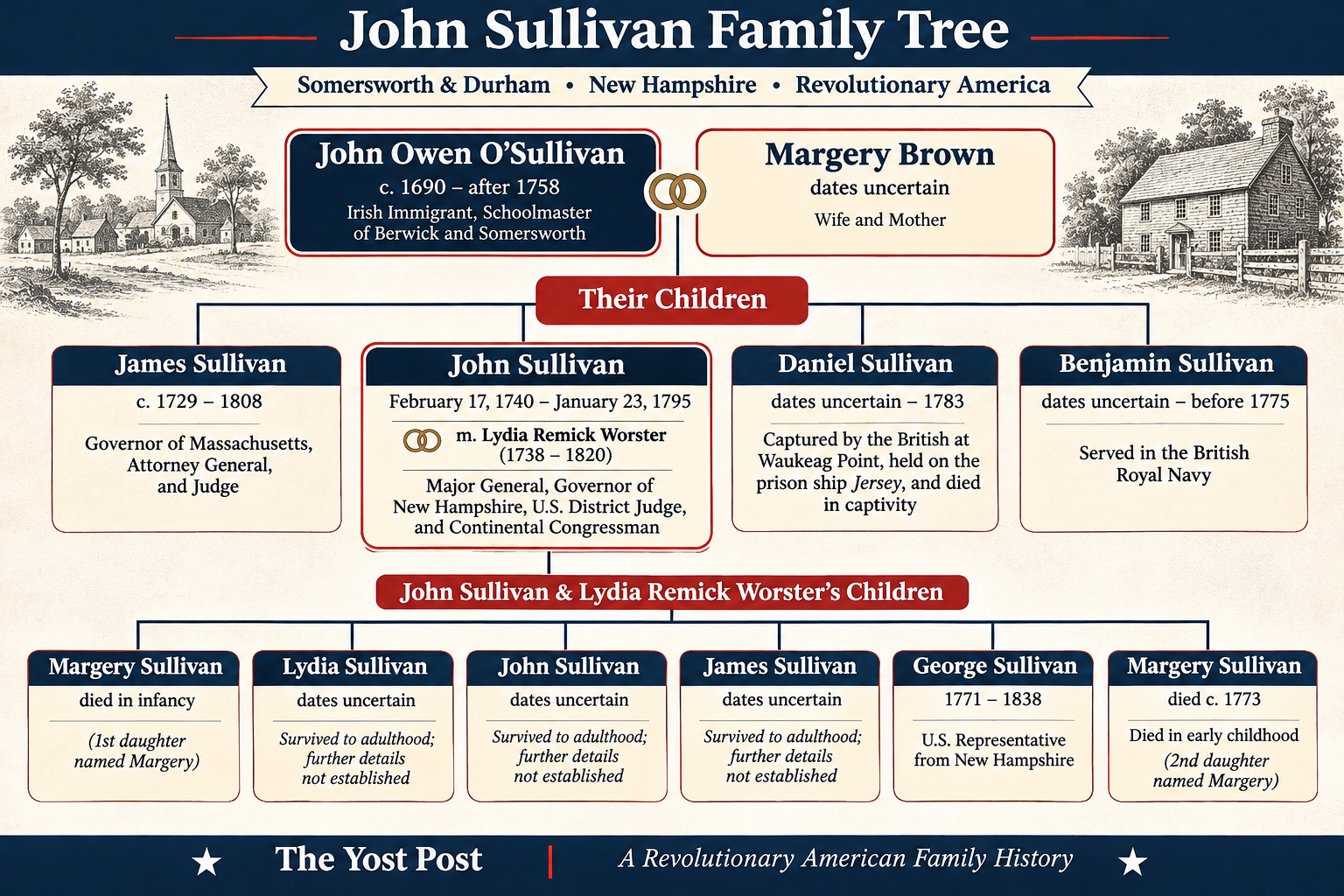
John Sullivan belonged to an Irish-American family whose members became involved in the military, legal, and political affairs of New England.
His father was an immigrant schoolmaster, his brother James became a prominent Massachusetts statesman, and his son George later served in the United States Congress.
Genealogical accounts also preserve the names of Sullivan’s wife and six children, including two daughters who died in early childhood.
Parents
John Owen O’Sullivan — Father
John Owen O’Sullivan (also known as John Sullivan; born about 1690). John Sullivan’s father emigrated from Ireland to colonial New England during the early eighteenth century, with family accounts generally placing his arrival around 1723.
He became a schoolmaster in the Berwick and Somersworth region and provided his children with their early education.
Genealogical histories associate him with the O’Sullivan families of southwestern Ireland. Some accounts trace his ancestry to the O’Sullivan Beare family, although individual links in the older pedigree should be treated as attributed genealogy pending verification.
His teaching career helped establish the family’s place in northern New England society during the colonial period.
Margery Brown Sullivan — Mother
Margery Brown was the wife of John Owen Sullivan and the mother of General John Sullivan.
Biographical accounts identify her as part of the family’s first generation established in New England.
She raised her family in the region around Berwick and Somersworth during a period when the communities along the Piscataqua River were connected through trade, farming, churches, and local schools.
Published accounts differ in the amount of detail they provide about her birth and death. Those dates require confirmation before being treated as established facts.
Spouse
Lydia Remick Worster Sullivan (1738–1820)
Lydia Remick Worster was born into a family associated with Kittery and Berwick in present-day Maine.
Family genealogies identify her as the daughter of John Worster and Lydia Remick. The Worster surname also appears in historical records as Worcester.
She married John Sullivan in 1760. The marriage preceded his move to Durham and his emergence as a prominent lawyer and political leader.
Lydia and John had six children, four of whom survived infancy.
During her husband’s military service, the family maintained its connections to Durham. The surviving biographical sources provide much more information about John’s public career than Lydia’s personal activities, and they do not establish her presence at his military campaigns.
Lydia survived her husband by approximately twenty-five years and died in 1820, according to published family genealogies.
Her lifetime extended from the colonial period through the Revolution and into the early decades of the United States.
Children
Biographical accounts identify six children of John and Lydia Sullivan. Four reached adulthood. Two daughters were named Margery, with the name apparently reused after the death of the first child.
Margery Sullivan — Daughter; Died in Infancy
The first daughter named Margery died during early childhood.
Her name appears in accounts of the six children of John and Lydia Sullivan. The practice of giving a later child the name of a deceased sibling was not unusual in eighteenth-century families.
Her precise birth and death dates should be established from family records before publication as exact dates.
Lydia Sullivan — Daughter
Lydia was one of the four children of John and Lydia Sullivan who survived infancy.
She grew up in the Durham household during the period of her father’s military and political career.
Her later marriage, descendants, and death date require additional verification against the family history and local records. No unsupported spouse or children are assigned to her here.
John Sullivan — Son
John was one of the surviving sons of General John Sullivan and Lydia Remick Worster.
He belonged to the generation that reached adulthood as New Hampshire moved from colonial government into statehood under the United States Constitution.
Published summaries of his father’s career identify him among the surviving children, but his individual life requires further research to establish his occupations, marriages, and descendants securely.
James Sullivan — Son
James was another surviving son of John and Lydia Sullivan.
He should not be confused with his uncle James Sullivan, the general’s younger brother, who became governor of Massachusetts.
The repeated use of the name James within the family makes it especially important to distinguish these two men in genealogical records.
Additional family documentation is needed to establish the younger James Sullivan’s complete adult history.
George Sullivan (1771–1838) — Son
George Sullivan followed his father into law and public service.
He became a lawyer and political figure in New Hampshire and served as a member of the United States House of Representatives.
His congressional service continued the family’s involvement in national government after his father’s death.
George belonged to a generation that inherited the political institutions established during the Revolution and participated in their development during the early nineteenth century.
U.S. House historical biographical directory
Margery Sullivan — Daughter; Died in Early Childhood
A second daughter named Margery was born after the death of the first child of that name.
Published biographical accounts state that she died at approximately two years of age.
Her short life is preserved primarily through family and genealogical records rather than public documents.
Siblings
John Sullivan came from a family that included several brothers whose lives followed markedly different paths during the eighteenth century.
Accounts identify James, Daniel, and Benjamin Sullivan among his brothers. The available sources differ in how completely they describe the wider sibling group.
James Sullivan (1744–1808) — Brother
James Sullivan became a lawyer, judge, and political leader in Massachusetts.
Like his older brother John, he participated in the political changes surrounding American independence.
James served in important legal and government positions, including attorney general of Massachusetts, before becoming governor of the commonwealth in 1807.
He remained governor until his death in 1808.
The brothers’ careers provide an example of how members of the same colonial family entered public service in different states during the Revolutionary and early national periods.
Daniel Sullivan — Brother
Daniel Sullivan was associated with the coastal region of eastern Maine.
Historical accounts describe his capture by a British landing party at Waukeag Point in February 1781.
He was reportedly held aboard the British prison ship Jersey and died in captivity in 1783.
The town of Sullivan, Maine, is associated with his family and the settlement history of the region.
Daniel’s experiences illustrate how the Revolutionary War affected coastal settlements and families far from the main Continental Army campaigns.
Benjamin Sullivan — Brother
Family accounts identify Benjamin Sullivan as a brother who served in the British Royal Navy.
He reportedly died before the outbreak of the American Revolution.
His reported service demonstrates the family’s connections to the wider British Atlantic world before independence.
His exact dates, naval assignments, and circumstances of death require additional confirmation from contemporary records.
Family Research Note
The names of John Sullivan’s parents, wife, and six children are supported by published biographies and family histories. Individual birth and death dates, marriages, and descendants are not equally well established for every relative.
Older genealogies may contain additional relatives and ancestral claims. Those connections should be reviewed against the original family history before expanding the tree.
Sources and Historical Research Notes
Historical and Archival Sources
- Federal Judicial Center — John Sullivan. Official federal judicial biography, including birth, death, public offices, judicial appointment, and bibliography. View biography.
- Biographical Directory of the United States Congress — John Sullivan. Congressional service and career chronology. View biography.
- United States House of Representatives — John Sullivan. Historical account of congressional service, military career, governorship, and judgeship. View biography.
- National Governors Association — John Sullivan. Service as president (governor) of New Hampshire. View biography.
- National Museum of the United States Army — John Sullivan. Military biography and Revolutionary War campaigns. View biography.
- New Hampshire Historical Society — John Sullivan Papers, 1769–1792. Archival correspondence and military and political records. View finding aid.
- George Washington to John Sullivan, May 31, 1779. Contemporary military instructions for the 1779 expedition. Read Library of Congress document.
- National Park Service — The Clinton-Sullivan Campaign of 1779. Campaign chronology and military operations. Read campaign history.
- National Archives — Daniel Bowen Pension File W.25261. Sullivan’s Life Guard, Captain Aaron Mann’s affidavit, Ensign John Westcott’s affidavit, and Sullivan’s 1778 orders. View pension file.
- National Archives — Charles Scott Pension File. Account of service in Sullivan’s Life Guard and a wound received in 1778. View pension file.
- National Archives — John Handy Pension File. Testimony concerning the Rhode Island campaign. View pension file.
- National Archives — Additional Sullivan Expedition Pension References. Pension file 54028069 and pension file 54052820.
- Meredith, Burke, and Amory, Materials for a History of the Family of John Sullivan of Berwick, New England, and of the O’Sullivans of Ardea, Ireland (1893). Published family history and attributed Irish ancestry; individual claims require verification. View digitized history.
- State Builders: An Illustrated Historical and Biographical Record of the State of New Hampshire (1903). Historical biographical reference. View publication.
- WikiTree — John Sullivan. Collaborative genealogical reference, to be compared with original records. View profile.
- Find a Grave — John Sullivan. Cemetery memorial reference. View memorial.
- The Society of the Cincinnati. Research organization associated with Revolutionary War officers. Visit organization.
- American Revolution Institute. Research and educational resources concerning the American Revolution. Visit institute.
Historical Research Note
Nature of the sources: John Sullivan’s career is documented principally through military correspondence, government records, published biographies, and accounts of soldiers who served under his command. No personal Revolutionary War pension application by Sullivan is presented in this biography.
Birth-date discrepancy: February 17, 1740, is used by the Federal Judicial Center and other major biographical references. A New Hampshire Historical Society finding aid gives February 14, while another federal court history gives February 18. The date should be checked against original family or vital records.
Military testimony: The pension accounts of Daniel Bowen, Charles Scott, John Handy, and other veterans were recorded years after the events described. They are identified as later recollections and should not be confused with Sullivan’s own contemporary military reports.
The 1779 expedition: The campaign is described using Washington’s contemporary instructions, military chronology, and recorded actions. The destruction of settlements, crops, and supplies, as well as the displacement of residents, are historical events documented in the campaign record. No present-day interpretation is presented as a firsthand judgment by a participant.
Family history: The family relationships summarized here derive from published genealogical and biographical accounts. Some individual relatives’ dates and adult histories remain insufficiently verified. The older Irish pedigree should be treated as attributed family history until supported by original records.
Burial: Sullivan’s burial in the family cemetery at Durham is reported in official congressional and gubernatorial biographies, independently of the online cemetery memorial.
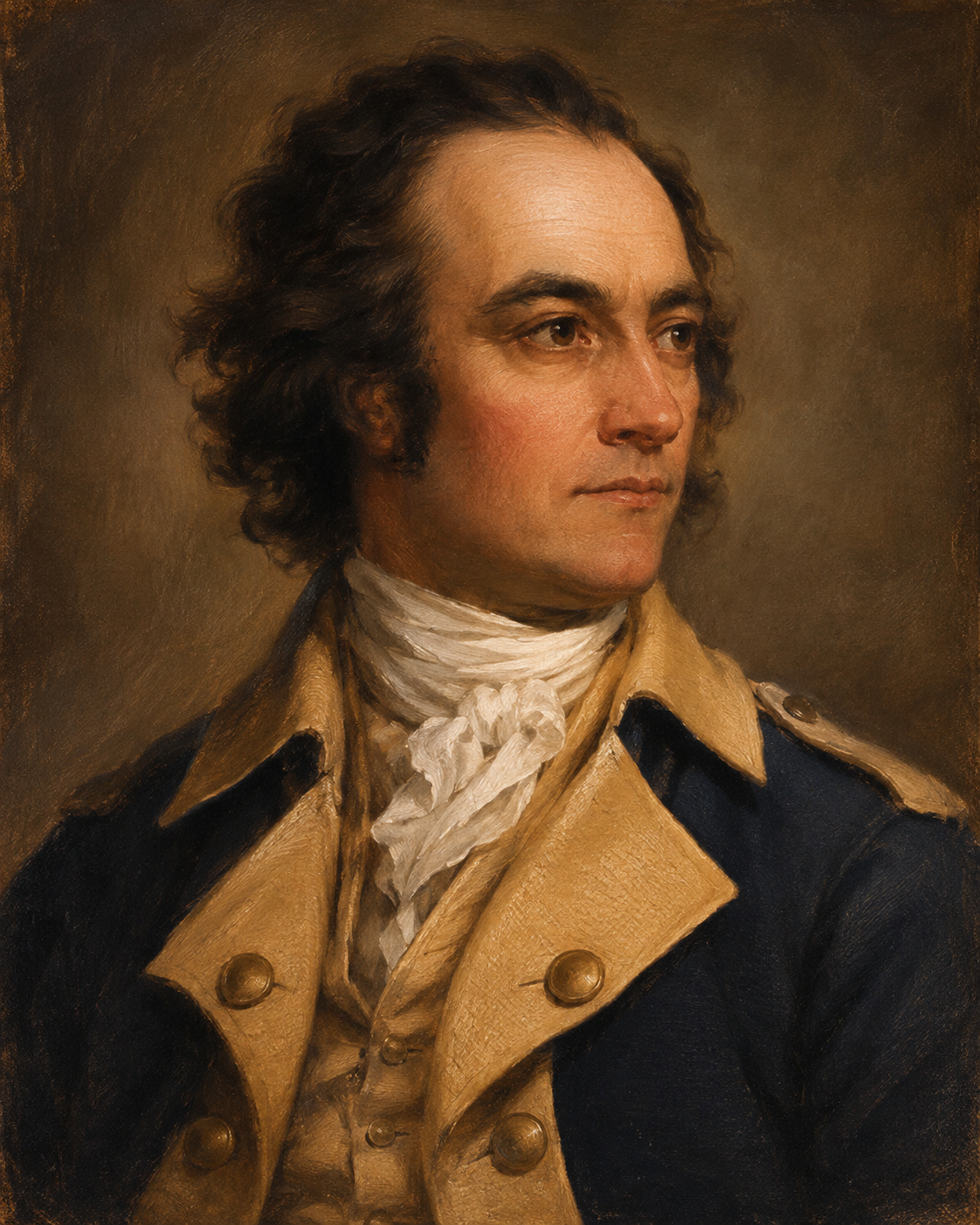
Portrait disclosure: The portrait displayed in the infobox is an AI-generated artistic interpretation. It is not presented as an authenticated historical likeness of John Sullivan.
Genealogical Research Note
This family history has been compiled from various genealogical records, family trees, historical publications, cemetery records, and ancestral research. The information reflects what has been recorded or attributed to these individuals by previous researchers and may contain inaccuracies, conflicting dates, or unverified family connections.
The Yost Post presents this information as a historical and genealogical resource rather than a definitive account of family relationships. Readers are encouraged to consult original records and conduct additional research when tracing their own ancestry.