
In This Article
His Story
In August 1832, seventy-two-year-old Daniel Bowen appeared before a Pennsylvania court to recount military service performed more than half a century earlier. He remembered marching toward British troops in Rhode Island, serving aboard American armed vessels, suffering a wound to his mouth, and being taken prisoner at sea.
But the most remarkable part of Bowen’s story may be what happened after the Revolution. He became the proprietor of Boston’s Columbian Museum, assembled a collection of natural and artificial curiosities for public exhibition, and suffered devastating financial losses when fires destroyed his property.
His surviving pension application is more than a record of enlistment. It preserves the recollections of a Revolutionary War veteran whose life crossed the worlds of military service, maritime warfare, public entertainment, commerce, and financial hardship.
Early Life in Massachusetts
Daniel Bowen stated in his 1832 pension application that he was born in Rehoboth, Massachusetts, in 1760. In a letter written that same year, he gave his birthday as April 8.
He remembered that his birth had been recorded in a family Bible. The Bible had last been in his mother’s possession, but she had died many years earlier, and Bowen did not know where the record had gone.
That detail illustrates a recurring problem in early American genealogy. Family Bibles could preserve valuable information about births, marriages, and deaths, but records sometimes disappeared as households changed and generations passed.
By the time the Revolutionary War reached Rhode Island, Bowen was living in Providence. He later stated that he voluntarily enlisted rather than being drafted or serving as another man’s substitute.
General Sullivan’s Life Guard
In 1778, Bowen enlisted in a volunteer rifle company organized to serve as a guard for Major General John Sullivan, who commanded American forces in Rhode Island.
The company was associated with Aaron Mann, whose name appears repeatedly in Bowen’s pension papers. Bowen described serving for nine months and stated that he held the appointment of orderly sergeant for much of that period.
The distinction between his rank and appointment is important. Pension records identify him as a private, while Bowen described performing the duties of an orderly sergeant. Both statements belong in his military history rather than treating one as an error without further evidence.
In September 1778, General Sullivan issued orders praising the conduct of his guard and announcing promotions for Aaron Mann, Levi Hoppin, George Potter, and John Westcott. A copy of those orders survives among the documents submitted with Bowen’s pension claim.
Fighting in Rhode Island
Bowen’s recollections place him in the fighting associated with the Rhode Island campaign of 1778.
He remembered skirmishes with British troops between places transcribed as Butts’ and Toming Hills. The precise identification of the second location requires verification against the original handwriting and historical geography.
His testimony included an unusually vivid memory. As his company advanced toward the fighting, Bowen recalled encountering men carrying wounded soldiers away from the battlefield. According to his account, those wounded men encouraged the advancing Americans to continue.
Bowen stated that the guard did not arrive at the beginning of the action and that his company eventually encountered superior British numbers.
His description offers a rare personal perspective on the campaign. It does not establish his participation in every phase of the Battle of Rhode Island, but it directly places him in military activity that he associated with the fighting around Butts Hill.
War at Sea: The Argus and Washington
Bowen’s military experiences did not end with his service in Sullivan’s Guard.
In his 1832 pension testimony, he described entering naval service aboard the sloop Argus, an armed vessel carrying approximately ten or twelve guns. He identified Silas Talbot as its commander.
Bowen reported serving as a sergeant of marines. During an engagement with a British vessel, he recalled that an American sailor was mortally wounded and that Bowen himself suffered a wound to his mouth.
He stated that the Americans won the engagement and brought their captured prize into port.
Bowen subsequently described serving aboard the Washington, a twenty-gun ship also commanded by Talbot. He recalled taking prizes before the vessel was captured by a British fleet.
In his account, the British ships included the hundred-gun London and the seventy-four-gun Culloden. Bowen reported that he and his fellow prisoners were eventually exchanged and returned to Newport aboard a cartel vessel.
He estimated that his naval service lasted between three and four months, although he could no longer remember the exact dates.
A Veteran Remembers Being Wounded
Bowen’s 1832 declaration reported a wound to his mouth during his service aboard the Argus. He stated that its mark was still visible decades later.
Source: Daniel Bowen, pension correspondence, August 7, 1832, Revolutionary War Pension File W.25261.
The Columbian Museum: Daniel Bowen’s Life After the Revolution
Daniel Bowen’s life after the American Revolution took a remarkable turn. The former soldier and naval veteran became the proprietor of the Columbian Museum in Boston, Massachusetts, an institution devoted to displaying collections of natural and artificial curiosities for public entertainment and education.
At a time when museums were still relatively uncommon in the United States, establishments such as Bowen’s introduced visitors to objects they might otherwise never encounter. Early American curiosity museums often combined natural specimens, manufactured objects, artistic displays, and unusual items intended to attract public interest.
Bowen’s pension file preserves a printed appeal describing his museum as containing a substantial collection of natural and artificial objects. Although the document does not provide a complete inventory of his exhibits, it establishes that the museum was an important commercial undertaking rather than merely a private collection.
The Columbian Museum belonged to an emerging world of public exhibitions in the early American republic. Such establishments offered visitors opportunities to encounter collections that reflected contemporary interests in natural history, science, craftsmanship, and curiosities from unfamiliar places.
For Bowen, the museum represented a dramatic change from military life. The young man who had served in General Sullivan’s guard and aboard American armed vessels was now engaged in the business of collecting, exhibiting, and entertaining the public.
A later letter preserved in his pension file also associates Bowen with newspaper publishing in Boston. The precise nature of that venture requires additional research, but the reference suggests that his postwar activities extended beyond the museum business.
Two Devastating Fires and the Loss of His Museum
Bowen’s efforts to establish himself in Boston were eventually overshadowed by a series of disasters.
A printed appeal dated February 22, 1808, preserved in his Revolutionary War pension file, describes two successive fires that destroyed property of considerable value. The destruction included his museum collections and buildings associated with the enterprise.
According to the appeal, Bowen’s second museum was housed in a building that had cost more than $10,000. The destruction of that property, combined with the expense of constructing another building, placed him under severe financial strain.
The amount represented a substantial investment in the early nineteenth century. It demonstrates the considerable resources Bowen had committed to his museum business and helps explain the seriousness of the losses he later described.
The appeal sought assistance from the public and carried endorsements from prominent religious and political figures in Massachusetts. Their support suggests that Bowen’s difficulties were known beyond his immediate household.
Additional endorsements appeared in 1813, indicating that his financial troubles had continued for years after the fires.
These events help explain the financial circumstances Bowen later described when applying for a Revolutionary War pension. His hardship was not simply the result of advancing age. His surviving documents reveal a man whose postwar business ventures had suffered repeated and costly disasters.
There is a striking contrast between the two major chapters of Bowen’s life. During the Revolution, he had faced enemy fire, suffered a wound, and endured captivity. In civilian life, he invested in a public museum only to experience destructive fires and the loss of property he had worked to establish.
By the time he sought federal assistance, Bowen’s story had become one of military service, commercial ambition, and prolonged financial difficulty.
Historical Document: The Columbian Museum Financial Appeal, February 22, 1808
A printed appeal preserved among Daniel Bowen’s pension papers describes the destruction of his museum property in two successive fires. It reports that a museum building had cost more than $10,000 and that the resulting losses left Bowen in difficult financial circumstances.
The appeal also contains endorsements supporting his request for public assistance. Additional endorsements from 1813 indicate that his financial difficulties continued for several years.
Primary Source: Daniel Bowen, Revolutionary War Pension File W.25261, National Archives Identifier 54019128.
View the original Columbian Museum financial appeal
Research note: The document establishes the museum’s existence, its general character, and Bowen’s reported losses. It does not provide a complete inventory of exhibits. The discussion of early American curiosity museums supplies historical context rather than identifying specific objects displayed by Bowen.

Military Service
| Conflict | American Revolutionary War |
| Allegiance | United States |
| Enlistment | 1778, Providence, Rhode Island |
| Company | General John Sullivan’s Life Guard |
| Commanding Officer | Captain Aaron Mann |
| Rank | Private; reported appointment as orderly sergeant |
| Army Service | Nine months, according to Bowen and supporting witnesses |
| Campaign | Rhode Island campaign, 1778 |
| Naval Service | Sloop Argus and ship Washington |
| Naval Commander | Silas Talbot, according to Bowen |
| Naval Position | Sergeant of marines aboard Argus; later service aboard Washington |
| Naval Service Duration | Approximately three to four months, according to his recollection |
| Wounded | Mouth wound reported during naval engagement |
| Captivity | Captured at sea; subsequently exchanged |
| Pension File | W.25261 |
| National Archives ID | 54019128 |
Pension Records & Testimony
Daniel Bowen’s pension application documents a prolonged struggle over whether his Revolutionary War service qualified for federal benefits.
The 1818 Application
On July 17, 1818, Bowen appeared before Judge Seth Chapman in Pennsylvania and declared that he had served nine months in a rifle company commanded by Aaron Mann under General Sullivan.
He described his financial difficulties and his need for government assistance.
His application was supported by sworn statements from Captain Aaron Mann and Ensign John Westcott, both of whom affirmed that Bowen had served in Sullivan’s Guard.
Bowen was initially placed on the pension rolls at eight dollars per month, effective September 24, 1818.
The Government Rejects His Service
In December 1819, the War Department removed Bowen from the pension rolls.
The reason was not simply that Bowen lacked witnesses. His commanding officer had provided testimony. Instead, the government questioned whether Sullivan’s bodyguard had been recognized by Congress as part of the Continental Army.
This distinction became central to Bowen’s later efforts. The dispute concerned the official classification of the military unit in which he had served.
The 1832 Declaration
On August 7, 1832, Bowen appeared before the Court of Common Pleas at Danville, Pennsylvania. He was then seventy-two years old and living in Berwick, Columbia County.
His declaration provided a much fuller account of his military career, including his service in Rhode Island, naval engagements, wound, capture, and exchange.
He also described his movements after the war and his family’s financial difficulties.
From His Account: Birth and Family Bible
“I was born in Rehoboth, in the State of Massachusetts, in the Year 1760.”
Bowen explained that a record of his age had existed in the family Bible, which he had last seen in his mother’s possession.
Source: Court interrogatories, August 1832, image 4154061_00354.jpg.
From His Account: A Personal Memory of Battle
Bowen remembered marching toward the British and encountering wounded Americans being carried from the fighting. His account described the men encouraging the advancing soldiers before his company met the enemy.
Source: Court interrogatories, August 1832, images 4154061_00354.jpg and 4154061_00355.jpg.
This passage is a summary rather than a complete verbatim transcription.
A Pension Finally Granted
Under the pension legislation of June 7, 1832, Bowen received a pension calculated at thirty dollars annually, effective March 4, 1831.
His pension certificate was issued on August 23, 1832.
Although this provided official recognition, Bowen continued to question the amount of his benefits. A letter written on his behalf in December 1850 stated that he believed he was entitled to a larger pension.
The pension file therefore preserves not one application, but a decades-long history of claims, correspondence, supporting testimony, and administrative decisions.
Later Life & Death
Daniel Bowen’s later years were marked by movement between several American cities and continued financial uncertainty.
In his 1832 statement, he reported having lived principally in Boston, New York, and Philadelphia before moving with his family to Berwick, Pennsylvania, in 1817.
By 1850, correspondence in his pension file placed him in Philadelphia, where an acquaintance wrote to federal officials about Bowen’s belief that his pension was insufficient.
Bowen died in Philadelphia on February 29, 1856, according to his widow’s subsequent pension and bounty-land applications.
He was approximately ninety-five years old, having lived from the colonial period through the Revolutionary War and into the decade preceding the American Civil War.
The examined pension transcriptions do not establish his burial location.
Family
Daniel Bowen’s pension file contains several important clues about his family, including his birthplace, his mother’s family Bible, his marriage, and the existence of two children in his household in 1832.
However, the records examined do not yet establish a complete family pedigree.
Parents
Father — Not Yet Identified
Bowen’s surviving pension declarations do not name his father. His statement that he was born in Rehoboth, Massachusetts, in 1760 provides a starting point for research in local vital records, church registers, and probate documents.
Mother — Name Not Yet Identified
Bowen remembered that his mother had possessed the family Bible containing a record of his birth. He stated that she had died many years before his 1832 application.
Her name and parentage have not been established from the pension transcriptions examined for this article.
Spouse(s)
Mary Ruggles Paine Bowen — Wife
Daniel Bowen married Mary Ruggles Paine in Boston, Massachusetts, on December 8, 1801.
The marriage was performed by the Reverend Joseph Eckley, according to the marriage information preserved in Mary’s later pension application and a certified Boston marriage-record transcription.
Mary survived Daniel and pursued federal benefits based on his Revolutionary War service.
Her 1856 application identified her as eighty-four years old and residing in Philadelphia.
She sought both a widow’s pension and bounty-land benefits. Her applications preserved details of their marriage that might otherwise have been lost from Daniel’s military biography.
A widow’s pension certificate was issued in October 1856, at thirty dollars annually, effective March 1, 1856.
Children
Two Children — Names Not Yet Established
In a letter to Secretary of War Lewis Cass dated August 7, 1832, Daniel Bowen described his household as consisting of a wife and two children.
He stated that neither he nor his family members were in good health and that the household lacked a reliable means of earning a comfortable living.
The names, birth dates, and later lives of these two children have not been established from the documents reviewed.
The statement confirms that two children were part of his reported family in 1832, but it does not necessarily establish the total number of children born to Daniel and Mary over the course of their marriage.
Siblings
No brothers or sisters of Daniel Bowen have been securely identified from the pension transcriptions reviewed for this biography.
Additional research in Rehoboth, Massachusetts, records may help identify his parents and possible siblings.
Sources & Historical Research Notes
Historical and Archival Sources
- Revolutionary War Pension File W.25261. Daniel Bowen and Mary R. Bowen. National Archives Identifier 54019128. View National Archives record.
- Daniel Bowen’s 1818 Pension Declaration. July 17, 1818. Describes nine months of service under Aaron Mann and General Sullivan. View original document.
- Captain Aaron Mann’s Affidavit. September 24, 1818. Confirms Bowen’s service in Sullivan’s Guard. View original document.
- Ensign John Westcott’s Affidavit. September 25, 1818. Corroborates Bowen’s service. View original document.
- Daniel Bowen’s 1832 Pension Declaration. August 7, 1832. Describes his military service and the dispute over his original pension. View original document.
- Daniel Bowen’s Court Interrogatories. August 1832. Birthplace, military recollections, residence history, and naval service. View original document.
- Daniel Bowen’s Letter to Lewis Cass. August 7, 1832. Discusses naval service, financial hardship, wife, and two children. View original document.
- Columbian Museum Financial Appeal. February 22, 1808, with later endorsements. Describes the museum fires and Bowen’s financial losses. View original document.
- Mary R. Bowen’s Widow’s Pension and Bounty-Land Applications. 1856. Documents the marriage, Daniel’s death, and Mary’s claims. View original document.
- Boston Marriage-Record Certification. Records the December 8, 1801, marriage of Daniel Bowen and Mary Ruggles Paine. View original document.


Historical Research Note
Primary source: This biography is based on transcriptions of Daniel Bowen’s Revolutionary War pension file, W.25261, contained in The Yost Post’s Revolutionary War transcription spreadsheet.
Military service: Bowen’s army service is supported by his own declarations and affidavits from Captain Aaron Mann and Ensign John Westcott. His naval experiences are principally described in his later recollections. Further independent verification of the naval engagements and vessels would strengthen the account.
Columbian Museum: A printed appeal dated February 22, 1808, describes the museum’s general character and the financial consequences of two fires. The surviving document does not establish a complete inventory of the museum’s exhibits. Descriptions of early American curiosity museums provide historical context, not a verified list of Bowen’s objects.
Pension dispute: The federal government’s 1819 decision concerned the official recognition of Sullivan’s Guard. Bowen subsequently received a pension under the legislation of 1832.
Family: His marriage to Mary Ruggles Paine is supported by a certified marriage-record transcription. His 1832 letter mentions two children, but their names have not been established here.
Death: The February 29, 1856, death date is supported by his widow’s pension materials. His burial place remains unconfirmed.
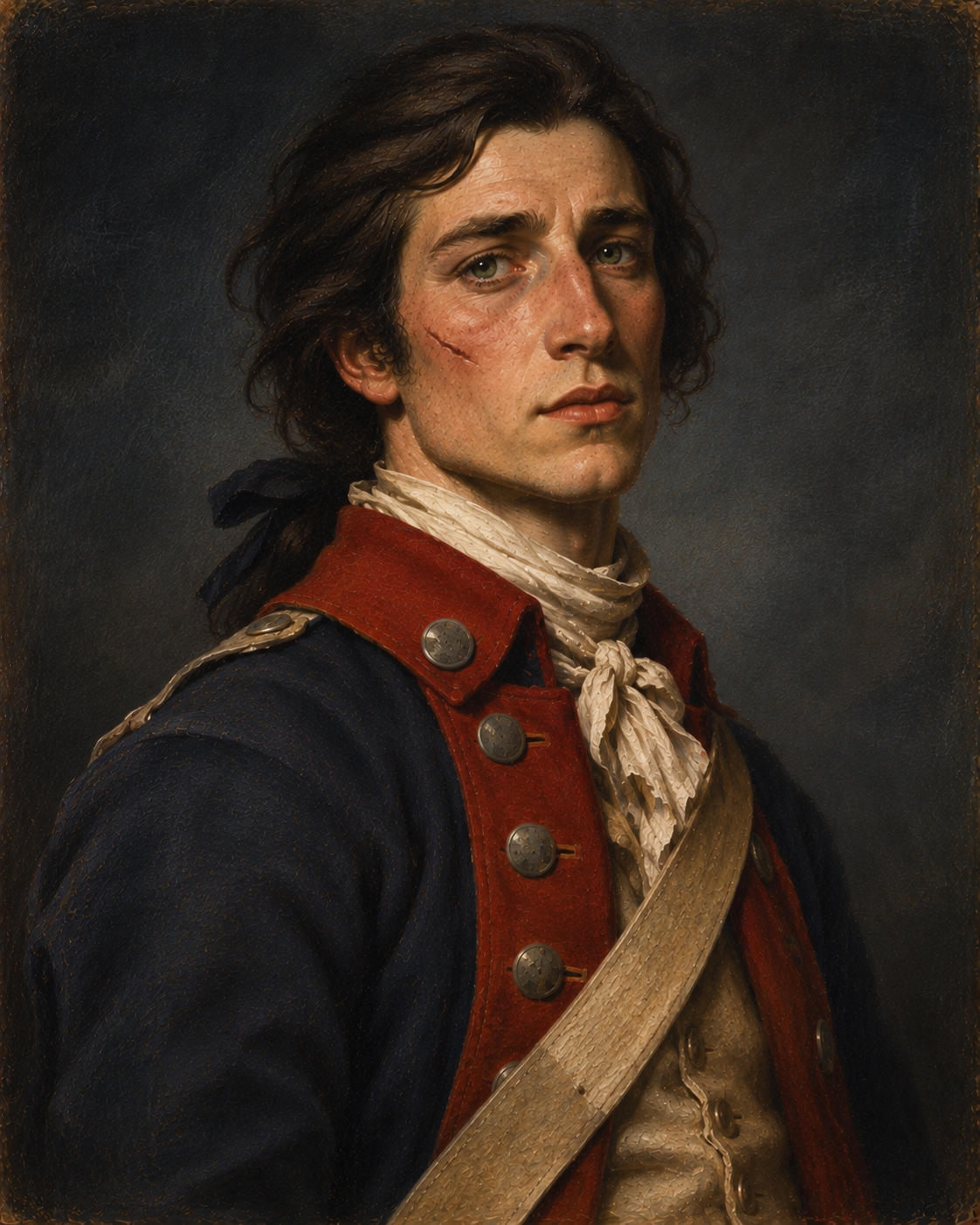
Portrait disclosure: The portrait accompanying this biography is an AI-generated artistic interpretation of Daniel Bowen in eighteenth-century military attire. It is not an authenticated historical likeness.
Genealogical Research Note
This biography presents information supported by the examined military pension transcriptions, together with clearly identified historical context. Family relationships, dates, and historical events should be checked against the original archival images and additional contemporary records.
The Yost Post distinguishes documented facts, personal recollections, later testimony, and unresolved genealogical questions. Readers are encouraged to consult the original records when researching their own family history.