
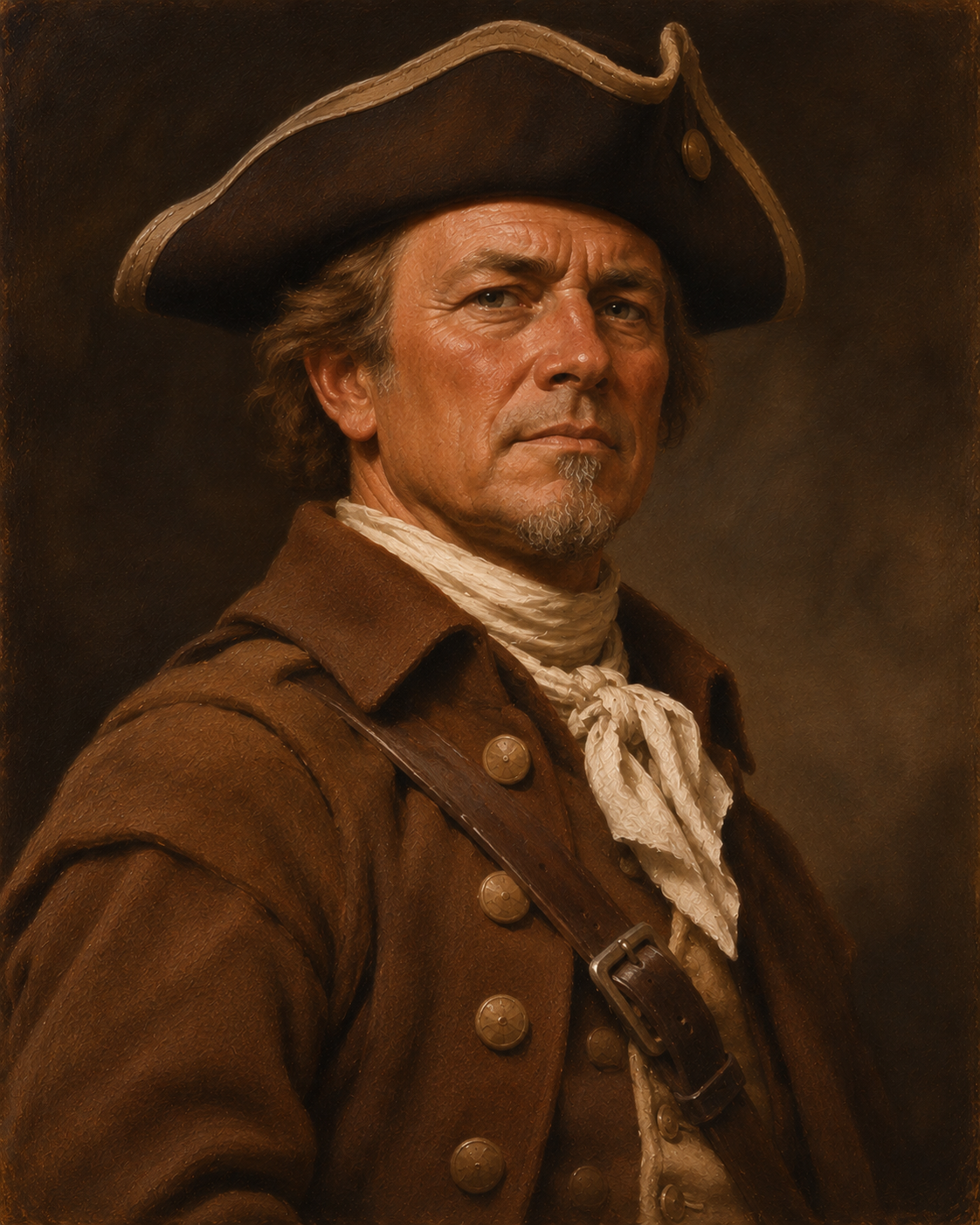
A Massachusetts artilleryman who served under Captain Edward Burbeck, fought to establish his Revolutionary War pension, and was associated with a family prominent in early American artillery history.
In This Article
His Story
On March 30, 1818, Joseph Burbeck appeared before a federal judge in Boston to seek a pension for his service during the American Revolution. More than four decades had passed since his first enlistment, and the records of his military service were no longer readily available.
Joseph stated that he had entered the Massachusetts artillery in May 1775, shortly after the opening battles of the Revolutionary War. He had served under Captain Edward Burbeck and Colonel Richard Gridley, reenlisted in 1776, and remained in military service until June 1777.
But there was a problem. His original discharge had been lost, and the pension authorities required additional proof that he had served.
Two former soldiers, Abraham Ingersoll and Joshua Hardy, eventually supplied the testimony Joseph needed. Both remembered him serving in Captain Burbeck’s artillery company during 1776, when the American artillery establishment was under the command of Henry Knox.
Their statements helped preserve the story of an ordinary Revolutionary War soldier whose experience might otherwise have disappeared from the historical record.
Joseph’s story also opens a window into one of Massachusetts’s notable military families. Genealogical accounts identify him as a son of Colonel William Burbeck, an artillery officer whose family included several men associated with the military history of the American Revolution.
The available records offer a compelling connection between Joseph’s military service and the wider Burbeck family, although some genealogical details remain unconfirmed.
Early Life & Family Background
Later genealogical accounts identify Joseph as Joseph Glover Burbeck, born November 21, 1756, in the Boston area of Massachusetts.
He is listed among the children of Colonel William Burbeck and William’s second wife, Jerusha Glover.
William Burbeck was born in Boston in 1716 and became associated with the colonial artillery establishment. His career connected the military traditions of British colonial Massachusetts with the revolutionary forces organized in 1775.
The family information preserved on William Burbeck’s Find a Grave memorial identifies two marriages. William’s first wife was Abigail Tuttle, whom he married in 1737. His second wife was Jerusha Glover, whom he married in 1748.
The same memorial lists Joseph among William’s children, alongside Edward, Henry, Thomas, and several other sons and daughters.
The genealogical information is consistent with a later military history that identifies Joseph among William Burbeck’s sons serving in Richard Gridley’s artillery regiment.
The military pension record establishes Joseph Burbeck’s service but does not identify his parents. The connection to Colonel William Burbeck is supported by secondary military history and genealogical accounts. The reported birth date and maternal relationship have not yet been verified through a contemporary birth or baptismal record.
The Burbeck Family and Massachusetts Artillery
Artillery service required specialized knowledge and organization. Unlike infantry soldiers, artillerymen were responsible for the operation, maintenance, and movement of cannon, ammunition, and related equipment.
The Burbeck family’s association with artillery extended across multiple members of the household. William Burbeck had an established military background, while Edward and Henry Burbeck became officers in the artillery service.
Joseph served as an enlisted man. His rank was private, and his pension records do not indicate that he received a commission.
The family connection is historically significant because Joseph’s commanding officer, Captain Edward Burbeck, was also identified in family genealogies as a son of Colonel William Burbeck.
Thus, the available evidence suggests that Joseph may have served in an artillery company commanded by his own brother. That relationship is supported by the family reconstruction, but Joseph’s pension declaration does not explicitly call Edward his brother.
Revolutionary War Service
Enlistment in May 1775
Joseph’s Revolutionary War service began during the first months of the conflict.
Following the battles of Lexington and Concord on April 19, 1775, Massachusetts militia forces gathered around Boston. The developing American army needed artillery units capable of supporting the siege of the British-held town.
Colonel Richard Gridley, an experienced artillery officer and military engineer, was selected to command the Massachusetts artillery regiment.
Joseph later stated that he enlisted in May 1775 as a private in Captain Edward Burbeck’s company under Colonel Gridley.
His first period of enlistment continued until January 1776, according to his 1818 declaration.
Although his regiment belonged to the military organization operating around Boston, the surviving pension file does not establish Joseph’s personal participation in the Battle of Bunker Hill or any other specific engagement.
Service Under Henry Knox
The American artillery organization changed as the Continental Army developed a more formal command structure.
Henry Knox became the leading artillery commander of the Continental Army, and the units associated with Gridley’s earlier Massachusetts regiment were reorganized.
Joseph stated that he reenlisted in January 1776 and continued serving in Captain Edward Burbeck’s company.
His fellow soldiers later confirmed that he served throughout 1776 in the company under Colonel Knox.
This testimony provides direct corroboration of Joseph’s wartime service during a critical year in the Revolution.
Discharge in 1777
Joseph reported that he received an honorable discharge on June 7, 1777.
Unfortunately, the discharge certificate was no longer available when he applied for his pension in 1818.
The exact discharge date therefore rests on his own sworn recollection. The supporting affidavits establish his service during 1776 but do not independently verify the June 1777 date.
His Revolutionary War Pension
In 1818, Congress established a pension program for qualifying Revolutionary War veterans who were in reduced financial circumstances.
Joseph Burbeck applied under this legislation on March 30, 1818, before Judge John Davis in Boston.
His application described his military service, named his officers, and explained that his discharge had been lost.
Joseph also stated that he needed assistance because of his financial circumstances.
Joseph identified himself as a resident of Boston and declared that he had served as a private beginning in May 1775.
He named Captain Edward Burbeck and Colonel Gridley, described reenlisting in January 1776, and stated that he was discharged June 7, 1777.
He explained that his discharge had been lost and that his financial condition made assistance necessary.
This is a summary of the declaration, not a verbatim transcription.
The Missing Military Record
The pension authorities initially required additional proof of Joseph’s military service because the records consulted did not establish his claim.
The missing discharge made his case dependent upon other surviving evidence.
On February 10, 1819, two former soldiers provided sworn testimony supporting Joseph’s account.
Abraham Ingersoll’s Testimony
Abraham Ingersoll stated that he had served as a private in Captain Edward Burbeck’s company during 1776.
He testified that he personally knew Joseph Burbeck to have served faithfully in the same company throughout that year.
This was important evidence because Ingersoll claimed direct knowledge of Joseph’s service, rather than relying on family tradition or later reputation.
Joshua Hardy’s Testimony
Joshua Hardy also identified himself as a private in Captain Edward Burbeck’s company.
He confirmed Joseph’s service during 1776 under Colonel Knox.
The statements were sworn before Stephen Hooper, a justice of the peace.
Together, the affidavits provided the corroboration needed to support Joseph’s pension claim.
Pension Approval
Joseph was placed on the Massachusetts pension roll at eight dollars per month.
His pension began March 30, 1818, and his certificate was issued March 27, 1819.
The pension record preserves not only his military service but also the challenges faced by veterans attempting to prove their eligibility decades after the Revolution.
From His Account
Joseph’s 1818 declaration is the central firsthand record of his military experience.
March 30, 1818: Joseph Burbeck submitted his declaration in Boston, identifying his officers, enlistment dates, and reported discharge.
February 10, 1819: Abraham Ingersoll and Joshua Hardy supplied supporting affidavits confirming Joseph’s service during 1776.
March 27, 1819: Joseph’s pension certificate was issued.
Original source: National Archives, Revolutionary War Pension File S.34,117, Catalog ID 54105145.
Military Service Record
| Conflict | American Revolutionary War |
|---|---|
| Allegiance | American |
| Rank | Private |
| Military Branch | Artillery |
| Initial Enlistment | May 1775, according to declaration |
| First Service Period | May 1775–January 1776, reported |
| Reenlistment | January 1776, reported |
| Discharge | June 7, 1777, according to Joseph’s declaration |
| Company Commander | Captain Edward Burbeck |
| Regimental Command | Colonel Richard Gridley; Colonel Henry Knox named in 1776 witness testimony |
| Specific Battles | Not individually established by the pension file |
| Pension Application | March 30, 1818 |
| Pension Certificate | March 27, 1819 |
| Monthly Pension | $8 |
| Pension Number | S.34,117 |
| National Archives ID | 54105145 |
Later Life & Death
Joseph’s life after the Revolutionary War is less clearly documented than his military service.
He was living in Boston when he submitted his pension application in 1818.
The application establishes that he was experiencing financial hardship, but it provides little detail about his occupation, property, or domestic circumstances.
The family information recorded on Colonel William Burbeck’s Find a Grave memorial identifies Joseph as having died March 26, 1820.
That date is consistent with the pensioner’s known chronology, but a separate death record has not yet been identified to establish that both records refer to the same individual.
Joseph’s individual burial location remains unverified. He should not be assigned to Copp’s Hill Burying Ground merely because his father is reported buried there.
Family & Descendants
The Burbeck family provides an unusually interesting context for Joseph’s Revolutionary War service.
Several men associated with the family served in Massachusetts artillery, including Colonel William Burbeck, Captain Edward Burbeck, and Henry Burbeck.
The family information recorded on William Burbeck’s memorial identifies Joseph as one of William’s children, born in 1756.
The memorial also names Elizabeth Saunders as Joseph’s wife, with a reported marriage date of March 14, 1784.
Colonel William Burbeck (1716–1785)
William Burbeck was born July 22, 1716, in Boston, Massachusetts, according to his memorial record.
He became associated with the Massachusetts artillery establishment and held the rank of colonel.
His military career placed him within the generation that preceded the American Revolution.
The memorial identifies two wives, Abigail Tuttle and Jerusha Glover, and lists a large family of sons and daughters.
William died July 22, 1785, and is buried at Copp’s Hill Burying Ground in Boston.
His gravestone, photographed on Find a Grave, identifies him as Colonel William Burbeck.
Jerusha Glover Burbeck (1722–1777)
Jerusha Glover is identified in the family memorial as William Burbeck’s second wife.
Their marriage is reported as October 7, 1748.
The genealogical reconstruction identifies Jerusha as Joseph’s mother, although the parent-child relationship has not yet been established through a contemporary birth record.
Jerusha is reported to have died in 1777, during the Revolutionary War.
Captain Edward Burbeck (1740–1783)
Edward Burbeck occupies an important place in Joseph’s biography because his name appears in Joseph’s original pension declaration.
Joseph identified Edward as the captain under whom he served during the Revolutionary War.
The family memorial identifies Edward as a son of Colonel William Burbeck, born January 14, 1740.
Edward is therefore identified as Joseph’s older half-brother in the reported family genealogy.
The memorial records Edward’s marriage to Jane Milk in 1776.
He is reported to have died May 23, 1783, the same year the Treaty of Paris formally ended the Revolutionary War.
The relationship between Joseph and Edward is supported by the family reconstruction, while their military association is independently documented in Joseph’s pension.
Henry Burbeck (1754–1848)
Henry Burbeck was another prominent member of the family’s military tradition.
Born in Boston in 1754, Henry entered the artillery service during the American Revolution.
Unlike Joseph, whose surviving records identify him as a private, Henry pursued a long military career.
He eventually attained the rank of brigadier general and served in the early United States Army.
Henry’s life is documented in the collections of the William L. Clements Library at the University of Michigan.
Thomas Burbeck (1758–1846)
Thomas Burbeck is listed among William Burbeck’s children on the family memorial.
His reported birth date is August 25, 1758, and his death date is May 8, 1846.
A later military history also identifies a Thomas Burbeck among the members of Gridley’s artillery regiment.
Further research is needed to establish the details of his individual service and confirm the connection to the family record.
Elizabeth Saunders — Attributed Wife
The genealogical information recorded on William Burbeck’s Find a Grave memorial identifies Elizabeth Saunders as the wife of Joseph Burbeck.
Their marriage is reported as March 14, 1784, approximately seven years after Joseph’s stated discharge from military service.
Joseph’s pension file does not identify a wife, and an original marriage record has not yet been independently confirmed.
Elizabeth’s parentage, life dates, and burial location remain subjects for additional research.
Children and Descendants
A separate online genealogical compilation attributes children to Joseph Glover Burbeck and Elizabeth Saunders.
However, the individual children’s identities and relationships have not been sufficiently corroborated to present a reliable descendant list.
No children are named as verified descendants in this article until the relevant birth, baptismal, probate, or family records can be examined.
Original Sources & References
-
National Archives —
Revolutionary War Pension File S.34,117.
Joseph Burbeck, Massachusetts. National Archives Catalog ID 54105145. Principal source for his military service, pension declaration, and supporting affidavits.
View Original Pension File -
Joseph Burbeck, Sworn Declaration,
March 30, 1818.
Identifies his officers, enlistment, reenlistment, reported discharge, and financial circumstances. Preserved within pension S.34,117.
View the Declaration Image -
Abraham Ingersoll and Joshua Hardy,
Sworn Affidavits, February 10, 1819.
Firsthand testimony supporting Joseph’s service during 1776 in Captain Edward Burbeck’s company. Preserved within pension S.34,117.
View the Witness Statements -
Massachusetts Pension Roll,
Certificate No. 8326.
Records Joseph’s pension at eight dollars per month, beginning March 30, 1818, with a certificate issued March 27, 1819.
View the Pension Roll -
Colonel William Burbeck —
Find a Grave Memorial 8441622.
Provides William’s burial information, gravestone photographs, marriages, and an attributed list of children, including Joseph Burbeck. The family list is secondary genealogical information and requires corroboration.
View William Burbeck’s Memorial -
William L. Clements Library —
Henry Burbeck Papers.
Biographical and historical materials relating to Henry Burbeck and the family’s military connections.
Explore the Collection -
Robert K. Wright Jr.,
The Continental Army.
Secondary military history providing organizational context for the Massachusetts artillery under Richard Gridley and the Burbeck family members associated with the regiment.
Read the Historical Study -
National Archives —
Revolutionary War Pension Research Guide.
Background on federal Revolutionary War pension legislation and genealogical information contained in pension files.
Read the Research Guide
Historical Research Note
Military Evidence. Joseph Burbeck’s Revolutionary War service is supported by his sworn declaration of March 30, 1818, and the affidavits of Abraham Ingersoll and Joshua Hardy.
His reported enlistment and discharge dates derive from his own statement. The witness affidavits independently support service during 1776.
Family Identification. The identification of Joseph as a son of Colonel William Burbeck is supported by secondary military history and genealogical accounts.
The specific birth and death dates, maternal relationship, and marriage attributed to Joseph Glover Burbeck require additional primary-source verification.
Military Campaigns. Joseph is not assigned to particular battles without direct evidence of his individual participation.
Burial. No verified individual grave or burial location has been identified for Joseph.
Portrait Disclosure. The portrait accompanying this biography is a modern historical illustration supplied for editorial presentation. It is not an authenticated likeness of Joseph Burbeck and should not be interpreted as a surviving eighteenth- or nineteenth-century portrait.
Family Diagram. The family-tree diagram is a modern editorial reconstruction, not an original historical document. Its relationships are labeled as reported where primary verification remains outstanding.
The Burbeck family reconstruction relies partly upon information contributed to Colonel William Burbeck’s Find a Grave memorial.
That information provides useful genealogical leads but is not equivalent to original birth, marriage, probate, or church records.
Further research should focus on Boston vital records, Massachusetts church registers, William Burbeck’s probate documents, and records of Joseph Burbeck’s reported marriage to Elizabeth Saunders.
Establishing those relationships would help determine whether Joseph Glover Burbeck, reportedly born in 1756 and deceased in 1820, was conclusively the same individual as Revolutionary War pensioner Joseph Burbeck, S.34,117.
The Yost Post documents the lives of historical individuals through original records, family history, and careful interpretation of surviving evidence.