
The Yost Post · The Lexington Alarm of 1775
Long before Paul Revere’s midnight ride, Massachusetts had built a network of committees, messengers, and militia officers ready to carry an urgent warning from town to town.
That network grew out of disputes over colonial rights and royal authority. It was tested by the Powder Alarm of 1774, organized more deliberately through the winter, and placed on alert as British soldiers prepared to march toward Concord. Its strength came not from one rider, but from communities prepared to receive a message and pass it along.
This chapter traces how the warning system developed between 1772 and April 1775. It explains the preparations behind the Lexington Alarm; the journeys of individual couriers are examined in the separate Riders & Messengers article.
In This Article — Click to Expand
- The Massachusetts Landscape of 1775
- The Committees of Correspondence
- The Powder Alarm of 1774
- The Massachusetts Provincial Congress
- Who Could Sound an Alarm?
- Preparing the Minute Men
- Watching the British Army
- Why Concord Mattered
- The Final Preparations
- The Written Lexington Alarm
- Timeline of the Alarm Network
- Family History and the Alarm
- Sources and Further Reading
The Massachusetts Landscape of 1775
Boston, Lexington, Concord, and the surrounding towns were connected by roads, ferries, meetinghouses, and trusted local contacts. The map below offers geographical context for the communities discussed in this chapter; it does not establish the route taken by any particular messenger.
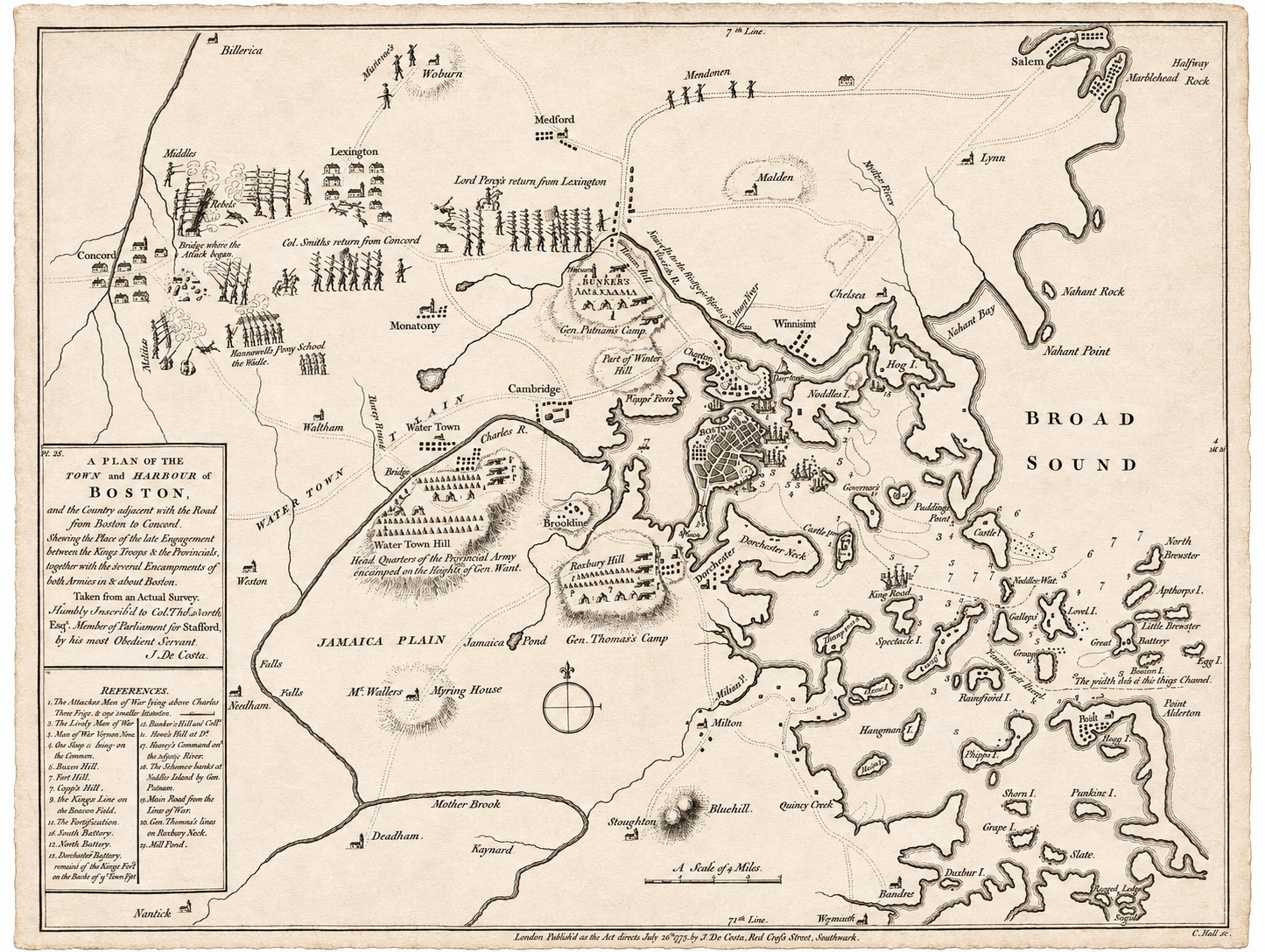
The geography helps explain the importance of preparation. An express from Boston might reach Lexington or Concord, but warning the rest of Massachusetts required a succession of local contacts. Each town needed people who could receive the news, determine its urgency, and carry it to neighboring communities.
1. 1772: The Colonies Learn to Communicate
Key DevelopmentNovember 1772 — Boston establishes a standing Committee of Correspondence.
In November 1772, a Boston town meeting established a standing Committee of Correspondence. Samuel Adams was among its leading organizers, joined by men including Joseph Warren, James Otis, and others concerned that royal policies were weakening the rights they believed Massachusetts possessed under its charter.
The committee did not begin as a military alarm service. Its immediate purpose was political: to explain Boston’s grievances, ask other towns for their views, and encourage a coordinated response. Its November 20 statement and accompanying letter invited communities across Massachusetts to consider the same questions and answer in writing.
Other towns formed committees of their own. Letters could be received at one town, discussed by its leaders, copied, and forwarded to another. By turning local protests into a conversation among distant communities, the committees created relationships and habits that would become invaluable when speed mattered.
The difference is important. A committee established to debate rights in 1772 was not automatically an armed resistance cell. Yet its members, clerks, and trusted messengers helped create the human infrastructure through which news could travel in 1775.
2. September 1774: The Powder Alarm Tests the System
Key EventSeptember 1, 1774 — British troops remove provincial gunpowder, triggering a widespread alarm.
On September 1, 1774, General Thomas Gage ordered British troops to remove gunpowder from a magazine in Charlestown, in the area now known as Somerville, and to secure artillery in Cambridge. The operation succeeded without the battle that many colonists feared.
The news did not remain a simple report of powder being taken. As it traveled, rumors claimed that British forces had fired on the people of Boston and that blood had been shed. Thousands of militiamen moved toward Cambridge before learning that the most alarming stories were false.
The Powder Alarm exposed both the power and the danger of a fast-moving warning network. Messages could summon armed men over considerable distances, but a rumor repeated as fact could bring a province close to fighting. The event encouraged Patriot leaders to think more carefully about military supplies, intelligence, and the authority to call men into the field.
When the real alarm came the following April, Massachusetts was not responding to an entirely unfamiliar situation. Its communities had already experienced what happened when an urgent report traveled from town to town.
3. Autumn 1774: A Government Outside Royal Control
The crisis deepened after Parliament’s Coercive Acts and the weakening of the Massachusetts charter government. In October 1774, representatives who had been elected to a legislature that Gage would not permit to meet organized themselves as the Massachusetts Provincial Congress.
Meeting first at Salem and then at Concord, the Provincial Congress claimed the practical authority to direct resistance to royal policy. John Hancock presided. Its members assessed the province’s defenses, encouraged towns to prepare their militia, and began arranging stores of arms, ammunition, and other supplies.
The Congress also established a Committee of Safety, with a Committee of Supplies working on the material requirements of defense. This was a significant change. Correspondence had connected communities politically; now Patriot leaders were creating an organization capable of watching military movements and directing a response.
The British government still claimed lawful authority in Massachusetts, while Patriot leaders increasingly exercised power outside it. By the winter of 1774–1775, two rival systems of authority were operating in the same province.
4. Who Had the Authority to Sound an Alarm?
The decision to summon armed men was not a small administrative matter. In September 1774, the Suffolk Resolves proposed that when danger threatened a town, local selectmen or committees could send written warnings to nearby communities, whose officials would forward the news farther outward.
This approach made an alarm more than a single messenger’s journey. A rider could deliver a written report, and the receiving town could become the next point of departure. The message gained reach through repeated local action.
The Provincial Congress gave its Committee of Safety authority, under specified conditions, to alarm and muster militia. Yet the consequences troubled some Patriots. In a February 22, 1775 letter, Provincial Congress member Joseph Hawley warned that calling out armed men might itself lead them to believe that fighting had been authorized.
His concern reminds us that the outbreak of war was not inevitable in every Patriot’s mind. Leaders disagreed about when resistance should become armed conflict. The alarm system was designed for defense, but using it could set events in motion that no single committee could easily control.
5. Winter 1774–1775: Preparing the Minute Men
Military PreparationsTown militia companies reorganize, selected minute men train for rapid assembly, and provincial leaders collect military supplies.
An alarm would have been of little use if the towns receiving it were unprepared. Throughout the winter, Massachusetts communities reorganized their militia. Many formed selected companies of minute men who trained more frequently and promised to assemble quickly when called.
These men were not a separate army of full-time professional soldiers. They belonged to local communities, with officers and neighbors who understood where to gather and how to respond. Readiness varied from town to town, and the surviving records must be consulted before assigning a particular man to a company or alarm.
The Provincial Congress also directed the purchase and storage of military supplies. Concord and Worcester became important supply centers. By February 1775, the Committee of Supplies had been instructed to obtain material sufficient for a large provincial force.
For the warning network, this meant that messages had practical destinations. A rider could alert a town whose militia had a plan for assembly, or a supply center where officers could move valuable stores out of danger.
6. Early 1775: Watching the British Army
The struggle over information was being fought long before the first shots. General Gage sent men into the countryside to learn about roads, bridges, and Patriot military supplies. Patriot organizers, meanwhile, watched British troops in and around Boston and tried to discover when and where they would move.
Paul Revere was already an experienced political courier. During 1774 and 1775 he carried messages for Boston’s Committee of Correspondence and the Massachusetts Committee of Safety. He was one participant in a wider circle of observers and messengers, not a man suddenly recruited for a single legendary ride.
In March 1775, the Committee of Safety arranged watches at strategic approaches including Roxbury, Cambridge, and Charlestown. Couriers were designated to carry word of British movements to the towns where provincial military supplies were stored. Men at those locations could then send the warning onward.
This is the essential link between planning and action: observation in Boston, an express rider on the road, a receiving town, and further messengers moving outward. The system did not require one person to ride everywhere.
7. Why Concord Became a British Target
Concord was more than a village west of Boston. It was one of the places where Massachusetts Patriots had gathered military stores, including arms and ammunition. Gage regarded those preparations as a threat to the Crown’s authority and sought to prevent the provincial forces from becoming stronger.
By mid-April, Gage planned an expedition to seize or destroy military supplies in Concord. The operation depended on surprise. If word reached the countryside first, stores might be moved and militia companies could assemble along the road.
Patriot intelligence was imperfect. Joseph Warren and others believed that Samuel Adams and John Hancock, who were staying in Lexington, might also be targets. Revere’s mission to warn them reflected that concern. The Paul Revere House notes, however, that the British expedition’s orders were directed at the military stores, not at arresting Adams and Hancock.
Distinguishing what Patriot leaders feared from what Gage actually ordered helps explain why Lexington and Concord both became central to the warning.
8. April 1775: The Final Preparations
The alarm did not begin without warning signs. Revere made earlier journeys into the countryside, including trips to Concord and Lexington in April. By the weekend before the expedition, he had also helped arrange a lantern signal at Boston’s Christ Church, now commonly called Old North Church.
The signal was intended to notify Patriot contacts across the Charles River in Charlestown of the route taken by the British troops: one lantern for a movement by land and two for a crossing by water. It was a backup communication measure, not a signal that Revere himself needed to see before beginning his ride.
On the evening of April 18, observers noticed British troops preparing to move. Dr. Joseph Warren summoned Revere and sent him to warn Adams and Hancock in Lexington. William Dawes traveled by a different route. Revere crossed the Charles River to Charlestown, where a horse and local contacts enabled him to continue.
The riders were entering a countryside that already had committees, officers, watchers, and neighbors ready to pass along urgent news. That preparation helps explain how the warning spread far beyond the movements of any one individual.
9. From Midnight Warning to the Lexington Alarm
The warnings before dawn on April 19 were largely immediate and local: riders reached houses and towns, militia officers were notified, and communities responded to news that British regulars were on the march.
After the fighting began, the term “Lexington Alarm” also came to describe written reports announcing the clash and carrying the news through the colonies. One important message was sent from Watertown on April 19 under the name of Joseph Palmer. Surviving copies show how committees and couriers relayed, copied, and endorsed the report as it moved south.
Historian John H. Scheide’s study of the surviving manuscripts shows that the written alarm did not simply reproduce one rider’s spoken warning. It was a second phase of communication, using established committees, town clerks, post roads, and successive messengers to carry news to communities far from Massachusetts.
The origins of the Lexington Alarm therefore belong to two connected stories: the preparations that allowed towns to respond before and during the fighting, and the correspondence network that carried the news of that fighting across colonial America.
10. Timeline: How the Alarm Network Developed
The warning network developed over several years. The following timeline traces the principal steps from political correspondence to military preparation and the eventual alarm.
| Date | Development |
|---|---|
| November 1772 | Boston establishes a standing Committee of Correspondence and sends its statement of rights and grievances to other towns. |
| 1773–1774 | Correspondence networks expand as colonial disputes with British authorities intensify. |
| September 1, 1774 | The Powder Alarm demonstrates how quickly news and rumors can mobilize militia across Massachusetts. |
| October 1774 | The Massachusetts Provincial Congress organizes and establishes a Committee of Safety. |
| Winter 1774–1775 | Towns prepare minute men and militia; provincial leaders collect supplies at locations including Concord. |
| March 1775 | Watches and couriers are organized to warn the countryside of British movements. |
| April 18–19, 1775 | Revere, Dawes, and other messengers carry the warning; after the fighting, written reports begin spreading through the colonies. |
11. Why the Origins Matter to Family Historians
For descendants researching Revolutionary-era families, the alarm network provides a way to ask more precise questions. Was an ancestor a member of a town militia? Did the town maintain a committee of correspondence? Was a relative a selectman, courier, clerk, or officer responsible for receiving and passing on warnings?
Town meeting minutes, militia rolls, committee records, letters, and contemporary newspapers can help answer those questions. But living in a town that received the alarm does not, by itself, prove that an ancestor rode with a message or marched to Lexington or Concord.
The story is larger than its famous names, and the evidence deserves to be treated carefully. The people who watched roads, copied reports, preserved supplies, and assembled in their towns formed the local foundation of a network that would soon carry news across the colonies.
A note for family researchers: Participation in a town’s warning network should be distinguished from documented military service. A person may have delivered a message, served on a committee, or helped prepare supplies without fighting at Lexington or Concord. Each claim should be supported by the appropriate historical record.
Continue the Story: Riders & Messengers
By the evening of April 18, 1775, the network was ready. Discover the people who carried the warnings through Middlesex County and beyond.
Next ArticleExplore Riders & Messengers of the Midnight Alarm →
Sources and Further Reading
The following archives, historical institutions, primary accounts, and scholarly studies inform this article. Links are collected here rather than placed throughout the narrative.
- John H. Scheide. “The Lexington Alarm,” Proceedings of the American Antiquarian Society, vol. 50 (April 1940), pp. 49–79. Especially useful for the Suffolk Resolves, Committee of Safety, Joseph Hawley, and the April 19 written alarm. View source.
- New York Public Library. “Boston Committee of Correspondence Records, 1772–1784.” Archival description and digitized collection, including the committee’s formation and correspondence. View source.
- National Park Service. Minute Man National Historical Park, “Organization.” Research overview of the Provincial Congress, militia preparations, supplies, and intelligence work. View source.
- National Park Service. Minute Man National Historical Park, “Radicalization.” Background on the Powder Alarm and the political crisis of 1774. View source.
- National Park Service. “Paul Revere Capture Site.” Explanation of the March 1775 watches and the wider alarm network. View source.
- Paul Revere House. “The Real Story of Paul Revere’s Ride.” Revere’s courier work, Warren’s warning, and the distinction between feared arrests and Gage’s actual objective. View source.
- Paul Revere House. “The Midnight Ride in Paul Revere’s Own Words.” Guide to Revere’s 1775 depositions and 1798 recollection. View source.
- Massachusetts Archives. “Massachusetts Archives Collection Overview.” Background on the Provincial Congress and Committee of Safety. View source.
- Boston Public Library. “1774: The Powder Alarm.” Research guide summarizing the incident and directing readers to additional contemporary records. View source.
- National Park Service. “Paul Revere.” Biographical research, including Revere’s earlier April 1775 rides. View source.
Historical and Genealogical Research Note: This is an original historical synthesis, not a transcription of a single document. Contemporary correspondence, later recollections, archival descriptions, and modern historical interpretation are distinct kinds of evidence. Where the record establishes a plan or a town’s preparation, it does not automatically establish the actions of every individual resident. The phrase “Lexington Alarm” is used in historical writing for both the immediate warnings surrounding April 18–19 and the written dispatches sent after the fighting began. This chapter focuses primarily on the origins of the warning system. The map above is a modern illustrative recreation, not proof of any particular rider’s route.