
The Yost Post · The Midnight Alarm of 1775
Paul Revere was not alone. On the night of April 18–19, 1775, a remarkable network of riders and messengers carried warnings through the Massachusetts countryside, calling communities to action before the British expedition reached Concord.
Some of these men became famous. Others are remembered only in town histories, family recollections, old diaries, and Revolutionary War records. A few remain completely unidentified, although their journeys helped alert entire communities.
Their stories reveal a side of the American Revolution that is often overlooked. The alarm was not carried by one man or even three. It was passed from neighbor to neighbor, from one rider to another, and from town to town. This is the story of the people who helped spread the warning.
In This Article — Click to Expand
Map of the Middlesex Alarm
The Middlesex Alarm spread across eastern Massachusetts during the night of April 18 and the early morning of April 19, 1775. Riders followed country roads, stopped at homes and taverns, and awakened local leaders who could summon their militia companies. From those communities, additional messengers carried the warning farther into the countryside.
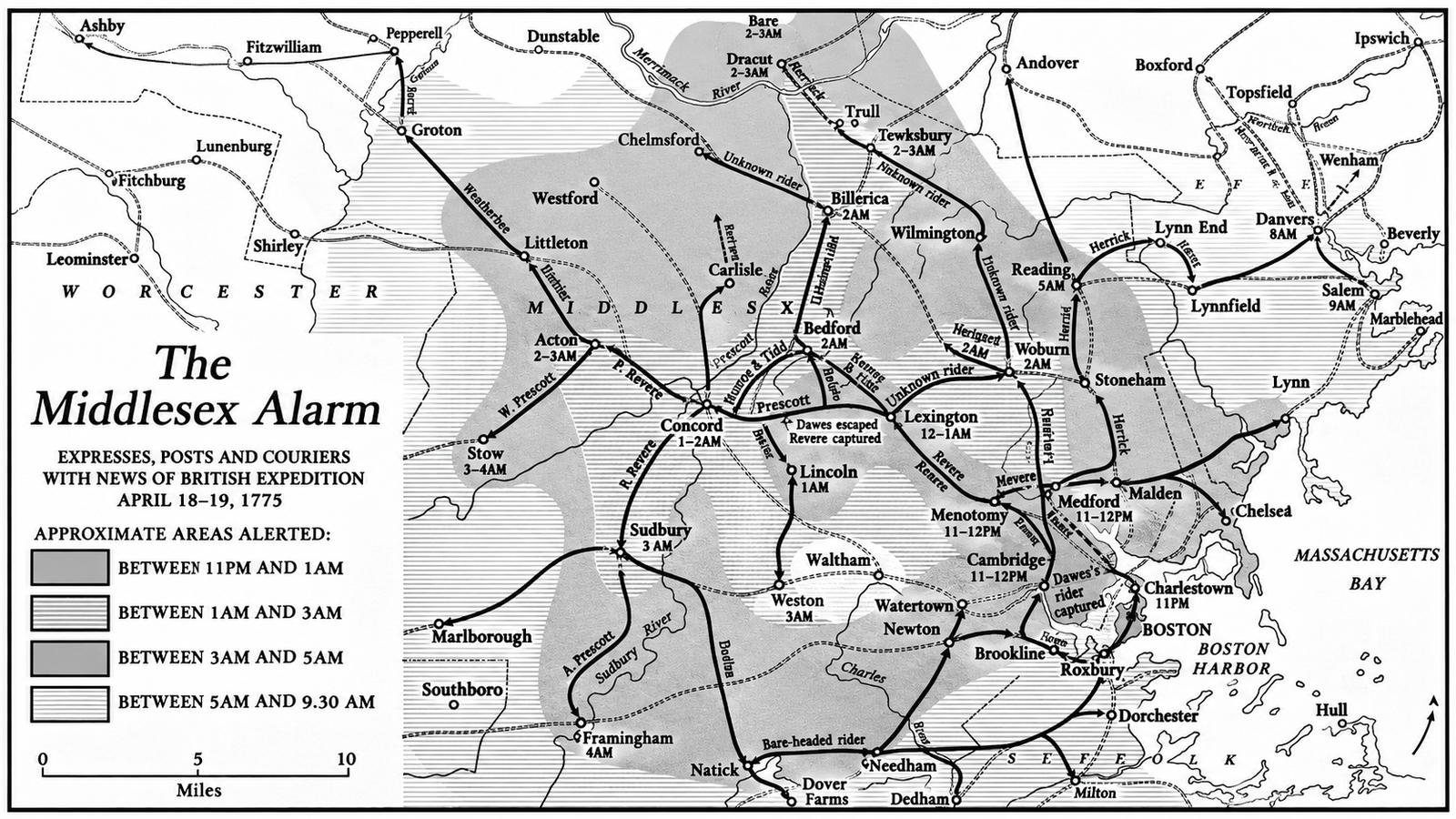
The map helps explain why so many riders were involved. Revere, Dawes, and Prescott traveled along the best-known routes, but other messengers headed north toward Tewksbury, northeast toward Reading and Lynn End, west toward Groton, and southwest toward Sudbury and Needham. The growing alarm depended on each community passing the warning along.
1. The First Riders: Boston to Lexington
Paul Revere: The Most Famous Messenger
RouteBoston → Charlestown → Medford → Menotomy → Lexington → toward Concord
On the evening of April 18, 1775, Boston silversmith Paul Revere received instructions from Dr. Joseph Warren to warn Samuel Adams and John Hancock that British troops were moving into the countryside. The two Patriot leaders were staying in Lexington, and there was growing concern that the British expedition might threaten them as well as military supplies at Concord.
Revere crossed the Charles River by boat and reached Charlestown, where he obtained a horse and began his journey. He passed through Medford and Menotomy, spreading the warning along the way. In Medford, he contacted Captain Isaac Hall, one of the local militia leaders who could help alert the surrounding community.
Shortly after midnight, Revere arrived in Lexington and delivered his warning. His mission did not end there. He joined William Dawes and continued toward Concord, accompanied by another rider, Dr. Samuel Prescott. Their journey was interrupted by a British mounted patrol in Lincoln. Revere was captured, but the alarm continued.
Revere’s name became closely associated with the events of that night, especially after Henry Wadsworth Longfellow published his famous poem in 1861. The real story, however, involved a much larger network of riders, townspeople, and militia leaders.
William Dawes: The Other Boston Rider
RouteBoston → Roxbury → Brookline → Brighton → Cambridge → Menotomy → Lexington
William Dawes left Boston by a different route from Revere. Rather than crossing the Charles River to Charlestown, Dawes traveled by land through Boston Neck and the southern communities leading toward Cambridge.
His route took him through Roxbury, Brookline, and the Brighton area before he continued toward Lexington. Dawes reached the town and delivered the warning, then joined Revere on the road toward Concord.
Much less is known about Dawes’s stops along the way. Unlike Revere, he did not leave a detailed firsthand account of his ride. Nevertheless, his journey was an important part of the plan. By sending two riders along different roads, the Patriot leaders improved the chances that at least one warning would reach Lexington.
Dr. Samuel Prescott: The Rider Who Reached Concord
RouteLexington area → Lincoln → Concord → Acton area
Dr. Samuel Prescott was a young physician from Concord who encountered Revere and Dawes after they left Lexington. He joined them as they traveled west toward his hometown.
Near Lincoln, the three riders encountered a British patrol. Revere was detained, while Prescott escaped and continued toward Concord. His arrival brought the warning to a town that would soon become central to the events of April 19.
Prescott is also associated with carrying the alarm toward Acton, where additional militia leaders and messengers helped spread the news. Although his name is less familiar than Revere’s, his successful escape and continued journey made him one of the most important participants in the alarm.
2. The Northern Alarm: Medford, Tewksbury, and the North Shore
While the best-known riders traveled toward Lexington and Concord, other messengers carried the warning north and northeast of Boston. Their journeys helped alert communities that might otherwise have remained unaware of the British expedition until morning.
The Unidentified Rider to Tewksbury
Reported routeCharlestown area → Woburn area → Wilmington area → Tewksbury
One of the earliest northern warning journeys was made by a rider whose name has not survived. Historical accounts describe a messenger leaving the Charlestown area and traveling north toward Tewksbury during the night.
According to the traditional account, the rider reached Tewksbury at approximately two o’clock in the morning and warned Captain John Trull. Trull then fired three musket shots, a signal intended to carry the alarm toward Dracut.
The rider’s identity remains unknown, but his reported journey demonstrates how the warning system worked. One messenger could reach a local leader, who then used an agreed signal to alert people farther away.
Dr. Martin Herrick: The Rider Toward Lynn End
Reported routeMedford → Stoneham → Reading → Lynn End (present-day Lynnfield)
Dr. Martin Herrick was another messenger associated with the northern alarm. Historical accounts place him on a route beginning in Medford and continuing through Stoneham and Reading toward Lynn End, the community later known as Lynnfield.
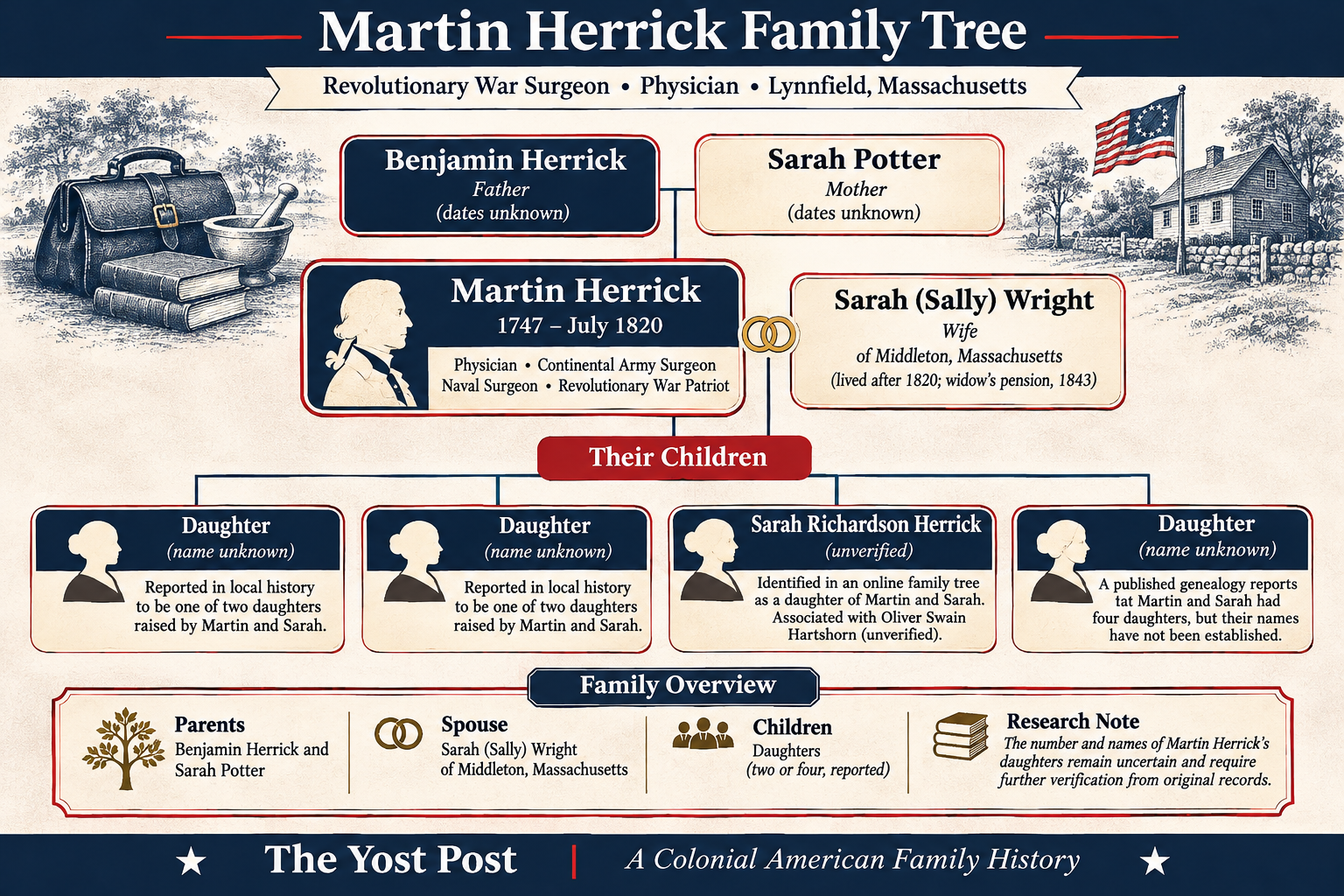
Herrick’s mission was to carry the warning into communities northeast of Boston, where local militia officers and residents could spread the news. The warning eventually reached other towns in the region, including Danvers and Andover, through additional messengers.
Herrick is also remembered in local histories as having joined the militia after completing his warning mission. His story is an example of a man whose role in the alarm was preserved largely through regional histories rather than the more familiar accounts of Revere’s ride.
Other Messengers Along the North Shore
Not every northern messenger was identified by name. Accounts describe additional warnings traveling from Medford toward Malden and Chelsea, and from the Reading area toward Danvers and Andover.
The journals of Thomas Boynton and James Stevens provide valuable glimpses of how the alarm reached the Andover region. These local records help preserve the experiences of communities beyond the principal Boston-to-Lexington route.
3. The Local Riders: Lexington, Bedford, Woburn, and Burlington
The warning did not simply pass through Lexington and continue west. Lexington residents also sent messengers toward neighboring towns. These smaller journeys were essential because local militia companies needed to know what was happening before they could respond.
Nathan Munroe and Benjamin Tidd: Lexington to Bedford
RouteLexington → Bedford → Meriam’s Corner in Concord → Lexington
Nathan Munroe and Benjamin Tidd were Lexington residents who helped spread the alarm beyond their own town. Their journey is especially interesting because Munroe later described it in a sworn statement dated December 22, 1824.
According to Munroe, Captain John Parker asked the two men to go to Bedford on the evening of April 18. They warned residents there, continued toward Meriam’s Corner in Concord, and then returned to Lexington.
When Munroe returned, he found the Lexington town bell ringing and Captain Parker’s militia company gathering. His recollection provides a personal connection to the events of that night and shows that Lexington was actively sending warnings to neighboring communities.
Historical reconstructions also associate their mission with Cornet Nathaniel Page of Bedford. Although Page is not named in Munroe’s surviving deposition, his connection with the Bedford warning appears in later accounts.
The Two Messengers Sent Toward Cambridge
Reverend Jonas Clarke’s account of the Lexington alarm also mentions two messengers sent toward Cambridge during the night. Their names have not been established.
These men appear to represent a separate warning mission from the journey made by Munroe and Tidd. Their story is a reminder that even in a town as closely associated with the Revolution as Lexington, some of the people who carried the alarm remain unidentified.
Ebenezer Stedman and the Warning to Woburn
Woburn received news through a warning connection associated with Ebenezer Stedman. Major Loammi Baldwin’s diary records the arrival of the alarm, providing an important account from the time.
Stedman’s role was connected with the sending or forwarding of the message, although the identity of the person who physically carried it is less certain. The distinction matters when tracing individual riders through old town records.
Joshua Walker and Jonathan Proctor
After the warning reached Woburn, Captain Joshua Walker reportedly sent another messenger toward Jonathan Proctor in the area that later became Burlington.
Here again, the names of the men who organized or received the warning are better preserved than the name of the actual courier. Their involvement shows how the alarm continued to spread through local militia leadership.
4. The Alarm Spreads West: Lincoln, Concord, Acton, and Groton
As news reached Concord, additional messengers carried the warning into towns farther west and northwest. In some communities, a single rider alerted a militia officer. In others, residents warned relatives, neighbors, and nearby households before the message moved on.
Nathaniel Baker and the Lincoln Families
Lincoln was among the communities awakened by the alarm. Nathaniel Baker appears in historical accounts as one of the local men who helped carry the warning to others, including members of the Baker family.
Amos Baker is also connected with the surviving recollections of the Lincoln alarm. These accounts are particularly valuable for family historians because they preserve names and relationships that might otherwise be absent from the better-known military histories.
The surviving material does not clearly establish that every local warning was carried on horseback. Some residents may have traveled only short distances between neighboring homes. Their contributions were nevertheless part of the same warning network.
Mary Hartwell and the Lincoln Alarm
Mary Flint Hartwell is one of the women remembered in accounts of the Lincoln alarm. Later stories describe her helping spread the warning among neighbors and local militia families.
The accounts differ about exactly when she received the news and whom she warned. Some versions connect her with Captain William Smith, while others describe different people carrying the earliest messages.
The Lincoln traditions also preserve references to Black residents who helped transmit the warning, including a man called Crispus in one account and an unnamed Black woman in another. Their stories are an important part of the community’s history, although the surviving accounts do not provide a complete picture of their lives.
Mary Hartwell should be remembered as part of the wider Lincoln alarm story, while recognizing that some details of the familiar tradition remain uncertain.
Joseph Robbins and the Acton Militia
Reported warning connectionConcord / Acton area → local Acton militia officers
After the warning reached Concord, it continued toward Acton. Captain Joseph Robbins is remembered as one of the men who helped spread the news among local militia leaders.
Historical accounts describe Robbins riding to notify men including Captain Isaac Davis and Deacon Simon Hunt. In South Acton, Major Francis Faulkner is associated with firing musket shots as a warning signal.
These local actions helped prepare Acton’s militia companies for the events of April 19. They also show that the alarm depended on more than mounted couriers. Officers, householders, and agreed signals all played a part.
Edward Bancroft: The Rider Toward Groton and Pepperell
Reported routeActon area → Groton → Pepperell area
Edward Bancroft is named in historical accounts as a messenger who carried the alarm northwest toward Groton and Pepperell.
His journey connected the Concord and Acton warning network with communities farther into Middlesex County. Once the news reached Groton, additional local messengers reportedly carried it onward.
Oliver Prescott and Samuel Lawrence
Local histories connect Oliver Prescott with the warning in Groton. He is said to have notified Samuel Lawrence, who then helped spread the news among additional residents.
Lawrence is remembered in later family recollections as riding a local circuit to warn others. Although the precise route needs further confirmation, these accounts preserve the names of men whose work formed part of the alarm beyond Concord.
Weatherbee and the Littleton Warning
A rider identified by the surname Weatherbee appears in historical accounts of the alarm moving through Littleton. His reported journey included the area around Beaver Brook Bridge.
His first name has not been established in the material used for this account. A separate warning also reached Billerica, although the messenger responsible has not been securely identified.
5. The Southern Alarm: Sudbury, Framingham, and Needham
The alarm also traveled southwest of Concord, reaching communities along the roads toward Sudbury, Framingham, Natick, Needham, and neighboring towns. These warnings were carried through a mixture of mounted messengers, local signals, and personal visits.
Abel Prescott: The Southwestern Warning
Reported warning areaConcord → Sudbury → Framingham / Natick area
Abel Prescott, brother of Samuel Prescott, is associated with carrying the alarm southwest from Concord. Historical accounts connect his journey with the warning reaching Sudbury and the surrounding countryside.
Thomas Plympton was among the local leaders associated with the Sudbury warning. Once news reached the community, bells, musket shots, and local messengers helped spread it to residents and militia companies.
Abel Prescott’s story is another reminder that the warning was a family and community effort. The Prescott brothers became associated with different branches of the alarm, while local residents carried the news farther from the main roads.
The Bareheaded Rider
One of the more unusual stories preserved in local histories concerns an unidentified rider described as bareheaded. He is associated with carrying the warning toward Needham and the Dover Farms area.
The tradition connects the warning with Bullard’s Tavern, where musket signals reportedly helped alert nearby residents. The rider’s name has not survived, and the exact route remains uncertain.
For family historians, stories such as this are worth preserving even when a person’s identity cannot yet be established. Future discoveries in local records may provide additional clues.
Abel Benson and the Trumpet Warning
Abel Benson is remembered in local tradition for helping spread the alarm by sounding a trumpet in the Needham and Framingham area.
The details vary among later accounts, including questions about his route and method of travel. His story illustrates how local warning signals became part of the remembered history of April 1775, even when the original evidence is incomplete.
6. Beyond Massachusetts: The Alarm Reaches Other Colonies
By the morning of April 19, the warning had taken on a new urgency. News was no longer limited to British troop movements. Reports of fighting at Lexington and Concord began traveling along the roads into other Massachusetts communities and neighboring colonies.
These later journeys were part of the broader Lexington Alarm rather than the original overnight Middlesex warning. They continued the same essential work: carrying news quickly enough for other communities to respond.
Isaac Bissell: The Express to Hartford
RouteWatertown → Worcester → Springfield → Hartford, Connecticut
On April 19, Joseph Palmer of the Massachusetts Committee of Safety prepared an urgent written message describing the fighting. Isaac Bissell of Suffield, Connecticut, carried the express westward through Worcester and Springfield toward Hartford.
In Worcester, town clerk Nathan Baldwin prepared another copy of the message, which was sent south by a different courier. Bissell continued toward Hartford, where the news could reach Connecticut leaders.
In 1776, Bissell requested payment for his service. The surviving records provide valuable evidence identifying him and the journey he made.
Isaac Bissell or Israel Bissell?
For many years, popular stories credited a rider named Israel Bissell with carrying the alarm all the way from Massachusetts to Philadelphia. Historical research has raised serious questions about that familiar account.
Records support Isaac Bissell’s journey to Hartford, while other couriers carried copies of the warning farther south. Some surviving copies of the original message use the name Israel Bissell, which helped create confusion in later retellings.
For the purposes of identifying the people who carried the alarm, Isaac Bissell is the better-supported name for the Hartford express. Israel Bissell should not be counted as a separate verified rider without additional evidence.
The Unknown Courier to Brooklyn, Connecticut
The copy prepared in Worcester traveled south and reached Brooklyn, Connecticut, by the morning of April 20. The courier who carried it has not been identified.
Daniel Tyler Jr. then certified another copy of the message, which continued toward Norwich. These written expresses allowed the news to move from one community to another without requiring the original rider to complete the entire journey.
Isaac Sheldon and the Connecticut Warning
Isaac Sheldon is named in Silas Deane’s diary as the messenger who brought news from Hartford to Wethersfield on April 20.
Other Connecticut residents, including Daniel Tyler Jr. and Christopher Leffingwell, helped preserve and forward the written alarm. Their involvement shows how committees, clerks, and messengers worked together as the news spread.
Mr. Moorbach and the Road to New Jersey
By April 23, news of the fighting had reached New York City. An express from Fairfield, Connecticut, brought an authenticated version of the warning.
New York Patriot leaders then sent a messenger identified as Mr. Moorbach toward New Brunswick, New Jersey, with instructions to notify the committee at Elizabethtown.
Additional couriers carried the message through New Jersey, and a certified copy reached Philadelphia on April 24. In only a few days, news of the fighting had traveled far beyond the towns surrounding Boston.
7. The Riders Whose Names Have Been Lost
Some of the most interesting figures in the alarm remain unidentified. Town histories sometimes mention an express arriving in the middle of the night without recording who carried it. In other cases, a messenger is remembered only by a surname or a brief description.
The following table identifies warning journeys for which the messenger’s name remains unknown or incomplete. Some accounts may describe the same person at different points along a route, so these entries should not automatically be counted as separate individuals.
| Messenger | Reported Route or Community | What We Know |
|---|---|---|
| Unidentified Tewksbury rider | Charlestown area to Tewksbury | Reportedly warned Captain John Trull |
| Malden express | Medford to Malden | Helped carry the northern warning |
| North Shore messengers | Reading area toward Danvers and Andover | Several warning connections are recorded |
| Woburn express | Cambridge-area warning to Woburn | Associated with Ebenezer Stedman |
| Walker’s messenger | Woburn toward Burlington | Sent toward Jonathan Proctor |
| Two Lexington messengers | Lexington toward Cambridge | Described in Jonas Clarke’s account |
| Billerica messenger | Warning toward Billerica | Identity remains uncertain |
| Bareheaded rider | Needham and Dover area | Remembered in later local traditions |
| Worcester courier | Worcester to Brooklyn, Connecticut | Carried a copy of the written alarm |
| Fairfield express | Fairfield, Connecticut, to New York City | Delivered an authenticated warning |
These unidentified riders are part of the story of the Revolution just as surely as the better-known men. Their names may yet appear in old family papers, town meeting records, diaries, or Revolutionary War pension accounts.
8. Directory of Riders and Messengers
This directory brings together the named people associated with carrying or helping transmit the alarm. Some are known to have ridden on horseback. Others are remembered as local messengers, militia organizers, or participants in later traditions.
| Name | Town or Route | Role in the Alarm |
|---|---|---|
| Paul Revere | Charlestown to Lexington | Mounted warning rider |
| William Dawes | Boston to Lexington by southern route | Mounted warning rider |
| Samuel Prescott | Lincoln, Concord, and Acton area | Mounted warning rider |
| Martin Herrick | Medford, Stoneham, Reading, Lynn End | Reported mounted warning rider |
| Nathan Munroe | Lexington to Bedford and Concord | Named messenger in his own deposition |
| Benjamin Tidd | Lexington to Bedford and Concord | Accompanied Nathan Munroe |
| Nathaniel Baker | Lincoln | Local messenger |
| Joseph Robbins | Acton | Reported mounted messenger |
| Edward Bancroft | Groton and Pepperell area | Reported warning rider |
| Weatherbee | Littleton | Reported rider; first name uncertain |
| Abel Prescott | Sudbury and Framingham area | Reported warning rider |
| Oliver Prescott | Groton | Local messenger in historical accounts |
| Samuel Lawrence | Groton | Reported local warning rider |
| Isaac Bissell | Watertown to Hartford | Mounted intercolonial express |
| Isaac Sheldon | Hartford to Wethersfield | Named messenger |
| Mr. Moorbach | New York toward New Brunswick | Intercolonial express messenger |
| Mary Hartwell | Lincoln | Local warning participant in later accounts |
| Abel Benson | Needham and Framingham area | Trumpet warning in local tradition |
| Israel Bissell | Legendary ride to Philadelphia | Disputed identification; not separately verified |
A note for family researchers: Appearing in this directory does not necessarily establish that a person served in a militia company or fought at Lexington or Concord. Some helped carry the warning without taking part in the fighting. Military service and family relationships should be confirmed through separate records.
9. The Legacy of the Midnight Alarm
For generations, the story of April 18, 1775, has been told through the ride of Paul Revere. His journey deserves its place in American history, but it was only one part of a much larger undertaking.
William Dawes traveled a separate route from Boston. Samuel Prescott carried the warning into Concord. Martin Herrick rode toward the North Shore. Nathan Munroe and Benjamin Tidd warned Bedford. Other messengers reached Tewksbury, Acton, Groton, Sudbury, and the towns beyond.
Many of these people were ordinary residents whose names survived because someone recorded a memory, wrote a diary entry, preserved a family story, or gave testimony years later.
The alarm belonged to all of them. It was the work of neighbors, families, militia officers, and messengers who carried news through the night, often without knowing how far the warning would eventually travel.
For descendants researching their Revolutionary-era ancestors, these accounts offer something especially valuable: a glimpse of the people and communities behind the familiar events of American independence.
Sources and Further Reading
The following historical works, firsthand accounts, and archival resources provide the foundation for this article. Some preserve accounts written during the Revolution, while others draw upon later recollections and local histories.
- David Hackett Fischer. Paul Revere’s Ride. Oxford University Press, 1994. Chapter 9, “The Alarm,” pp. 138–148, with the accompanying Middlesex Alarm map and endnotes on pp. 393–395. The principal historical study used to reconstruct the Massachusetts warning network.
- Paul Revere House. “Revere’s Own Words.” A collection of Revere’s accounts of his journey, including his later correspondence. Read the historical accounts.
- Nathan Munroe. Deposition dated December 22, 1824, reproduced by the Lexington Minute Men. An important personal account of the warning journey made with Benjamin Tidd. Read the deposition PDF.
- J. L. Bell. “The Story of Isaac Bissell—and the Legend of Israel Bissell.” Journal of the American Revolution, June 27, 2024. Examines the surviving records of the alarm’s journey into Connecticut and the identification of the rider. Read the article.
- William Emerson. Diary, April 19, 1775. A contemporary account associated with the arrival of the warning at Concord, discussed in Fischer’s historical study.
- Donald L. Hafner. “Mary Hartwell and the Alarm on April 19, 1775.” National Park Service. Discusses the differing accounts of Mary Hartwell and the Lincoln warning. Read the National Park Service article.
- Scottish Rite Masonic Museum & Library. Lexington Alarm correspondence and related archival material concerning the transmission of the written warning into Connecticut. View the archival collection description.
- Loammi Baldwin. Diary, April 19, 1775. An important account of the warning reaching Woburn, cited in Fischer’s study.
- Thomas Boynton and James Stevens. Journals describing events in the Andover region during April 1775, cited in Fischer’s reconstruction of the northern alarm.
- Alfred Sereno Hudson. History of Sudbury, Massachusetts. Includes local historical accounts relevant to the southwestern warning.
- Duane Hamilton Hurd. History of Middlesex County, Massachusetts. A regional history containing accounts of Revolutionary-era communities and their residents.
- Additional Town Histories. Historical works concerning Medford, Lynnfield, Woburn, Groton, Littleton, Lincoln, Acton, and surrounding Massachusetts communities, as identified in Fischer’s endnotes.
Historical and Genealogical Research Note: The Midnight Alarm was remembered in diaries, military records, family accounts, town histories, and later personal recollections. Some participants left detailed statements, while others are known only through local traditions. Where names, routes, or circumstances remain uncertain, this article preserves those distinctions. Readers researching an ancestor should consult the original records whenever possible and avoid assuming that participation in the alarm establishes military service, family relationships, or involvement in the subsequent fighting.