
The Yost Post / The Lexington Alarm of 1775
Timeline of the Lexington Alarm
How Massachusetts developed a network of political correspondence, military preparation, and emergency warnings—and how that network mobilized the countryside in April 1775.
1772–1775
The Lexington Alarm did not begin with a single rider on the night of April 18, 1775. Its foundations had been developing for years as Massachusetts towns organized political correspondence, resisted British authority, strengthened their militia companies, and prepared to communicate news of military movements. By the spring of 1775, these overlapping systems made it possible for warnings to spread through the countryside and for armed companies to respond.
This chronology traces that development from the establishment of Boston’s Committee of Correspondence in 1772 through the mobilization of Massachusetts militia companies in April 1775. It also follows the subsequent transmission of news beyond Massachusetts. The purpose is not simply to recount the battles of Lexington and Concord, but to explain how the warning network emerged, how it functioned, and why its messages produced such a substantial military response.
Part I · 1772–1773
The Birth of a Network
Political correspondence establishes relationships between Massachusetts communities that later become essential to organized resistance.

November 2, 1772
Boston Establishes Its Committee of Correspondence
At a Boston town meeting, residents establish a Committee of Correspondence to communicate the town’s concerns about British policies and colonial rights. The committee, associated with Samuel Adams and other Patriot leaders, prepares statements intended for circulation among Massachusetts communities.
Its significance lies not in creating a military alarm system, but in developing a structured means of exchanging political information. Letters could be read in town meetings, discussed by local leaders, and answered through additional correspondence. These communications helped communities recognize that their grievances were shared.
Why it mattered: The committee helped establish habits of communication and cooperation between towns that would become increasingly important as the political crisis intensified.
1773
Committees and Correspondence Spread Across Massachusetts
Throughout 1773, additional towns engage in correspondence concerning Parliament, colonial rights, and the actions of royal officials. Committees, town meetings, and local political leaders exchange letters and resolutions, building relationships that extend beyond Boston.
These exchanges do not constitute a uniform emergency-warning network. Nevertheless, they strengthen the connections among communities and demonstrate how information can move through established local channels rather than through a single central authority.
Why it mattered: Massachusetts communities develop practical experience in receiving, circulating, and responding to information from other towns.
December 16, 1773
The Boston Tea Party Deepens the Crisis
Protesters destroy East India Company tea in Boston Harbor in opposition to British taxation and imperial policy. The event intensifies the confrontation between Massachusetts Patriots and British authorities.
In the months that follow, the political consequences of the destruction of the tea help produce a new stage of colonial resistance. The need to communicate rapidly between towns becomes more pressing as communities consider how to respond to British measures.
Why it mattered: Political correspondence becomes increasingly connected to collective action.
Part II · 1774
From Political Resistance to Military Readiness
British enforcement measures, the Powder Alarm, and alternative political institutions move Massachusetts toward organized military preparation.
Spring–Summer 1774
The Coercive Acts and the Massachusetts Political Crisis
Parliament’s punitive legislation following the Boston Tea Party alters the political situation in Massachusetts. The Boston Port Act closes the port to most commerce, while the Massachusetts Government Act restricts important elements of the colony’s established system of self-government.
Opposition spreads beyond Boston. Towns and counties organize meetings, publish resolutions, and increasingly challenge the legitimacy of royal administration. The growing crisis gives existing networks of correspondence greater urgency.
Why it mattered: Political coordination expands as Massachusetts communities confront a shared dispute over the authority of the British government.
September 1–2, 1774
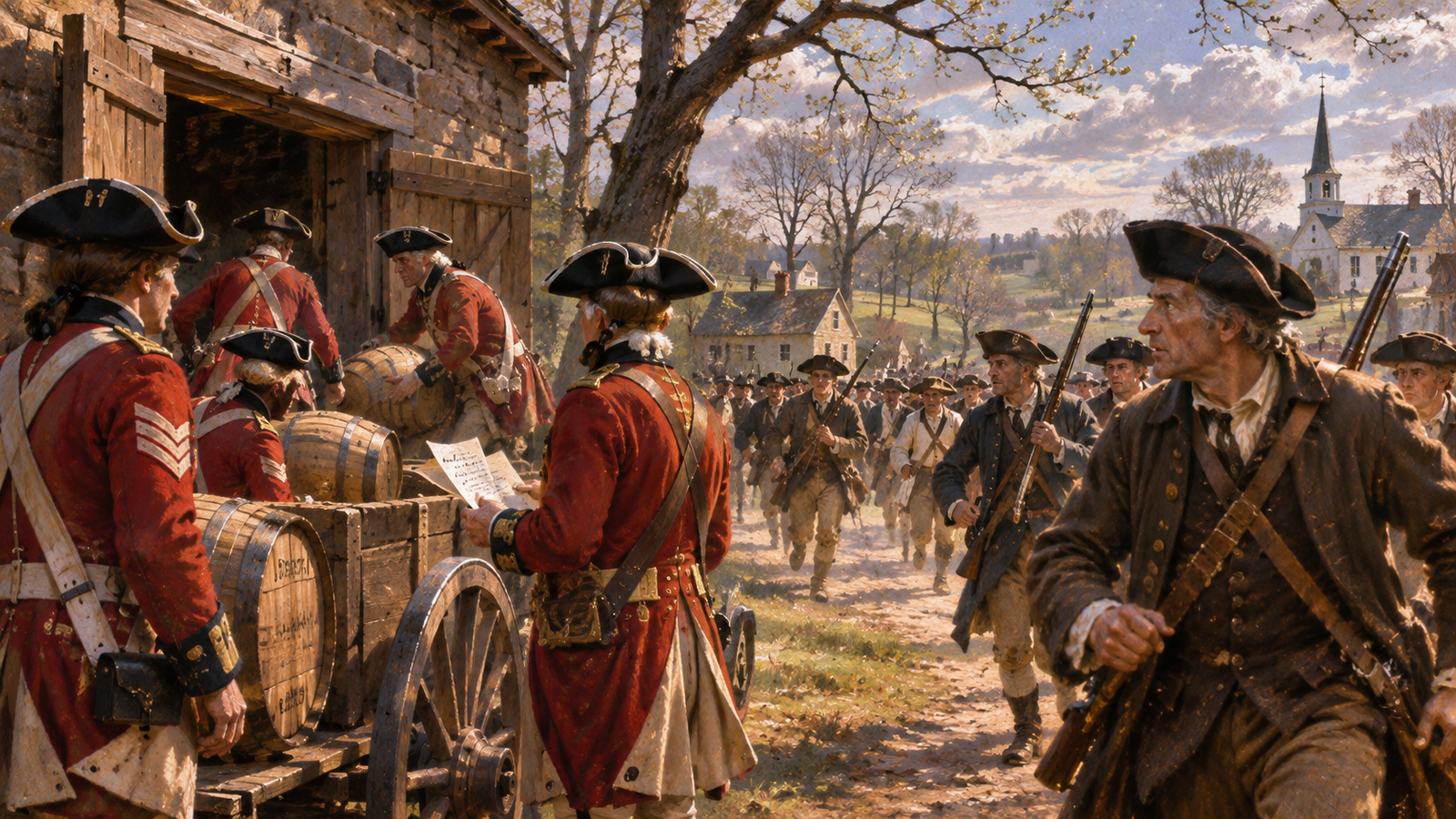
The Powder Alarm Tests Massachusetts Mobilization
On September 1, British soldiers acting under General Thomas Gage’s authority remove provincial gunpowder from the powder house at Charlestown, in what is now Somerville. The operation is conducted without the battle that later rumors would suggest.
Reports spread through Massachusetts that British troops have attacked colonists and that blood has been shed. Although these reports are inaccurate, they produce a remarkable response. Thousands of armed men from surrounding communities move toward the Boston area before the rumors can be fully corrected.
The episode reveals that information—accurate or otherwise—can travel quickly enough to mobilize large numbers of militia members. It also exposes the limitations of a warning system dependent on hurried reports, word of mouth, and local interpretation.
Why it mattered: The Powder Alarm provides an early demonstration of large-scale militia mobilization in response to alarming reports of British military action.
Historical distinction: The Powder Alarm was not a battle. The reported bloodshed that prompted much of the militia response had not occurred. Its historical importance lies in the speed of the rumors, the number of men who responded, and the lessons Patriots could draw from the episode.
September–October 1774
County Conventions Challenge Royal Authority
Massachusetts counties organize conventions and meetings in opposition to the restructured royal government. In Worcester County, for example, Patriot resistance contributes to the effective disruption of royal court proceedings.
These county-level gatherings strengthen cooperation between towns and create opportunities for discussing political resistance, military readiness, and local organization. They also demonstrate that authority is increasingly being exercised through institutions outside the normal royal administration.
Why it mattered: Local communities acquire experience coordinating action across town and county boundaries.
October 1774
The Massachusetts Provincial Congress Assembles
With the relationship between elected representatives and Governor Gage breaking down, Massachusetts Patriot leaders organize the Provincial Congress. Meeting outside the authority of the royal governor, this body assumes an increasingly important role in directing colonial resistance.
The Provincial Congress establishes committees to oversee military readiness and supplies. Its actions help connect local militia preparations to a broader provincial strategy.
Why it mattered: Massachusetts develops a political organization capable of coordinating military preparations beyond individual towns.
October 26, 1774
The Provincial Congress Recommends Minute Companies
The Provincial Congress recommends measures to improve militia readiness, including the selection of men prepared to assemble and march rapidly when called upon. The recommendations encourage the development of minute companies within the existing Massachusetts militia system.
The distinction between ordinary militia service and minute-company readiness is important. Minute men were intended to provide a more immediate response, while other militia companies remained part of the wider military organization.
Why it mattered: A warning could now activate men who had been specifically selected and prepared for rapid mobilization.
December 1774
Arms, Ammunition, and Equipment Become Priorities
Massachusetts leaders continue urging military preparation. Towns and companies work to obtain firearms, ammunition, cartridge equipment, and other supplies necessary for field service.
These preparations vary by community. Some towns possess substantial military resources, while others face shortages or depend on privately owned equipment. The effectiveness of any future alarm therefore depends not only on the speed of communication but also on the readiness of the men who receive it.
Why it mattered: The alarm network is becoming connected to a practical system of armed response rather than political protest alone.
Part III · January–April 17, 1775
The Network Prepares for Confrontation
Militia training, military stores, and intelligence gathering increase as British officials and Massachusetts Patriots anticipate a possible confrontation.
Winter 1774–1775
Militia Companies Train Across Massachusetts
Throughout the winter, Massachusetts towns continue organizing and training their militia and minute companies. Officers conduct drills, communities acquire supplies, and local leaders consider how quickly men could assemble if called into service.
Preparations are not uniform. Training schedules, equipment, manpower, and leadership vary from town to town. Nevertheless, the overall effect is to increase the number of communities prepared to respond to an emergency.
Why it mattered: The alarm system becomes more consequential because the men receiving warnings are increasingly prepared to march.
February 26, 1775
The British Expedition to Salem
British troops under Lieutenant Colonel Alexander Leslie march to Salem in an attempt to secure military supplies believed to be stored there. Local resistance delays the expedition, and the confrontation ends without a battle.
The incident reinforces the expectation that British commanders may conduct additional expeditions to seize colonial arms and military stores. For Massachusetts Patriots, such movements demonstrate the importance of detecting troop departures and warning threatened communities.
Why it mattered: British operations against colonial military supplies make rapid intelligence and local communication increasingly important.
March–Early April 1775
Military Stores and Intelligence Networks
Patriot leaders continue collecting military supplies while monitoring British activity around Boston. Concord becomes one of the locations associated with the storage of provincial military materials.
Observers, informants, and messengers help Patriot leaders assess British intentions. These arrangements are not a single centralized communication system. Instead, they rely on overlapping personal relationships, local knowledge, established routes, and individuals willing to carry urgent information.
Why it mattered: Intelligence gathering provides the information needed to activate the warning networks already developing throughout Massachusetts.
April 8, 1775
Renewed Instructions for Military Readiness
With the possibility of a British expedition becoming more serious, Massachusetts Patriot authorities continue emphasizing the need for militia preparedness. The Provincial Congress and its committees encourage arrangements intended to make an organized response possible.
By this stage, the principal elements of the alarm response are increasingly evident: information must be obtained, warnings must reach local leaders, and armed companies must assemble according to local arrangements.
Why it mattered: The developing warning system now operates within an atmosphere of heightened military expectation.
Part IV · Tuesday, April 18, 1775
The Warning Is Activated
British preparations in Boston prompt Patriot leaders to dispatch messengers toward Lexington and Concord.

April 18 · Afternoon and Evening
British Preparations Attract Attention
British troops prepare for an expedition from Boston toward Concord, where provincial military supplies are believed to be stored. Patriot observers watch British activity and attempt to determine the destination and intentions of the force.
The expedition does not take place without warning. Patriot leaders have already anticipated the possibility of a British movement against military stores, and information concerning troop preparations circulates among those responsible for the colonial response.
Why it mattered: Surveillance and intelligence allow Patriot leaders to begin issuing warnings before the British expedition reaches its destination.
April 18 · Evening
Joseph Warren Arranges the Warning
Dr. Joseph Warren, an important Patriot leader in Boston, arranges for Paul Revere and William Dawes to carry warnings toward Lexington. Their routes differ, providing more than one means of reaching the threatened area.
The immediate concern includes the safety of Samuel Adams and John Hancock, who are staying in Lexington, as well as the possibility of a British advance toward Concord.
Why it mattered: The warning is not entrusted to a single messenger or a single route.
April 18 · Late Evening
The Lantern Signal and the Departure of the Riders
A lantern signal is displayed from the steeple of Boston’s North Church to communicate the route of the British movement across the Charles River. The signal forms part of a previously arranged contingency plan.
Revere crosses the Charles River and proceeds through Charlestown, while Dawes takes a separate land route out of Boston. As they travel, warnings begin reaching communities along their paths.
Why it mattered: Multiple communication methods help reduce dependence on any one messenger and extend the warning beyond Boston.
From the historical record: Paul Revere’s later accounts describe his assignment, crossing of the Charles River, ride through Middlesex County, and subsequent encounters with British patrols. These recollections are valuable evidence, but they must be read alongside other contemporary records and later testimony. The lantern signal should not be confused with the entire alarm network; it was one element in a much broader system of warning and communication.
Part V · Wednesday, April 19, 1775
The Militia Responds
Warnings reach local communities, militia companies assemble, and the British expedition encounters armed resistance.
Shortly After Midnight · Approximate
Lexington Receives the Warning
Revere reaches Lexington and warns Patriot leaders of the British expedition. Dawes arrives separately. Hancock and Adams receive information concerning the approaching troops, while local militia preparations continue.
The warning is not confined to the famous riders. Information also circulates through local residents and additional messengers, helping communities understand that a British force is moving into the countryside.
Why it mattered: The warning reaches its immediate political targets and begins to produce a broader military response.
Early Morning · Approximate
Prescott Continues Toward Concord
After leaving Lexington, Revere and Dawes are joined by Dr. Samuel Prescott. British patrolmen intercept the riders along the road. Revere is detained, while Prescott escapes and carries the warning onward toward Concord.
The episode demonstrates why the Lexington Alarm cannot be reduced to one man’s journey. Other messengers and local participants continue the transmission of information even when individual riders are stopped.
Why it mattered: The warning survives the interruption of Revere’s ride and continues toward Concord.
Before Dawn · April 19
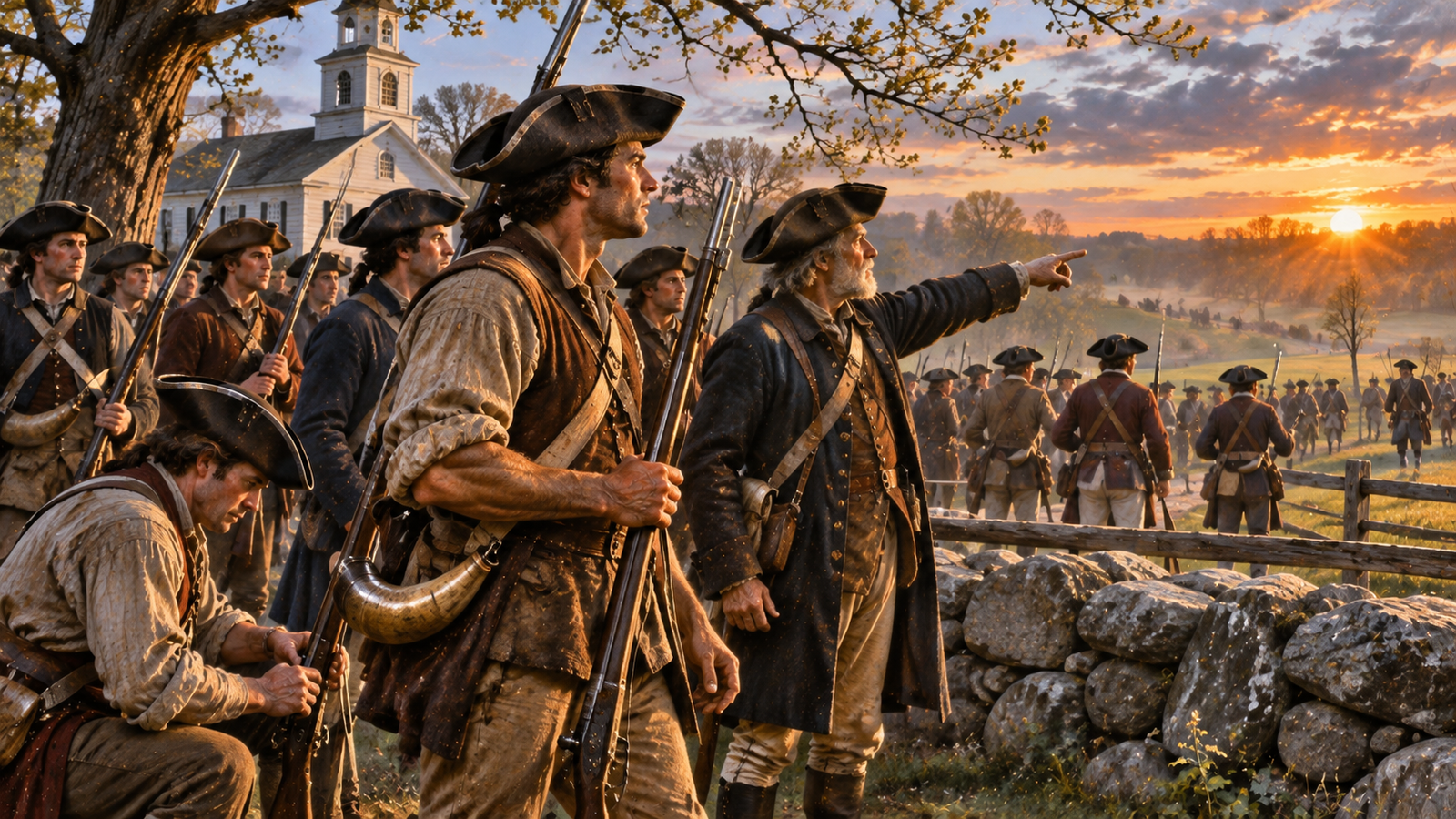
Militia Companies Assemble
As warnings move through Middlesex County and neighboring communities, militia officers and local residents organize their responses. Bells, drums, messengers, and direct personal warnings are among the means by which men may be summoned, depending on the town and the surviving evidence.
Men gather with firearms and available equipment. Some companies assemble quickly enough to approach the advancing British force, while others are still organizing or marching as the morning progresses.
Why it mattered: The warning network becomes an armed response through the decisions and preparations of individual Massachusetts communities.
Around Sunrise · April 19
The Confrontation at Lexington
British regulars reach Lexington, where Captain John Parker’s militia company has assembled on the common. A confrontation develops, shots are fired, and several Lexington militiamen are killed.
The fighting transforms the significance of the alarm. What had begun as a warning of an approaching military expedition becomes news of actual bloodshed, increasing the urgency of the messages moving through Massachusetts.
Why it mattered: The alarm now carries reports of armed conflict, giving additional communities an immediate reason to mobilize.
Morning · April 19
British Troops Reach Concord
The British expedition continues to Concord and searches for military stores. Militia from Concord and surrounding towns gather as the British occupy the town.
At the North Bridge, fighting breaks out between British regulars and colonial militia. The confrontation confirms that the military crisis has extended beyond Lexington and that organized resistance is underway.
Why it mattered: The developing response brings militia from multiple communities into direct conflict with British troops.
Late Morning–Afternoon · April 19
The British Retreat and the Widening Response
As British troops withdraw from Concord toward Boston, additional militia companies converge on the route. Fighting occurs at numerous points along the road, and the number of participating colonial forces increases as the day progresses.
Not all responding companies receive the same message at the same time. Some are warned before the first fighting, while others respond to later reports that British troops and Massachusetts militia are already engaged.
Why it mattered: The Lexington Alarm develops into a continuing process of communication and reinforcement throughout the day.
Important historical distinction: A muster roll documenting service on April 19 does not, by itself, establish when a company first received the alarm, which messenger delivered it, or whether every listed man participated in the fighting. Such conclusions require additional evidence from town records, officers’ accounts, diaries, or other contemporary documents.
Evening · April 19
British Forces Return Toward Boston
After a day of fighting, the British expedition returns toward Boston under the protection of reinforcements. Massachusetts militia continue arriving, and the confrontation gives way to the beginning of an extended military standoff around the occupied town.
For communities farther from Middlesex County, the response is still developing. Some companies have not yet reached the fighting, while others receive reports only after the day’s principal engagements have ended.
Why it mattered: The alarm’s consequences continue beyond the first day of battle, as Massachusetts shifts toward sustained military mobilization.
Part VI · April 19–23 and Beyond
The Alarm Spreads Beyond Massachusetts
Express messages and written accounts carry news of the fighting beyond Massachusetts, connecting the local alarm to a broader colonial crisis.
April 19–20, 1775
News of the Fighting Travels Outward
Reports of the encounters at Lexington and Concord begin moving beyond the communities directly involved. Messengers, letters, and personal accounts carry news to towns that had not participated in the initial fighting.
These messages vary in detail and reliability. Some emphasize the movement of British troops, while others describe casualties or the developing military confrontation. As the news spreads, communities interpret events through the information available to them.
Why it mattered: The alarm becomes more than a warning of troop movements. It develops into the transmission of news about an armed political crisis.
April 20–23, 1775
Express Riders Carry Reports Through New England
News of the fighting continues through established roads and networks of correspondence. Express riders carry reports into neighboring colonies, while committees and local officials receive and circulate accounts of the confrontation.
The messages help transform events in Middlesex County into a matter of broader colonial concern. The speed and routes of individual reports require examination of surviving letters, endorsements, and contemporary newspaper accounts rather than assumptions about a single continuous chain of riders.
Why it mattered: Networks originally used for political correspondence now help carry news of military conflict between colonies.
Late April 1775 and Beyond
From Emergency Alarm to Sustained Mobilization
The immediate warning of April 18–19 gives way to a larger military mobilization. Massachusetts militia companies and forces from neighboring New England colonies gather around Boston, while colonial leaders confront the implications of open warfare.
The Lexington Alarm illustrates how years of political communication, local organization, military preparation, and individual initiative combined during a rapidly developing crisis. No single rider, committee, or town accounts for the entire response.
Why it mattered: The alarm demonstrates the capacity of interconnected colonial communities to turn information into collective military action.
Understanding the Historical Record
The Lexington Alarm was not a single, centrally controlled communication system. It was a series of overlapping networks that included committees of correspondence, Patriot organizers, local militia officers, express riders, townspeople, and individuals who carried news from one community to another.
The surviving evidence does not provide an exact time or route for every warning. Some events are supported by contemporary documents, while others are known chiefly through later recollections or local histories. Exact times should therefore be distinguished from approximate reconstructions, and later traditions should not be presented as contemporary documentation.
Research principle: Evidence that a militia company responded to the Lexington Alarm does not necessarily identify who warned it, when it first received the message, or whether it reached the battlefield. The chronology of warning and the chronology of military service must be examined separately.
Sources and Further Reading
- Paul Revere, accounts of his ride and the events of April 18–19, 1775. See the Massachusetts Historical Society for manuscript collections and historical context.
- Massachusetts Provincial Congress proceedings and records concerning militia organization and military preparation, 1774–1775.
- Boston town records and Committee of Correspondence proceedings, beginning in November 1772.
- National Park Service, Minute Man National Historical Park: April 19, 1775.
- Frank Warren Coburn, The Battle of April 19, 1775, in Lexington, Concord, Lincoln, Arlington, Cambridge, Somerville, and Charlestown, Massachusetts (1912). Digitized edition.
- Massachusetts, Massachusetts Soldiers and Sailors of the Revolutionary War, for company service and muster-roll references.